


HANGZHOU, May 21 (Xinhua) -- Before a seaside monument on an island off the coast of east China's Zhejiang Province, Josephine Olsson embraced Wu Xiaofei, the descendant of a Chinese fisherman who once helped in an operation that saved her great-uncle, a former British prisoner of war (POW), from the sea during World War II (WWII).
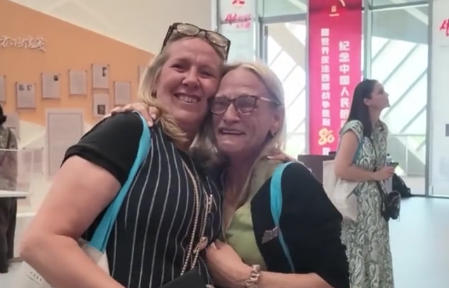
Josephine Olsson (L). (Screenshot photo: Chinanews.com.cn)
Around them, the wind carried the sharp scent of saltwater and the memory of a wartime rescue that still resonates more than eight decades later. Holding back tears, the two women exchanged scarves as keepsakes of a bond forged in one of the darkest moments of WWII.
"Josephine told me she will treasure the scarf for a lifetime. So will I. It represents the purest bond between the two peoples," Wu said.
Twenty descendants of those British POWs aboard the Lisbon Maru gathered in Zhoushan, Zhejiang Province, for a commemorative ceremony honoring a remarkable act of courage.
In October 1942, the Lisbon Maru, a cargo vessel requisitioned by the Japanese army to transport more than 1,800 British POWs from Hong Kong to Japan, was torpedoed off the Zhoushan Islands by a U.S. submarine after failing to display mandated POW transport markings.
Local Chinese fishermen, despite Japanese soldiers firing into the water, made 65 trips in 46 small wooden sampans to rescue 384 British POWs from the sinking ship.
For residents of the Zhoushan Islands, the rescue has long been passed down not only as an episode of wartime heroism but as a moral instinct.
"If someone is in the water, you save them," said Lin Zhonghua, whose father was among the fishermen who joined the rescue operation. "There is an old saying here: save a life, and heaven will remember your kindness."
Also among the crowd were Christopher Borge and his sister Kirsteen Dugan, visiting the island for the first time. Their grandfather and great-uncle had both been aboard the Lisbon Maru and saved by Chinese fishermen in 1942.
"It is here, at one of the darkest moments of war, that we see extraordinary humanity," said Borge, adding that Chinese fishermen, at great personal risk, offered kindness to strangers in a time of fear and conflict.
"Even in war, we see love and friendship prevail," he added. Dugan echoed her brother. "What happened here was not only an act of extraordinary bravery, but also an act of friendship and compassion that created a bond between China and the UK that still lives on today," she said.
For Dugan, the story had been part of family memory since childhood. She recalled asking her grandmother to show her the tins that stored her grandfather's wartime keepsakes. "I always remember the newspaper cutting about the Lisbon Maru and the brave fisherman who carried out the rescue," Dugan said.
Beyond blood ties, the gathering also drew those dedicated to preserving this shared history. Richard Graham, an 85-year-old author, once served alongside several Lisbon Maru survivors and later devoted decades to recording their stories.
"If I could meet a survivor today, I would tell them what I have been doing," Graham said. "I would tell them that they can rest in peace, because in Zhoushan, they are not forgotten."
After the flowers were laid, relatives of British soldiers and the fishermen's descendants took up shovels. Together, they planted a boxwood sapling, a gesture intended to symbolize a friendship that has outlived war and distance.
"I think that is a beautiful symbol of what was created here. A lasting connection across the waters between China and the UK, built through kindness, courage and humanity in one of history's darkest moments," Dugan said, expressing hope that the story will continue to be passed down through future generations.
She said she hopes that one day her two boys will also make this journey, stand here beneath the tree, and continue to share this story of courage, sacrifice, and friendship.
In front of the young tree, the sea wind also carried Dugan's poem: "A living bond from sea to shore, between two nations, evermore. May those who stand beneath their shade, remember all the sacrifices made."
(Xinhua reporters Duan Jingjing, Weng Xinyang and Song Lifeng in Hangzhou also contributed to the story.)