


The fourth China International Supply Chain Expo (CISCE) will debut a dedicated artificial intelligence (AI) exhibition zone, bringing together leading Chinese and global AI firms, including Nvidia, Intel, Qualcomm, and Alibaba, officials from China's top trade promotion body said on Friday.
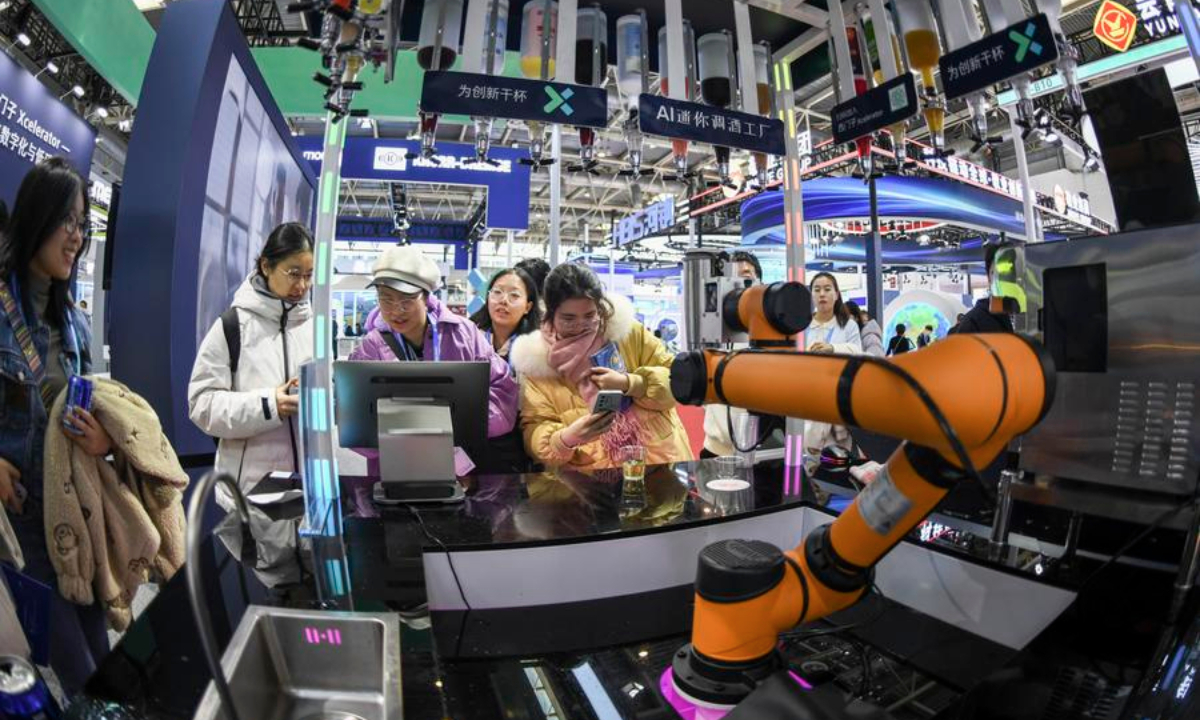
People view an AI-driven bartending system at the booth of Siemens in the Advanced Manufacturing Chain exhibition area of the second China International Supply Chain Expo in Beijing, capital of China, Nov. 27, 2024. (Photo: Xinhua)
With a theme of "Connecting the World for a Shared Future," the CISCE has drawn a total of 676 leading companies, and industry institutions from China and abroad to confirm their participation, representing 85 countries, regions, and international organizations.
Experts said the expo's evolving focus, including its new AI-themed section, reflects the accelerating digital and intelligent transformation of global supply chains, while strong multinational participation underscores China's continued commitment to open trade and international industrial cooperation.
The fourth CISCE will be held in Beijing from June 22 to 26, with Australia serving as the guest country of honor. It marks Australia's first official national-level participation in the expo.
Also, it will feature foreign guest provinces for the first time, represented by France's Auvergne-Rhône-Alpes and Italy's Liguria.
The AI exhibition zone has been systematically designed around the industrial evolution path spanning data and perception, computing power and algorithms, and applications and solutions, according to Li Xingqian, vice chairman of the China Council for the Promotion of International Trade (CCPIT). "The goal of the exhibition is to showcase the complete AI ecosystem across the entire industrial chain, from data collection and intelligent computing to real-world applications."
Beyond serving as exhibits, robots will also take on a variety of new roles at the CISCE, including robot volunteers, intelligent tour guides and event hosts.
The CISCE's evolving focus was also a key highlight of the press conference. Chinese experts said the newly added AI exhibition zone reflects the rapid growth of the sector and China's hope to provide a platform for companies from different countries to deepen cooperation and leverage their respective strengths.
The AI exhibition zone provides a platform for companies from different countries to deepen cooperation and leverage their respective strengths, Bian Yongzu, executive deputy editor-in-chief of Modernization of Management magazine, told the Global Times on Friday. "As AI development remains uneven and concentrated in a handful of countries such as China and the US, stronger international cooperation could help ease barriers created by rising protectionism, while promoting industrial coordination, standards alignment, and faster global AI development."
Friday's data also showed that foreign exhibitors account for 36.5 percent of participants, and more than 65 percent are Fortune Global 500 companies or industry leaders, Li said. Including upstream and downstream supply chain partners brought by exhibitors, the total number of participating companies is expected to exceed 1,200, he said.
So far, more than 150 overseas delegations have confirmed visits to China for the expo and business talks, with both the number and level of delegations expected to surpass the previous edition.
Meanwhile, this year's CISCE will also serve as an important platform for practical cooperation between the Chinese and US business communities.
From the first edition through this year's fourth edition, US companies and institutions have consistently ranked first among foreign exhibitors at the CISCE, Liu Jiannan, vice chairman of the CCPIT, said at the Friday press conference.
Many of the Fortune Global 500 US companies joining the delegation this year are "regular participants" or "old friends" of the CISCE. Government departments and business associations from US states including Florida, New Mexico and Utah will also organize delegations to attend the expo, while organizations such as the US Soybean Export Council will host promotional events.
Despite rising global protectionism, the strong participation of international businesses at the CISCE shows that openness and cooperation remain the prevailing trend, Bian noted. He said China's efforts to build the platform reflect its commitment to high-level opening-up and deeper global industrial and supply chain cooperation.
Bian said that while protectionism has been on the rise, the internationalization of industrial and supply chains remains a long-term trend and "the broader direction of economic globalization will not change."
He added that despite ongoing China-US friction, US companies continue to actively participate in the CISCE and remain among the largest foreign exhibitor groups, underscoring the strong real-world demand for global cooperation and division of labor.