


(Photo: Xinhua)
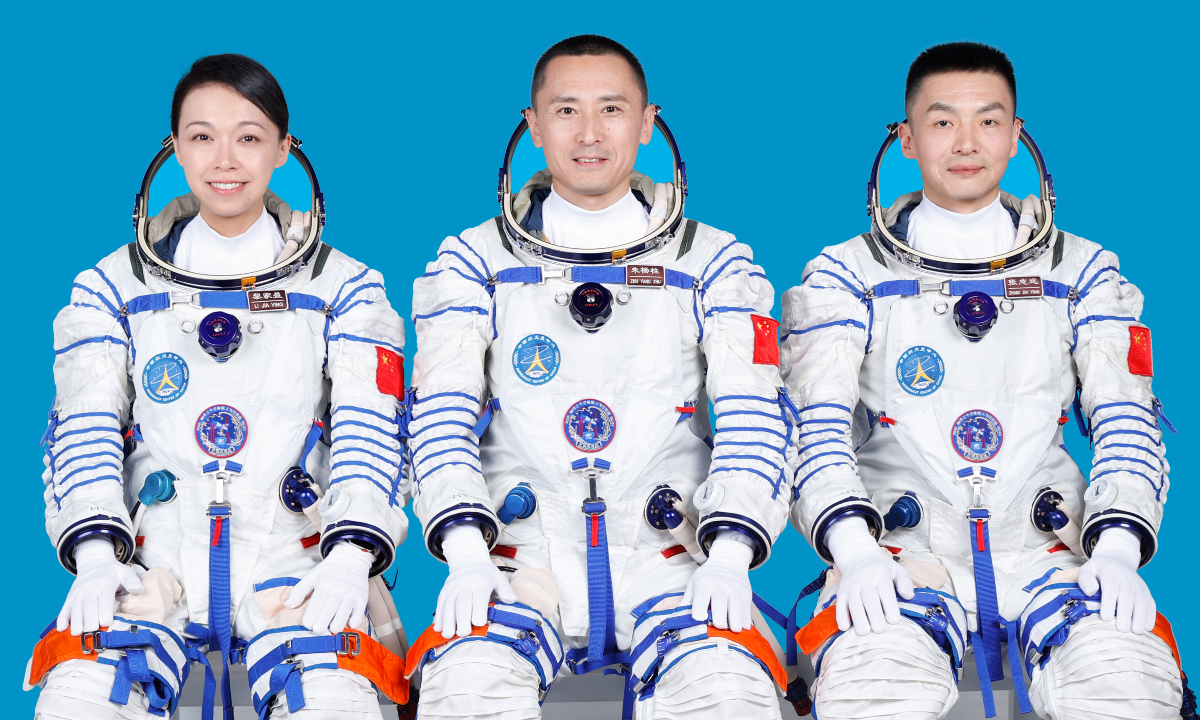
China on Saturday morning held a press conference on the Shenzhou-23 manned spaceflight mission, announcing mission details as well as the astronaut crew, which includes Lai Ka-ying, the country’s first astronaut from the Hong Kong Special Administrative Region (HKSAR) to carry out a spaceflight mission. The China Manned Space Agency (CMSA) also announced that the Shenzhou-23 manned spacecraft is scheduled to launch at 11:08 pm on Sunday.
The three-member crew consists of spaceflight engineer Zhu Yangzhu, spacecraft pilot Zhang Zhiyuan, and payload specialist Lai, with Zhu serving as commander. Lai is also the first female payload specialist selected from the Hong Kong and Macao regions for China’s space program, while both Zhang and Lai will embark on their first spaceflight missions.
“Astronaut Zhu previously carried out the Shenzhou-16 manned spaceflight mission. Zhang and Lai are from China’s third and fourth batches of astronauts, respectively, and both will perform their first flight missions,” Zhang Jingbo, spokesperson for CMSA, said at the press conference, according to Xinhua News Agency. Zhang noted that before being selected as an astronaut, Zhang Zhiyuan served as an Air Force pilot, while Lai previously worked for the Hong Kong Police Force.
The Global Times learned that Lai was born in Hong Kong in November 1982. Before being selected as a payload specialist in China’s fourth batch of astronauts in June 2024, she served as a superintendent in the Hong Kong Police Force. Following comprehensive assessments, she was selected as a member of the Shenzhou-23 crew.
“Hong Kong and Macao have maintained close cooperation with the mainland in the aerospace sector. Universities and scientific research institutions from the two regions have participated in many space projects, and the Hong Kong astronaut selected for the Shenzhou-23 mission also possesses relevant expertise and a professional background. Therefore, the appearance of an astronaut from the HKSAR on the Shenzhou mission is a natural progression,” Kang Guohua, a senior member of the Chinese Society of Astronautics and a professor of Aerospace Engineering at Nanjing University of Aeronautics and Astronautics, told the Global Times on Saturday.
According to the CMSA, the Long March-2F Y23 carrier rocket assigned to the launch mission will be fueled shortly. The mission will mark the seventh crewed mission during the space station’s application and development stage, as well as the 40th flight mission of China’s manned space program.
Zhang also revealed that an astronaut from the Shenzhou-23 crew will carry out a one-year-long in-orbit stay experiment. The Shenzhou-23 mission’s primary objectives include completing an in-orbit crew rotation with the Shenzhou-21 astronauts, continuing space science and application experiments, conducting extravehicular activities, carrying out cargo transfer operations, and installing and recovering external payloads and equipment.
After entering orbit, the Shenzhou-23 spacecraft will carry out autonomous rendezvous and docking procedures with the radial port of the Tianhe core module, forming a combined structure of three modules and three spacecraft.
Following the in-orbit handover, the Shenzhou-21 crew will return to the Dongfeng landing site. As of Saturday, the Shenzhou-21 astronauts had remained in orbit for 203 days and are expected to set a new national record for the longest in-orbit stay by a Chinese astronaut crew.
At the press conference, Zhang also responded to questions regarding China’s first emergency launch-readiness exercise, saying that “over the course of 20 days, the emergency response operations went smoothly and efficiently.”
“We now have a much clearer understanding of the space debris environment and what it takes to protect orbiting spacecraft from it. The upcoming Shenzhou-23 spacecraft has already been adapted with improvements to its window protection against space debris, which enhances its ability to withstand impact,” Zhang said.
The press conference also provided updates on China’s lunar exploration program. Zhang disclosed that the Chang’e-7 probe arrived at the Wenchang Space Launch Site in South China’s Hainan Province in April and is currently undergoing pre-launch testing and preparation work, with all tasks progressing as planned ahead of a launch scheduled for the second half of this year.
The Chang’e-7 mission will adopt integrated methods including orbiting, landing, roving and flyby operations to study the environment and resources at the moon’s south pole. There will also be international cooperation involved, Zhang said.
We will also proceed as planned with major tasks including the Long March-10 carrier rocket technical-verification flight, as well as the maiden flights of the Mengzhou crewed spacecraft and the Lanyue lunar lander, making every effort to achieve the goal of landing Chinese astronauts on the moon before 2030, he added.
Zhang also introduced the latest progress in international space cooperation, saying that two Pakistani astronauts have entered the astronaut research and training center to train alongside Chinese astronauts. According to the current plan, one Pakistani astronaut will serve as a payload specialist on a short-term space mission and they are currently undergoing both basic and specialized training as planned.
“With the further expansion of China’s space station and the execution of more missions, we can expect to see more international cooperation projects aboard the station, allowing it to become more ‘international,’” Kang told the Global Times.