


Editor's Note:
Chinese President Xi Jinping has urged efforts to further review the development experience of the city of Yiwu in East China's Zhejiang Province, and put it to good use. Yiwu's small commodities have broken into a vast market and developed into a major industry, forming the Yiwu development experience, he said, adding that this represents a successful model for developing county economies in line with local conditions, according to the Xinhua News Agency. The Securities Times launched a series titled "Close-up observations on Yiwu's development experience," exploring the vibrant "world supermarket." Through on-the-ground perspectives and close-up observations, the series delves into the rich essence and enduring vitality of Yiwu's development experience.
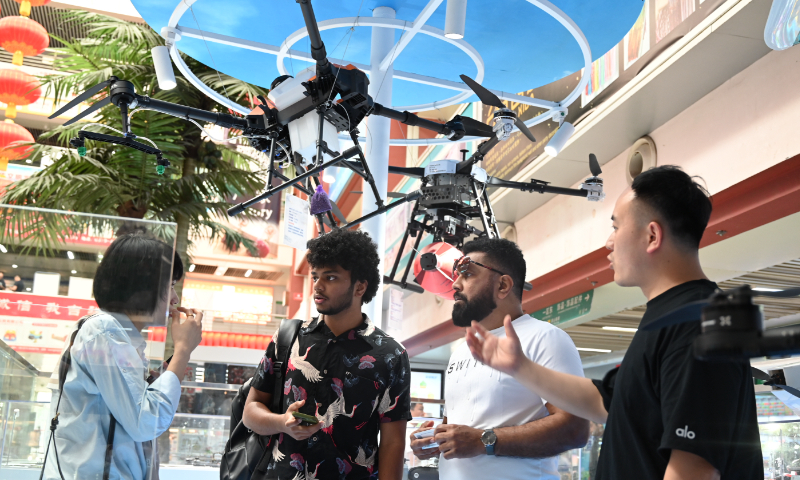
Overseas merchants inquire about drone procurement at Yiwu International Trade Market in Yiwu, East China's Zhejiang Province. (Photo: Courtesy of Yiwu International Trade Market)
"Xiaoliang sees the market," an entrepreneurship-sharing platform established in May, in Quanbei village in Yiwu, East China's Zhejiang Province, quickly became a hit.
"The first batch of more than 100 workstations attracted nearly 1,000 applicants from across the country," said Xiaoliang, the platform's founder. Quanbei village, located next to Yiwu's high-speed railway station, provided free office space, desks, chairs and entrepreneurship training. After completing the training, participants can either start their own businesses or pursue other employment opportunities.
Located in central Zhejiang, Yiwu has neither coastal nor border advantages. Yet through hard work and pragmatism, it has become a magnet for entrepreneurship and employment. According to the Yiwu Human Resources and Social Security Bureau, the city recorded a net population inflow of 240,000 in 2025, including 70,000 university graduates.
Behind this influx of college graduates and entrepreneurs from across China lies the successful implementation of Yiwu's long-term "prospering the city through commerce" approach. For over 40 years, Yiwu has focused on building and thriving its markets, respecting market rules and the pioneering spirit of its people, while unleashing private-sector vitality. At the same time, the government has played an effective guiding role by providing sound planning, improving infrastructure, and optimizing public services.
Sticking with one product for 33 years
"Can a straw company become a century-old enterprise?" This question has driven Lou Zhongping, known as the "straw king," for 33 years. "I don't want to switch to other fields. I want to take one thing to the extreme," he said.
Like Lou, Yiwu has steadfastly adhered to its "prospering the city through commerce" development approach for more than four decades. From the early days of "exchanging chicken feathers for sugar" to becoming the "world supermarket" connected to the globe, Lou has been both a witness to and a builder of Yiwu's success.
"Exchanging chicken feathers for sugar" was a traditional livelihood practice among Yiwu peddlers, who, during the slack farming season, traveled through villages and towns, carrying baskets of sugar to exchange for chicken feathers, which were later used as fertilizer or made into feather dusters.
Now in his 60s, Lou still vividly remembers his early experiences. Coming from a poor family, he dropped out of school at 14 and followed his elders to Jiangxi Province, carrying goods on a shoulder pole, shaking a rattle drum, and peddling along the streets. The calls of "exchanging chicken feathers for sugar" in a strong Yiwu accent still echo in his memory.
In the early 1980s, Yiwu had no formal trading venues. Farmers set up stalls along the streets, spontaneously forming "basket markets" and "roadside markets." Thousands of people like Lou gradually paved the way, selling small commodities across the country one small order at a time. Yiwu's daily necessities trade began to flourish.
In September 1982, Yiwu officially opened its first small commodities market at Huqingmen. In 1984, it launched the strategy of "prospering the county through commerce," which was upgraded to "prospering the city through commerce" in 1988 when Yiwu was upgraded from a county to a city. The government took the lead in building markets, strengthening services, and optimizing the business environment. Subsequent generations of markets were built and put into operation.
In 1990, Lou became a stall owner in Yiwu's specialized streets. In 1992, he was among the first to enter the fourth-generation Huangyuan Market. Today, his company, Shuangtong Daily Necessities Co., Ltd., has become the world's largest manufacturer of drinking straws.
Hard work and global expansion
"Things are thriving!" said Tao Juying, a veteran Yiwu entrepreneur with over 20 years of experience, when talking about Yiwu's development.
Tao started her business in 2004 in Yiwu International Trade Market District 2. The opening of Districts 1 and 2 marked Yiwu's entry into the international arena. "After they opened, you could clearly see more foreign buyers," she recalled.
From 2002 to 2011, Districts 1 through 5 of the Yiwu International Trade Market were completed, creating ever-stronger agglomeration and scale effects.
Tao shifted from a "stationary merchant" to a "mobile merchant," actively participating in overseas exhibitions organized by the government and the Yiwu International Trade Market group. Her company, Zhejiang Yilingnuo Technology Co., Ltd., now exports products to more than 170 countries and regions, with agents in 38 countries and more than 5,000 clients.
"We just returned from North Korea and the Philippines. Next, we're heading to five African countries in May. We will go to Latin American countries in June," she said, showing her packed schedule, which is an epitome of Yiwu entrepreneurs' hard work.
Starting from scratch, Tao has grown into a major player in the Yiwu market. She is full of confidence in the future of both the Yiwu market and her company. "Traveling around half the globe every year has not been in vain. This year, we plan to open 80 new flagship stores worldwide, of which 23 are already in the planning stage. At the same time, we will add 200 new chain supermarket clients," she said.
A new generation of entrepreneurs
For more than 40 years, Yiwu has stayed true to its blueprint, consistently pursuing the strategy of "prospering the city through commerce" and creating more opportunities for entrepreneurs..
Entrepreneur Ji Ruixin, who was born after 1995, sees it this way: "Today's Yiwu is not just making the market more prosperous - it is giving ordinary entrepreneurs from every generation more opportunities to grow."
Three years ago, Ji left a major internet company in Shanghai and returned to Yiwu to start her own business in the jewelry and accessories sector. She chose a different path from the previous generation, focusing on original, niche, and avant-garde silver jewelry designs under her brand "Yu Ji."
Ji has over 4,000 original designs in her store at the Yiwu International Trade Market. Her products have appeared on fashion week runways and entered overseas markets.
Having grown up in the Yiwu International Trade Market, Ji has a profound understanding of the changes taking place in the Yiwu market in recent years. In the past, many merchants operated as "stationary merchants," simply waiting for customers to come to their stalls. Now, they have shifted toward "globalized operations." For example, while the accessories business used to rely mainly on counter-style sales, Ji now focuses not only on products but also on building brands, creating content, strengthening supply chains, and aligning with international aesthetic trends.
She noted that Yiwu's high tolerance and service efficiency for young entrepreneurs have left the deepest impression on her.
Data showed that "second-generation" and "new-generation" merchants now account for 52 percent of businesses in the Yiwu International Trade Market. This new generation is following in their predecessors' footsteps while breaking new ground, reshaping the character and core of Yiwu's market.
This was compiled and translated by the Global Times based on an article originally published on the Securities Times on May 18, 2026.