


Editor's Note:
Chinese President Xi Jinping has urged efforts to further review the development experience of the city of Yiwu in East China's Zhejiang Province, and put it to good use. Yiwu's small commodities have broken into a vast market and developed into a major industry, forming the Yiwu development experience, he said, adding that this represents a successful model for developing county economies in line with local conditions, according to the Xinhua News Agency. The Securities Times launched a series titled "Close-up observations on Yiwu's development experience," exploring the vibrant "world supermarket." Through on-the-ground perspectives and close-up observations, the series delves into the rich essence and enduring vitality of Yiwu's development experience.
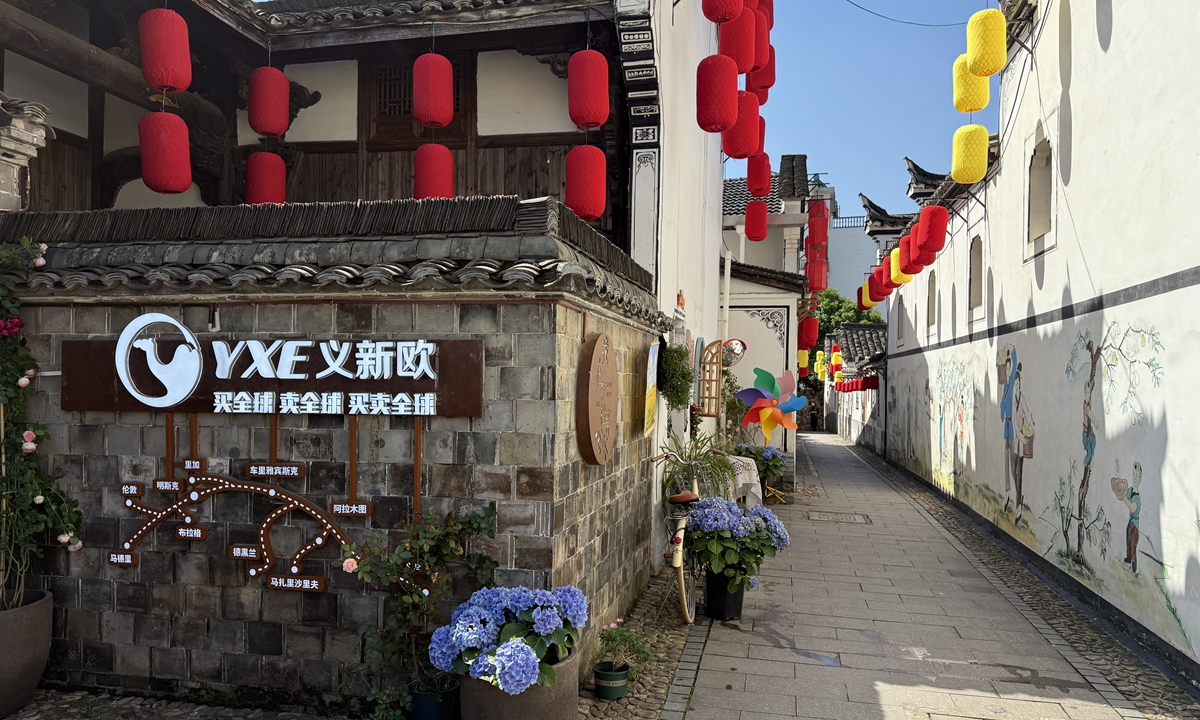
A corner of Lizu village in Yiwu, East China's Zhejiang Province (Photo: Li Xiaoping/Securities Times)
About 10 minutes north of Yiwu International Trade Market, Lizu village greets visitors with white-walled houses, flagstone lanes, the scent of coffee, and a busy weekend when finding a parking lot isn't easy.
Once a poor, remote village, the village — with only 700 permanent residents — now hosts 80 agricultural innovation projects and 282 "new farmers," generating 70 million yuan ($10.3 million) in annual sales and welcoming more than one million tourists every year.
The village's rise reflects Yiwu's urban-rural integration strategy. In this global small-commodity hub, city and countryside form a two-way empowerment network: urban spillover (warehousing, logistics, processing) meets rural appeal (creators, tourists, new businesses) — proving they are not separate but a 1+1>2 development community.
Talent returning to villages
Jin Ying, a Yiwu native who left her stressful city job in foreign trade, opened a cafe in Lizu village in 2025. Keeping the original decor of the rented shop, she invested in quality coffee beans instead. Today, she sells an average of 40 cups a day, reaching 200 cups during holidays.
"The more coffee shops a village has, the more young people it attracts," said Jin. There are now nine or ten coffee shops in the village, each with its own character.
Her cafe focuses on bean quality — she selects and roasts beans herself from raw bean factories in Uganda. Her customers include locals, other creators in the village, and tourists who come after seeing her shop on a Chinese app for sharing daily life Xiaohongshu or China's major short-video platform Douyin.
Asked why she chose the village, Jin said that she first learned about the village in 2019 and has watched it develop ever since. "The village has a dedicated operations team, which is very attractive to creators." She said. "This is different from other villages, and the activities are not dictated by village officials but adjusted based on creators' feedback," Jin said.
In recent years, the village has adopted a professional manager model, partnering with an operations company to handle planning, branding, and incubation. The company has transformed more than 140 idle houses and 400 mu (2.66 hectares) of farmland into 80 agricultural innovation projects, created public IPs, and developed over 40 products.
Nan Fang, a teacher at the Zhejiang Provincial Institute of Mechanical and Electrical Technicians, quit her job in Ningbo to co-found "Rushi Ting," a Song brocade handicraft workshop in the village, bringing her students along. "The courtyard feels like home. Though Song brocade originated in Suzhou, Yiwu is the starting point of the New Silk Road — I hope this craft can continue here," she said.
Since September 2023, the number of "new farmers" in the village has risen from 220 to 282. These city-to-countryside migrants have set up studios by paddy fields and in old houses. reflecting a reverse flow of talent toward rural areas. The return of talent has turned the village from a left-behind place into a new entrepreneurial frontier.
Striding into new boundaries
The reason entrepreneurs come and stay lies in the village's "urban-level" infrastructure, which is possible precisely because Yiwu's urban functions naturally extend into the countryside.
Fang Zhijian, deputy secretary of the Lizu village Party branch and a lifelong village resident, remembered the village as a child as exactly what a "traditional rural village should look like" — dirt roads, old houses, isolated, with no direct bus route. To catch a bus to town, one had to walk through the neighboring village.
Fang recalled several key milestones in the village's transformation into the beautiful village.
In 2003, Zhejiang Province launched the "Thousand Villages Demonstration and Ten Thousand Villages Renovation" project, and in 2004, Lizu village began new rural construction, starting with environmental improvement.
In 2017, during the second phase of the project, the village became one of Yiwu's first five-star beautiful villages. Taking this opportunity, the village committee hired a professional manager to carry out micro-renovations and targeted improvements.
By May 2018, the village had completed all infrastructure renovations, including road surfaces, electrical wiring, and rainwater-sewage separation. In 2020, the village began advancing smart and digital facilities.
"The most critical part of rural revitalization is talent revitalization," Fang said. "We want young people to enjoy urban conveniences even in the village." Today, the village has a 365-day convenience service center handling medical insurance, social security, and business licenses, plus health stations, a clinic, and a courier point.
With Yiwu's urban development space starts to saturate, warehousing, logistics and small-scale processing have expanded into surrounding villages. The village absorbed these functions. After relocating its stationery factories to industrial parks, the vacated space was used to attract cultural and creative businesses, forming a complementary relationship with Yiwu International Trade Market.
Thanks to Yiwu's market, neighboring villages are now all organic parts of its system. The city supplies customer traffic and distribution channels, while villages contribute space and experiences.
Empowered by market
The return of talent and the decentralization of functions ultimately converge into a complete "market-village-creator" value chain. The starting point and endpoint of the new chain are both Yiwu International Trade Market.
Thanks to Yiwu's unique market, large numbers of tourists and global buyers visit Lizu village for coffee, handicrafts, and homestays, Fang said. Yiwu International Trade Market provides ample supplies for the village's more than 80 creative businesses. Meanwhile, Yiwu's commercial atmosphere drives Lizu's agri-innovation economy, forming a virtuous cycle.
Fang said the village will continue to advance future village construction with smart and digital facilities to give villagers and creators a more modern lifestyle. At the same time, the village will persist in integrated urban-rural development, using talent revitalization to drive industrial revitalization, ultimately achieving common prosperity.
The village has formed an alliance with eight surrounding villages and planned 81 sub-projects with a total investment of 616 million yuan. The clustering development case was selected as one of Zhejiang's top 10 integrated urban-rural development examples — the only one from Jinhua, East China's Zhejiang Province.
Behind these achievements is Yiwu's institutional commitment to urban-rural integration. This has transformed rural areas into diversified, organic parts of the market system, where city capital and visitors meet rural land, ecology and culture, the two supporting and fulfilling each other.
(Source: Global Times)