


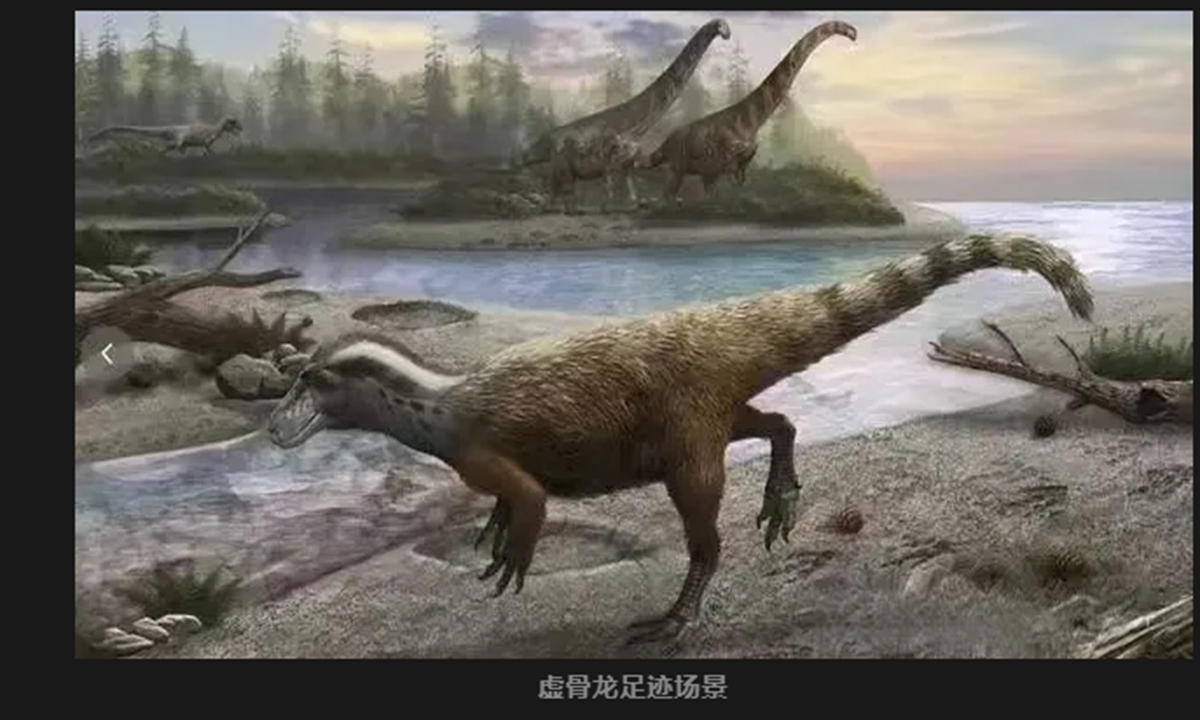
Picture of Coelurosaur. (Photo: Zhangjiajie Daily)
A Chinese research team has recently confirmed the discovery of a large-scale dinosaur footprint site in Xuanhua of Zhangjiakou, North China's Hebei Province. Researchers also identified traces of a carnivorous dinosaur moving at just 1 kilometer per hour for the first time at the site, the finding sets a new record for the slowest dinosaur walking speed identified in comparable strata, local media Zhangjiakou Daily reported on Sunday.
The new discoveries help complete the picture of the ancient dinosaur ecosystem, according to the report. For the first time, traces of a carnivorous dinosaur moving at merely one kilometer per hour have been found, providing vivid evidence for reconstructing the ecosystem dating back over 100 million years.
After years of surveys and research, experts have gained a preliminary understanding of the site's overall scale. It covers an exposed area of about 30,000 square meters with over 5,000 preserved dinosaur footprints, further enriching China's dinosaur footprint fossil record.
Sites yielding thousands of dinosaur footprints at one time are rare nationwide, said Gu Zhenfei, a senior engineer from the third geological brigade of Hebei Bureau of Geology and Mineral Resources Exploration. With more than 5,000 well-preserved footprints uncovered here, the Xuanhua site ranks among China's largest discoveries of its kind. Among them, Site I was found earlier, famous for mixed tracks of sauropod brontosaurs, medium-sized theropod Asian dinosaurs tracks and small graciliraptors.
Further research uncovered Site II and Site III, 1.5 kilometers and 2.25 kilometers southeast of Site I. Twenty-seven intact three-toed grallator footprints were found here, ranging from 10.1 centimeters to 26.7 centimeters in length, preserving traces of dinosaurs of various sizes. The new findings lift the number of theropod-dominant led footprint sites to at least 17, depicting a fuller profile of the ancient dinosaur community.
Carnivorous dinosaurs are commonly perceived as agile and swift, yet the Xuanhua discovery challenges this perception.
Xing Lida of the China University of Geosciences (Beijing), whose research team took part in the study, conducted precise measurements on five well-preserved footprints at Site III. The surprising results show these grallators had a stride length of 32 to 46 centimeters and a walking speed of merely one kilometer per hour, comparable to the pace of an ordinary tortoise.
This marks the slowest theropod trackway speed recorded in comparable strata and an extremely rare slow-speed dinosaur record worldwide. By comparison, most small dinosaurs living in the same area and period could run at 9 to 14 kilometers per hour.
Such huge speed differences have been explained by researchers. These slow-moving dinosaurs were capable of moving much faster. Instead, they slowed down to observe their surroundings and hunt for prey. They likely slowed down to search for small prey and monitor their surroundings for potential danger, reflecting their actual survival behaviors in ancient times.