


Workers injured in a coal mine gas explosion in Shanxi province are receiving targeted treatment and psychological support while being kept under close observation, local health officials said, adding that all the hospitalized miners are in stable condition.
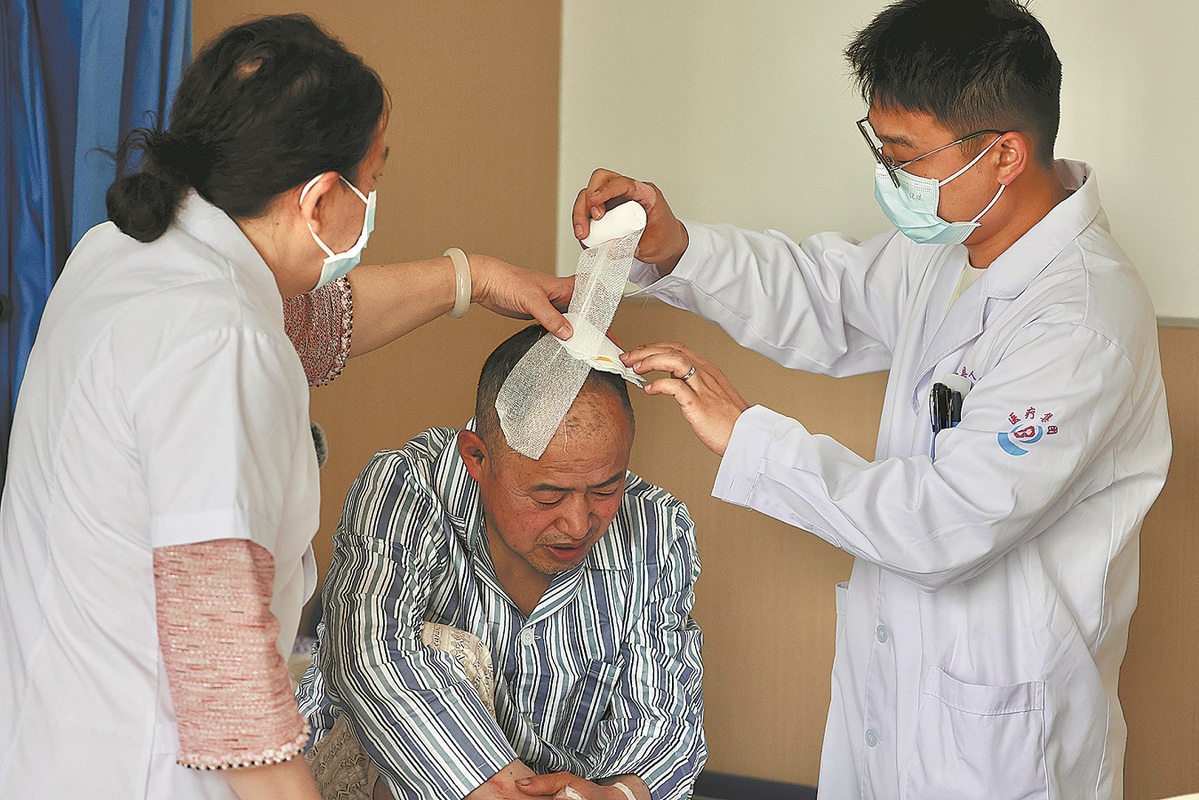
Zhang Taosuo, a lightly injured miner, receives medical treatment at Qinyuan People's Hospital on Sunday. (Photo: China Daily)
The blast occurred at 7:29 pm on Friday at the Liushenyu coal mine, which is operated by Shanxi Tongzhou Group, in Qinyuan county of Changzhi. As of press time, the death toll stood at 82, with two miners still missing and 128 injured.
Guo Junzhi, head of the Changzhi health commission, said the medical teams were prioritizing the most seriously injured, classifying patients by condition and providing targeted treatment.
Guo said that 124 workers with minor injuries had already been transferred to Grade A tertiary hospitals — the highest-level public hospitals in China's medical grading system — for observation and symptomatic treatment. Two seriously injured and two critically injured patients were receiving customized treatment, with provincial — and city-level medical experts working to reduce the risk of further complications.
"All hospitalized patients are currently displaying stable vital signs, and their conditions are generally under control," Guo said.
Immediately after the accident, Shanxi activated its medical emergency response plan, mobilizing local medical resources and sending provincial experts to the front line. The experts helped health personnel in Changzhi carry out injury assessment and provide emergency treatment as well as life support.
The National Health Commission organized multidisciplinary remote consultations involving specialists from the National Center for Trauma Medicine and the National Center for Respiratory Medicine to further optimize treatment plans. Experts from Peking Union Medical College Hospital and Beijing Jishuitan Hospital were also sent to the site to provide intensive care, burn treatment and trauma care.
Zhao Caihong, vice-president of Qinyuan People's Hospital, said the hospital had opened up additional wards as soon as the injured miners were brought in and mobilized doctors and nurses to provide treatment.
"As soon as the patients' vital signs stabilized, we started hyperbaric oxygen therapy, because most of them were affected by carbon monoxide poisoning," Zhao said.
She said the hospital's hyperbaric oxygen chamber can treat only six patients at a time, and each session takes nearly two hours. After Changzhi activated its broader emergency response, hospitals in surrounding areas were mobilized, and patients with milder symptoms were transferred to those hospitals for hyperbaric oxygen treatment.
On Friday night, 86 patients were transferred to other hospitals, while Qinyuan People's Hospital kept its own oxygen chamber running continuously, Zhao said.
Some miners who had returned home after being assessed as having no major problems were contacted on Saturday morning and asked to return for observation and treatment.
Zhao said that 43 people had been screened at the hospital's emergency department on Sunday. Some chose to return home, while hospital staff continued to review all test results. Patients who showed signs of myocardial injury were advised to remain hospitalized.
"Most patients suffered carbon monoxide poisoning or organ damage caused by toxic gases, but they were mostly mild cases," she said.
Psychological intervention has also been launched. Guo from the Changzhi health commission said that professional teams have been arranged to provide counseling, emotional support and humanitarian care for injured workers and their families. Follow-up treatment, rehabilitation and health monitoring will continue under the guidance of national and provincial medical experts.
Liang Jianwei, 54, a repairman at the mine, said the explosion occurred in a tunnel about 4 kilometers from where he was working. He received the evacuation order at around 10 pm on Friday, and it took him around two hours to escape from the mine.
"My condition was not serious. After I came out after midnight, I went to the dormitory, took a shower and slept," Liang said. He returned home the next morning, but was called back to the hospital for further checks.
At the hospital, he met several coworkers and learned that all 14 people in his group had escaped safely.
Another lightly injured miner, 47-year-old Zhang Taosuo, a member of the mine's transport team, said he arrived at the hospital shortly before 9 pm on Friday and received oxygen therapy and infusion treatment.
"When the explosion took place, I was knocked down," Zhang said. He remained conscious, but suffered a scalp injury.
Zhang said that nearly 40 coworkers had gone underground with him, and he was among the first to get out because he was about 400 meters from the entrance. He reached the surface in seven or eight minutes.
The workers said there were no obvious warning signs before the explosion. Zhang said that while workers had been trained in emergency response and self-rescue, a real accident was hard to deal with.
After reaching safety, Zhang, a father of two, called his family immediately to let them know he was safe.
"I didn't feel much while escaping, but after I reached the entrance, I felt nauseous," he said. "I still feel scared when I think about it. I was lucky to survive."