


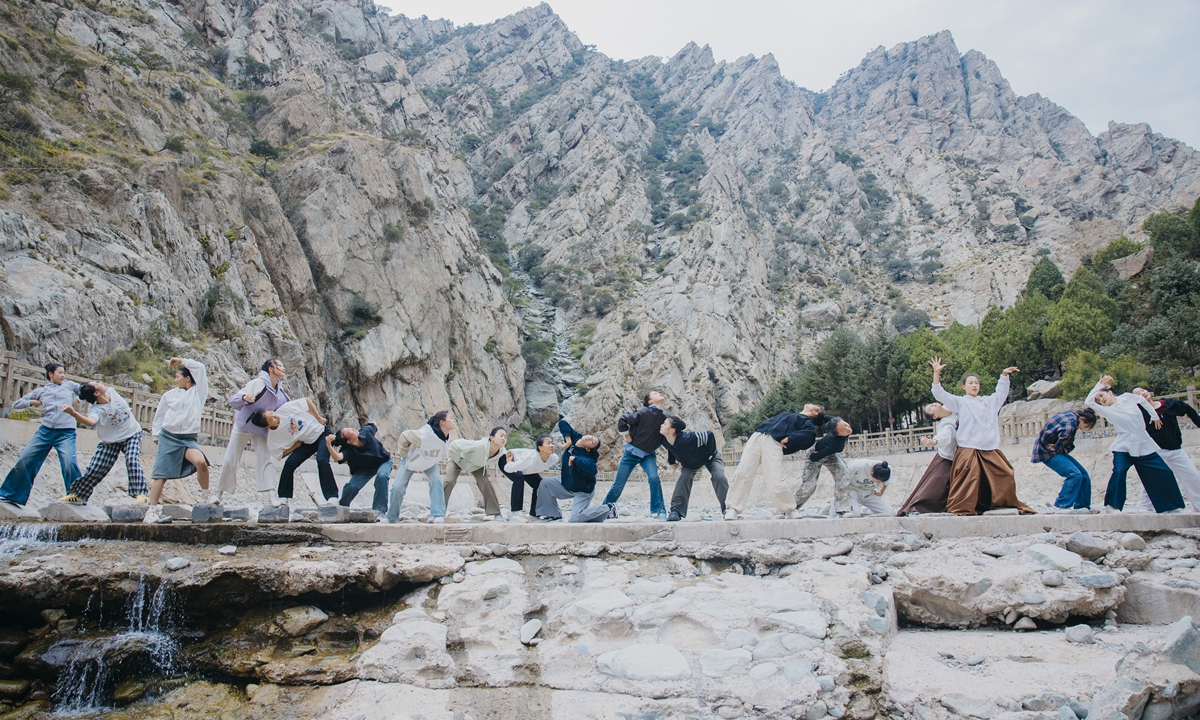
Performers practice dance movements near ancient rock paintings in Northwest China's Ningxia Hui Autonomous Region. (Photo: Courtesy of Kang Lili)
On the evening of May 14, the ceremony for the 14th China Dance Lotus Awards, China's highest national professional award for dance, was held in Xi'an, Northwest China's Shaanxi Province. Rock Talk, an original dance production created and performed by a group of students from the Yinchuan High School in the Ningxia Hui Autonomous Region, won the Chinese Contemporary Dance award.
Standing on the stage, their teacher Kang Lili felt a surge of emotion. Two images crystallized in her mind: her students drenched in sweat in the rehearsal hall, and the raw, enigmatic rock carvings etched into the Helan Mountains millennia ago.
Those carvings, scattered across more than 20 sites along Ningxia's Helan Mountains, number over 27,000 individual images, covering hunting scenes, battles, rituals, and dances. Left by prehistoric communities along the Yellow River, they were designated a major national cultural heritage site in 1996.
The dynamism of life
Kang encountered the carvings on a field trip in 2023 and was instantly spellbound.
"The stones were speaking," she recalled. "These age-old markings are like love letters written by ancient people to heaven and earth. 'What a miracle it would be if we could bring them to life through dance,' I thought."
At the entrance to the rock art site stands a greeting stone carved with the line, "Time loses its voice; only the stones can speak." Inspired, Kang named the piece Rock Talk.
In June 2024, Kang and her students began translating stone into motion. They pored over the static images, including the stark straight lines, hard angles and crude forms of human and animal figures, and reimagined them as straight arms, stiff wrists, right-angle joints and abrupt, percussive movements that evoked the texture of rock and the sharpness of carved grooves.
Drawing a bow, chasing prey, bending to herd animals -ancient gestures were turned into tableau-like poses linked by slow, flowing transitions.
Through staccato joints and heavy, measured breathing, the dancers summoned the roughness and weight of stone. At one point, their bodies pile together to form a "human rock mountain," echoing the layered cliff faces.
Almost none of the students had stage experience. To help them internalize the spirit of the carvings, Kang repeatedly took them to the cliffs.
Standing before crude outlines of animals and hunters, student Ma Yuanyuan felt a jolt of recognition. "In that moment, I felt a profound empathy with the Yellow River ancestors who tenaciously survived in such a harsh natural world."
Gazing up at petroglyphs thousands of years old, she sensed the resilience of life, the very essence Rock Talk sought to capture.
The troupe rehearsed three hours a day, endlessly refining each movement. In late 2024, at a regional showcase in Ningxia, Rock Talk stunned the audience. Experts from arts academies praised its raw power and life force. Encouraged by the professional acclaim, Kang and her colleagues submitted a video of their performance for the national award evaluation.
Of the hundreds of entries nationwide, only 16 made it into the contemporary dance finals, a field packed with elite academies and professional companies. Rock Talk stood out as the only entry performed entirely by high school students.
With just two months until the finals, Kang launched a grueling boot camp. The dancers pushed through relentless drills; no one quit.
"The Lotus Award is a coveted national honor for every dancer. We gave it our all and refused to back down easily," said student Shen Linru. Another student, Wu Jingyi, added, "I saw a bird in the rock carvings. During rehearsal, I'd imagine I was that bird, breaking free and flying into the sky."
As the weeks passed, the dance shed its rawness and gained control and emotional depth. "The teens developed their own understanding of the piece over time," Kang said. "When the music played, their eyes lit up. They used their bodies to narrate the ancient ancestors' longing for survival, their tenacity and unyielding spirit."
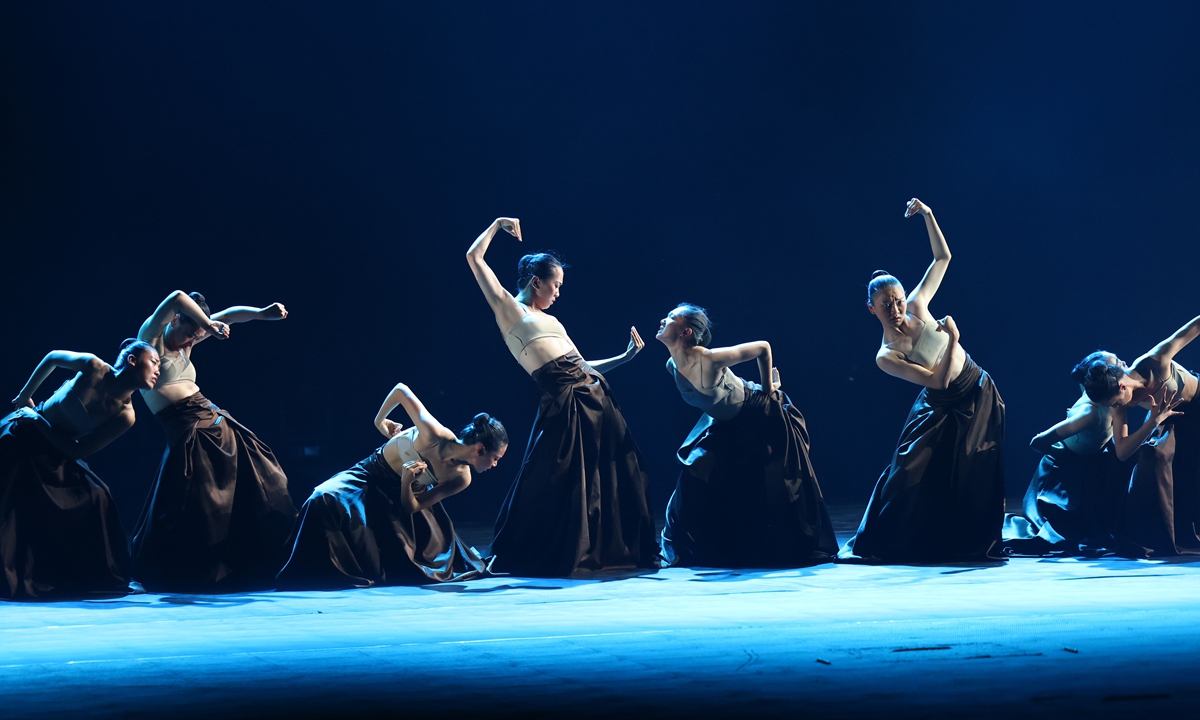
Students perform Rock Talk in South China's Hainan Province on April 23, 2026. (Photo: VCG)
Reaching a broader audience
At the final competition, Rock Talk was the 11th performance. Kang sat in the audience, anxious, but as the music swelled and her students glided onto the stage, she relaxed.
With no hired choreographer and a shoestring budget, the teenagers filled the space with a polish that rivaled their competitors. "Their skill was entirely comparable to other professional troupes. The weight on my heart lifted," said Kang.
When the last light faded, applause erupted. Audience members rushed backstage to take photos and chat with the young dancers. "Are you really high school students? Your performance was incredible!" "Where are these rock paintings located? We can't wait to visit!"
"Even if we hadn't won, the trip was worth it," Kang reflected emotionally.
Kang recalled that she was on tour with the students performing Rock Talk when a notification lit up her phone, a post from the China Federation of Literary and Art Circles' official WeChat account. She opened it to find the Lotus Award winners. In the Contemporary Dance category, only three works had been honored. One of them was Rock Talk. "We did it!" they screamed, some laughing, some in tears. Every drop of sweat suddenly felt worth it.
Beyond the trophy, the experience transformed the young dancers. Parents wrote to Kang, saying their daughters had become confident, no longer complaining or retreating from challenges.
"We learned what it means to challenge ourselves and to persevere. We pulled together as one, chasing a dream," student Gao Wenjing said.
The troupe has since received invitations to perform across China. Through the universal language of dance, the grand, profound charm of Helan Mountain Rock Art has been introduced to a broader audience.
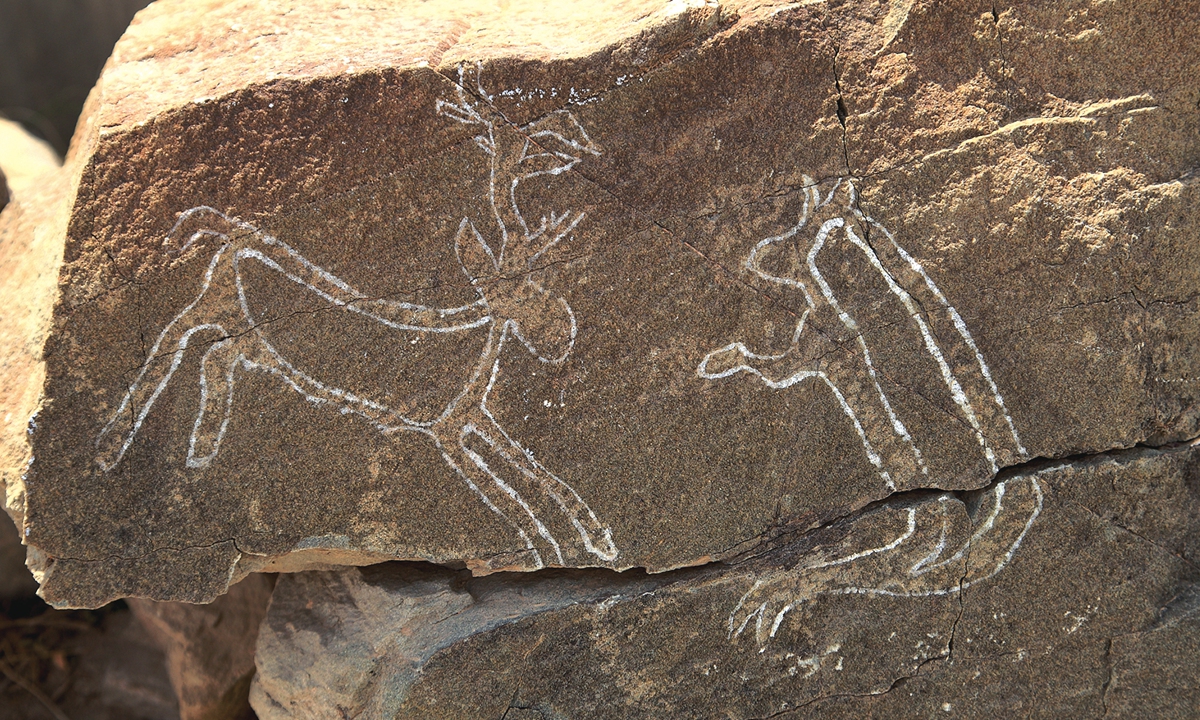
A rock carving depicts a deer and a dog in Ningxia. (Photo: Helan Mountain Rock Painting Management Office)
This was compiled and translated by the Global Times based on an article originally published in the People's Daily on May 25, 2026.