


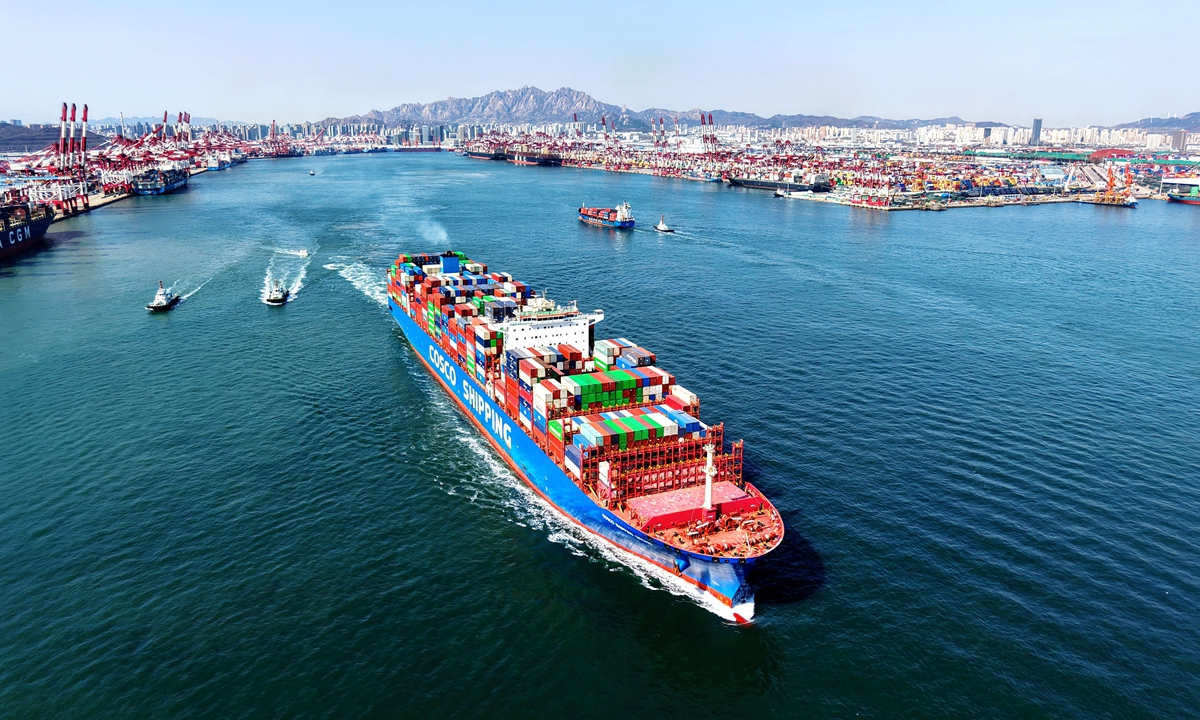
View of a container vessel near Qingdao port in East China's Shandong Province on April 7, 2026 (Photo: VCG)
China plans to leverage the upcoming summit for multinational companies in Qingdao, East China's Shandong Province, to connect global companies with projects in traditional industrial upgrading, emerging industries and future sectors, as the country moves to help multinationals better tap the opportunities of its vast market.
Co-hosted by the Ministry of Commerce (MOFCOM) and the Shandong Provincial Government, the seventh Qingdao Multinationals Summit will be held in Qingdao from June 15 to 17, Vice Minister of MOFCOM Yan Dong said Tuesday.
The summit comes in the opening year of the 15th Five-Year Plan period (2026-30), as China works to facilitate multinationals' deeper integration into its industrial, supply and innovation chains and wider participation in its innovation-driven growth and institutional opening-up.
So far, 435 corporate guests have confirmed attendance, including 355 representatives of overseas multinationals from 36 countries and regions, from members of the ASEAN, the EU, and South Korea, said Wen Nuan, vice governor of Shandong Province.
And, 80 Chinese corporate representatives will attend the event, mainly Fortune Global 500 firms and industry leaders.
The summit will put stronger emphasis on practical outcomes, with 23 parallel events covering investment promotion, trade matchmaking, industry exchanges and regional cooperation to unlock cooperation potential, Wen said.
Investment promotion events will center on the renewal and upgrading of traditional industries, the clustering of emerging sectors and early positioning in future industries, with targeted project matchmaking designed to turn cooperation intentions into concrete programs.
This year's summit will introduce a country-themed corporate day. Marking the 55th anniversary of China-Turkey diplomatic ties, the summit will host the 2026 China (Shandong)-Turkey Exchange Day to deepen bilateral trade and investment links, according to Wang Lei, director of the Shandong Provincial Department of Commerce.
In addition, through "one-on-one" supply-demand meetings, the summit will encourage multinational companies to take part in the intelligent and green transformation of traditional industries. Newly added events on new-energy vehicles and new energy storage will better match their cutting-edge technologies with China's industrial application scenarios, Wang noted.
China’s sustained expansion of high-level opening-up is giving multinational corporations solid institutional safeguards, broad market space and greater confidence to expand in China for the long term, Song Ding, a research fellow at the China Development Institute, told the Global Times on Tuesday.
The Qingdao summit, together with other open platforms such as the China International Supply Chain Expo, shows that China is not only opening its market wider, but also creating channels for global companies to connect with China's industrial upgrading, innovation demand and supply-chain resilience, Song said.
MOFCOM data showed that in the first four months of this year, more than 20,000 foreign-invested enterprises were set up in China, up 6.8 percent year-on-year. Actual foreign investment in high-tech industries rose 20.3 percent from a year earlier.
Recent foreign chamber surveys also pointed to sustained interest in the Chinese market. Nearly 60 percent of surveyed US companies plan to increase investment in China, according to the American Chamber of Commerce, while the British Chamber of Commerce in China said British firms were more optimistic about 2026 than in any year since before COVID-19, with most planning to maintain or raise investment.
"These fully show that China is not only a stabilizer of the global economy, but also a must-choose destination for multinationals' future-oriented planning," Yan said.
The summit will include an opening ceremony, a forum on the high-quality development of multinational corporations and a series of parallel forums. It will also release the latest edition of the research report Multinational Corporations in China.
During the 15th Five-Year Plan period, MOFCOM pledged to further open the services sector, align more actively with high-standard international economic and trade rules, and optimize the structure of foreign investment.
China will support foreign-invested services companies in moving further up the value chain and ensure that, in sectors already open to foreign investors, they can both enter the market and operate effectively, Yan noted.
China has updated its foreign investment incentive catalogue. The 2025 catalogue, which took effect on February 1, 2026, gives greater priority to areas such as advanced manufacturing, modern services, high technology, energy conservation and environmental protection.
Yan pledged that China will attract more multinational corporations to place research and development as well as high-end manufacturing operations in the country, making foreign investment in China better structured and more innovation-driven.