


TAIPEI, May 26 (Xinhua) -- Taiwan's Democratic Progressive Party (DPP) authorities' policies obstructing all kinds of exchanges with the mainland have hurt development opportunities for the island's tourism industry and suppressed the booming public demand for mainland travel, said insiders at the just-concluded 2026 Taipei Tourism Exposition, calling for the full resumption of travel across the Taiwan Strait.
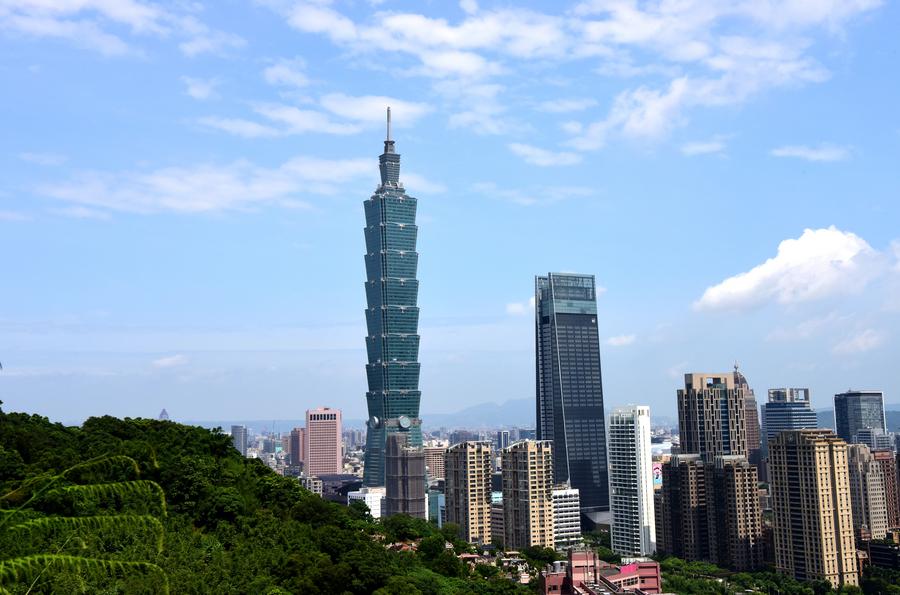
Photo taken on July 21, 2019 from Xiangshan Mountain shows the Taipei 101 skyscraper in Taipei, southeast China's Taiwan. (File photo: Xinhua)
More than 100 mainland visitors were invited to attend the four-day expo, the largest of its kind in Taiwan so far this year, which concluded on Monday, with them getting there despite obstacles imposed by the DPP authorities on mainland participation.
The turnout, achieved via determined efforts by Taipei's tourism industry, was nonetheless far below that of more than a decade ago, when hundreds of booths from different provinces filled a dedicated mainland pavilion, according to Echo Chen, director of the Taipei Association of Travel Agents.
"I hope we can see those bustling scenes of the past again in the future," she said.
Tourism across the Strait has been undermined since the DPP came to power in 2016 and intensified its "Taiwan independence" agenda, finally leading to the suspension of a pilot scheme for mainland individual tours to Taiwan that had operated since 2011.
The situation worsened in 2020, when the DPP authorities, citing the pandemic as a pretext, banned mainland residents from visiting Taiwan and prohibited the island's travel agencies from organizing group tours to the mainland. Both restrictions are still in place.
These have dealt a major blow to the tourism industry on the island.
Terry Chien, a senior practitioner at Kaohsiung-based travel agency Life Tour, said that cross-Strait tourism once accounted for as much as about 20 percent of the agency's business volume, but now makes up only around 3 percent.
"More than a decade ago, we used to receive at least 1,000 tourists from the mainland every month," said Chien, who has worked in the industry for nearly 30 years and once served as a liaison based in Beijing for business development.
However, according to Chien, many travel agencies in Taiwan have now closed their offices on the mainland due to a sharp decline in business amid obstructions resulting from DPP policies.
According to industry insiders, during the peak years of mainland tourists visiting Taiwan, the island's annual inbound tourist arrivals had exceeded 10 million for several consecutive years, a figure to which mainland tourists contributed roughly 40 percent. In 2025, the total number of inbound tourists to the island was only approximately 70 percent of the 2019 level.
Pauline Chen, general manager of Taipei-based Sky Way Tour Travel Service Co., Ltd., said that with mainland tourists unable to visit Taiwan, some small and medium-sized travel agencies mainly engaged in inbound tourism have had to adjust their business to navigate this change.
Meanwhile, strong demand among Taiwan residents for visiting the mainland, ranging from the snow-capped mountains to urban landscapes, has remained undiminished despite continuous discouragement and threats from the DPP authorities.
Chien noted that although the DPP authorities have banned group tours to the mainland, his agency still serves about 2,000 to 3,000 customers per month traveling across the Strait on individual tours.
"Each time we participated in travel expos in Taiwan, we were asked by many enthusiastic visitors for recommendations regarding travel destinations on the mainland," said He Jie, director of the Taipei Office of the mainland-based Association for Tourism Exchange Across the Taiwan Straits.
During the 2026 Taipei Tourism Expo, many visitors also came to the association's booth to ask about future resumption plans for direct passenger flights across the Strait.
According to the Taiwan Affairs Office of the State Council, as of April, direct passenger flights to Taiwan were operating from 15 mainland airports, compared with 61 before 2020.
Several mainland airlines, including China Eastern Airlines and Spring Airlines, have further announced the resumption of direct flights from mainland cities such as Chengdu and Ningbo to Taichung and Kaohsiung in Taiwan, starting in July 2026.
A staff member with a mainland airline told Xinhua that resumption plans were largely driven by strong market demand. "Currently, the occupancy rates on our existing resumed flights have exceeded 85 percent, with particularly strong demand from central and southern Taiwan."
In April this year, the mainland announced the acceleration of the resumption of regular direct passenger flights across the Strait, as part of a package of 10 policies and measures for boosting exchanges and cooperation with Taiwan, which were released following a mainland visit by a delegation of Taiwan's Chinese Kuomintang party led by its chairwoman Cheng Li-wun.
The package also includes a plan to promote the resumption of individual tours to Taiwan for Shanghai and Fujian residents.
As a start, residents of Shanghai have been able to apply for group and individual tours to Kinmen and Matsu via qualified travel agencies as of April 29. The first batch of Shanghai visitors arrived in Kinmen on May 11 for a three-day trip.
Zhu Fenglian, spokesperson for the Taiwan Affairs Office of the State Council, said at a press conference on May 20 that the mainland is willing to actively promote any measures conducive to facilitating exchanges across the Strait.
She urged the DPP authorities to follow public opinion and respond properly to the call from the island's tourism sector, and lift unreasonable restrictions as soon as possible.
"People on both sides of the Strait speak the same language and share the same ancestry, and the emotional bond between us cannot be severed," Echo Chen said. "We sincerely hope that tourism and other people-to-people exchanges across the Strait will return to normal at an early date." ■