


China is ramping up investment in a "Six Networks" initiative as the country seeks to expand domestic demand, stabilize economic growth and strengthen long-term development resilience amid external uncertainties and lingering domestic supply-demand imbalances.
The "Six Networks" include water networks, new-type power grids, computing power networks, next-generation communication networks, urban underground pipeline networks and logistics networks.
China is now moving quickly to implement the initiative. Li Chao, spokesperson for the National Development and Reform Commission (NDRC), said the NDRC will soon roll out detailed plans and implementation schemes, clarify investment priorities, set annual targets and establish timelines for key projects.
According to NDRC head Zheng Shanjie, investment in the "Six Networks" and related sectors is provisionally estimated to exceed 7 trillion yuan (about $1.02 trillion) this year alone.
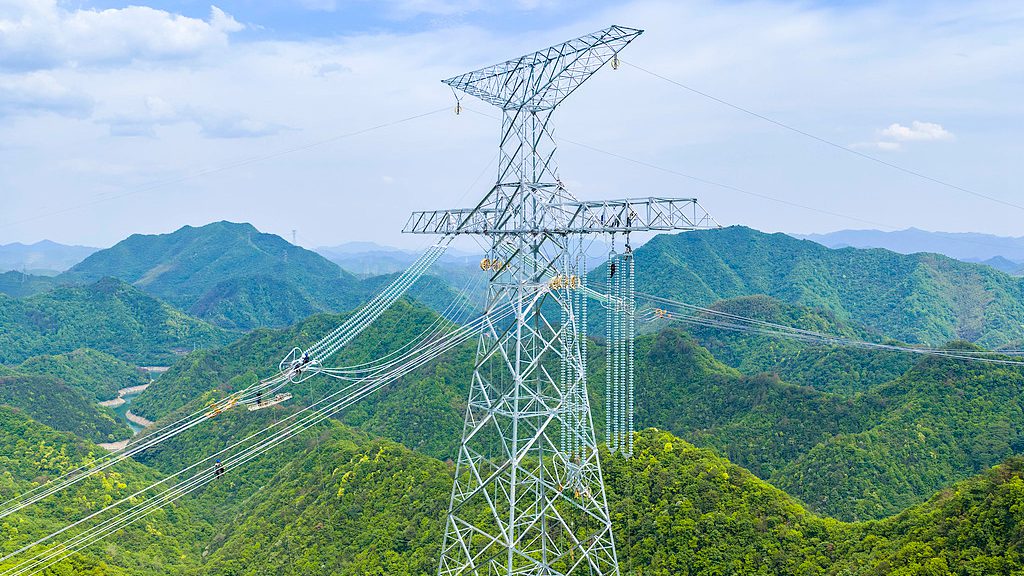
The construction site of the ±800 kV ultra-high-voltage direct current transmission project linking Gansu and Zhejiang, located in Lin'an District, Hangzhou City, Zhejiang Province, April 27, 2026. (Photo: VCG)
China expects to invest more than 5 trillion yuan during the 15th Five-Year Plan period (2026-2030) on the upgraded power grid alone, which will involve the building of power transmission corridors and inter-provincial electricity mutual-aid projects, and upgrading of urban power distribution networks and the strengthening of weak county-level and rural power grids.
While China has already built a massive, safe and technologically advanced national power grid, surging demand for new energy connections, growing regional imbalances between power supply and demand, and the increasing complexity of grid safety operations have prompted efforts to build a more secure, reliable and environmentally friendly power system.
Underground pipelines represent another major area of investment. By the end of 2025, China had built nearly 3.9 million kilometers of pipelines, forming the world's largest such network.
Yet challenges remain, as aging pipelines urgently need replacement, while issues such as insufficient urban drainage capacity and water supply leakage persist.
During the 15th Five-Year Plan period, China is expected to invest approximately 5 trillion yuan to build and renovate around 770,000 kilometers of gas, water supply, drainage and heating pipelines, in a move aimed at enhancing urban infrastructure safety and resilience.
A slew of projects are already underway. Construction on the Zhejiang 1,000 kV ultra-high voltage AC loop project has officially begun. Upon completion, it will integrate with the existing provincial grid network. The Datong-Huailai-Tianjin South 1,000 kV ultra-high voltage AC line project has entered full-scale construction to boost power transmission from Shanxi Province to the Beijing-Tianjin-Hebei region.
Meanwhile, China Mobile's 1-billion-yuan intelligent computing center project in Taizhou, a city in Zhejiang Province, has broken ground. It is set to house over 1,000 high-performance computing servers.
The investment wave will ripple across a wide range of sectors, said Zhou Wei, managing director of China Investment Consulting Co., Ltd., citing demand for steel, pipes and construction machinery from traditional infrastructure upgrades.
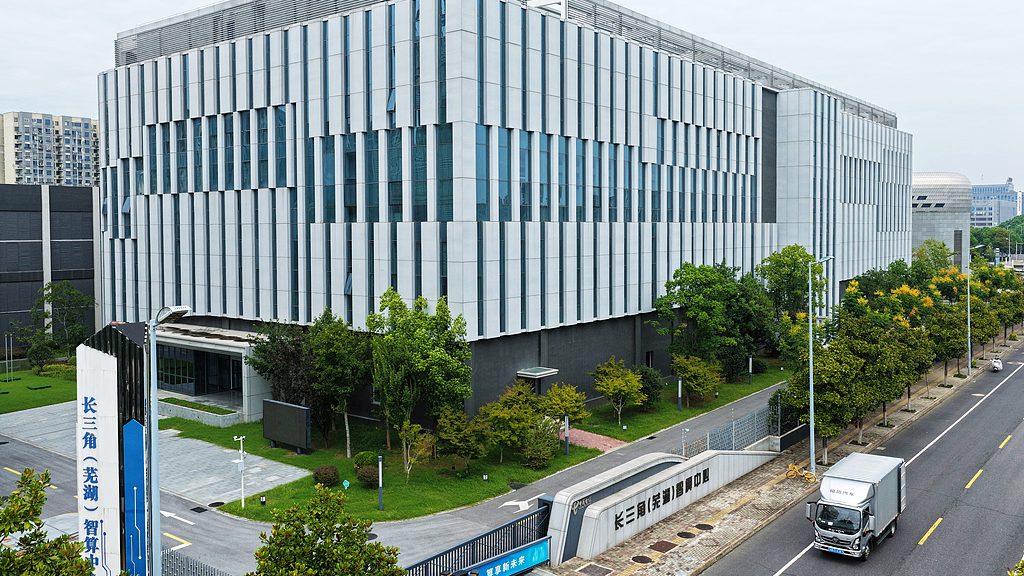
China Telecom's Yangtze River Delta (Wuhu) Intelligent Computing Center, Wuhu, Anhui Province, September 11, 2025. (Photo: VCG)
New infrastructure like computing and communication networks will drive rapid growth in servers, optical modules, AI chips and 5G-A equipment, said Zhou, adding that construction of "new-type" power grids and strengthening of urban underground pipe networks and other weak areas will boost sectors such as high-voltage equipment, energy storage and smart pipeline systems.
Surging demand is already reflected in corporate earnings. Demand for optical modules – a core component of next-generation communication and computing networks – has surged as large-model computing infrastructure construction accelerates.
Zhongji Xuchuang, a leading listed company in the optical module industry, reported first-quarter revenue of 19.496 billion yuan, up 192.12% year on year, with net profit surging 262.28%. The A-share optical communication sector has also strengthened this year, with leading stocks repeatedly hitting all-time highs.
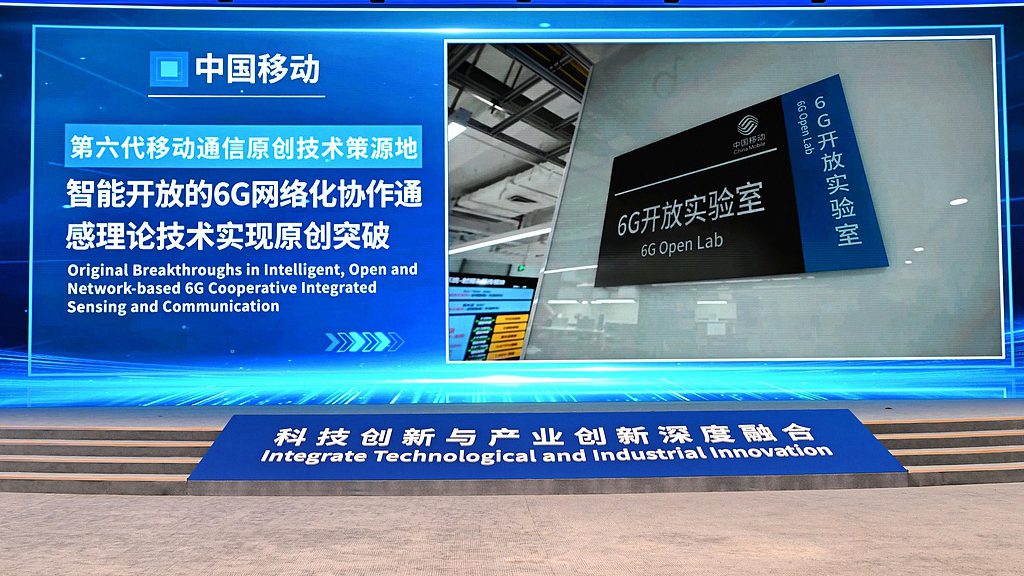
China Mobile Research Institute's 6G Open Lab serves as an important platform for 6G technology research and development. (Photo: VCG)
Experts said the "Six Networks" investment serves both immediate and long-term economic goals. Guo Lei, chief economist at GF Securities, said the initiative balances short-term economic support with medium-term structural transformation and long-term security guarantees.
"The planning and construction of the 'Six Networks' is not only conducive to raising the potential economic growth rate, but also to enhancing the security of development," said Luo Zhiheng, chief economist at Yuekai Securities. He added computing networks underpin AI development, while underground pipeline construction expands effective investment and improves living conditions.
Multiple funding channels are being mobilized. NDRC Vice Chairman Wang Changlin said that 755 billion yuan in central budget investment and 1 trillion yuan in ultra-long special treasury bonds will be largely disbursed by the end of June, while 800 billion yuan in new policy-based financial instruments will be deployed effectively.
In the latest move, the NDRC has issued the second batch of projects for implementing major national strategies and building security capacity in key areas for 2026, allocating 216.8 billion yuan in ultra-long special treasury bonds to 336 major projects. In the first four months of this year, local governments issued 1.3343 trillion yuan in new special bonds.
The "Six Networks" should not only serve as an independent network separately, but also can play a part in multi-network collaboration, to promote the optimization and integration of modern infrastructure systems, to achieve larger efficiency, the NDRC emphasized.
"In the short term, hardware and some software investments related to the 'Six Networks' construction carry the certainty of incremental investment," said Wang Xiaojie, chief domestic policy analyst at Western Securities' research center.
In the long term, the new infrastructure is expected to boost the improvement of industrial ecosystem, leading to a virtuous cycle of investment and consumption, further amplifying domestic demand.