


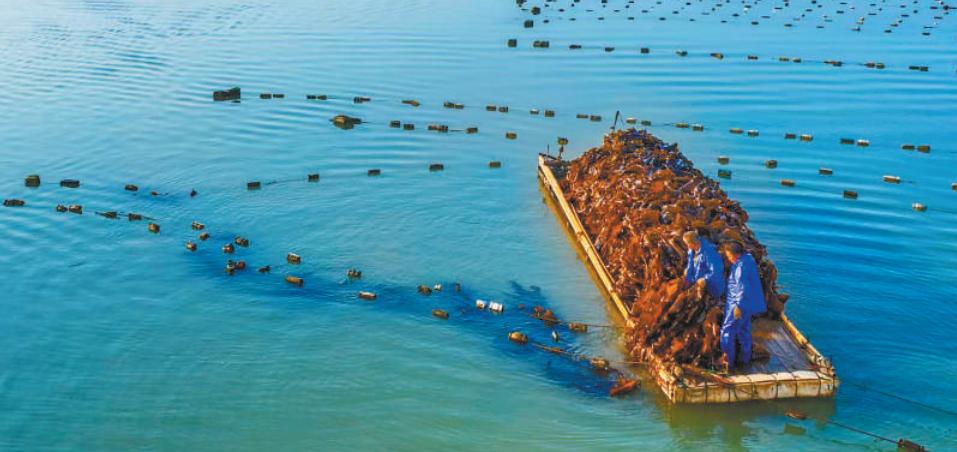
Farmers harvest kelp in Huangbi'ao township, Xiangshan county, Ningbo, east China's Zhejiang province. (Photo/Shen Yang)
The harvest season for branched string lettuce recently wrapped up along Xihu port in Huangbi'ao township, Xiangshan county, Ningbo, east China's Zhejiang province.
"I earned more than 60,000 yuan ($8,846) harvesting seaweed for the science and technology backyard," said Baiyu village resident Qiu Yonggao with a broad smile. "I never thought tidal-flat seaweed could bring real income."
Huangbi'ao township sits along the East China Sea. Stretching across the coastline are vast expanses of high-quality tidal flats where algae such as branched string lettuce, kelp and laver thrive naturally.
The "science and technology backyard" Qiu referred to is the Xiangshan Seaweed Science and Technology Backyard, jointly established by the local government, universities and leading enterprises.
Supported by this innovation hub, the local seaweed industry now spans cultivation, processing and domestic and overseas sales. This shift has upgraded the industry from traditional extensive farming to modern intensive production, lifting incomes for more than 180 local households.
At a local production base, workers are testing indoor cultivation of branched string lettuce in a 900-square-meter, state-of-the-art seedling workshop.
"The branched string lettuce produced here is purchased in large quantities by internationally renowned snack companies and used as a food seasoning," said Zhu Wenrong, head of the production base and chairman of Xiangshan Xuwen Seaweed Development Co., Ltd. "Thanks to the area's natural ecological advantages, branched string lettuce around Xihu port stands out for its premium quality and rich nutrients."
Operating under a "company + farmer" model, the base provides growers with free seedlings, technical guidance, and guaranteed minimum prices. During this year's bumper harvest, more than 100 local villagers participated in harvesting every day, with daily purchases of fresh branched string lettuce reaching more than 40 metric tons at peak times. Some villagers earned up to 1,500 yuan ($221) a day solely from harvesting.
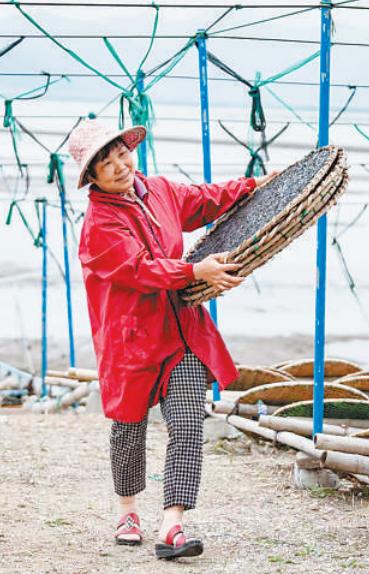
A farmer sun-dries nori at Xihu port in Huangbi'ao township, Xiangshan county, Ningbo, east China's Zhejiang province. (Photo/Zheng Kaixia)
Building on the growth cycle of branched string lettuce, the base has also introduced high-quality kelp and laver seedlings, creating what locals call a "marine vegetable garden" in Xihu port. Moving beyond the traditional practice of "depending on the weather," the farms now use intelligent equipment to monitor seawater temperature and pH levels, enabling precise environmental regulation.
"Look at this kelp -- broad leaves and thick flesh. It can sell for around 20 yuan per kilogram," Zhu said, pointing toward the rows of kelp racks in the sea. Last year, kelp production remained stable at over 2,000 metric tons, most of which was sold to supermarkets and restaurants in Shanghai and Hangzhou, capital of Zhejiang.
Remarkably, one kilogram of seedlings yields 1,000 kilograms of mature seaweed. As the algae grow, they absorb nitrogen and capture carbon dioxide. Scientists now quantify sequestered carbon, unlocking new industry potential.
On Feb. 28, 2023, China's first blue carbon auction deal was finalized in Huangbi'ao township. The annual fishery carbon sink of 2,340.1 tons from Xihu port was traded at 106 yuan ($15.63) per ton, with a total transaction value of around 248,000 yuan ($36,563).
"Blue carbon trading clarifies pathways to monetize ecological value," said Yang Yang, deputy director of Xiangshan marine economic development center.
Profit distribution from carbon trading directly benefits villagers. Hugang Village resident He Shichang received 1,200 yuan ($176.93) worth of seedlings last year, calling it "income from protecting the ocean." Local fishers now practice sustainable harvesting and actively safeguard marine ecosystems.
Xiangshan county has incorporated the seaweed industry into its overall marine economic development plan and established multi-party coordination mechanisms to turn the Xiangshan Seaweed Science and Technology Backyard into a key platform for technological breakthroughs and the commercialization of research results.
"In the past, universities often struggled to commercialize research findings. Now, technologies developed in the lab can be tested and promoted directly in the waters of Xihu port," said Chen Haimin, a researcher from Ningbo University who leads a team studying healthy seaweed cultivation and resource utilization at the science and technology backyard.
According to Chen, new laver varieties developed by the team are now applied in standardized and precise seedling breeding and harvesting demonstrations across laver farming zones in Xiangshan.
Today, seaweed cultivation in Huangbi'ao township has also become deeply integrated with rural tourism. Visitors can experience sea farming and recreational fishing, enjoy local seafood cuisine, and learn about blue carbon through science exhibitions.
At the Xiangshan Marine Carbon Sink Comprehensive Exhibition Center, a "digital blue carbon map" provides real-time visualization of carbon sink changes across local waters, making ecological assets visible and tangible.
Meanwhile, researchers at the science and technology backyard are refining an ecological mixed-farming model integrating algae, shellfish and fish. Fish are raised in the upper waters, shellfish in the middle layer, and algae below, forming a circular system that maximizes the use of the same body of water.
From "seaweed" growing on tidal flats to a fully developed industrial chain, and from invisible carbon sinks to tradable ecological assets, the ocean in Huangbi'ao township is steadily becoming a "blue granary" that offers broad prospects for advancing all-around rural revitalization.