


BEIJING (People's Daily) - A Chinese think tank on Tuesday released its inaugural report analyzing the military activities of non-US extra-regional countries in the Western Pacific, highlighting rising tensions in the region.

This photo taken on May 26, 2026 shows the launching event of the "Report on the Military Activities of Non-US Extra-Regional Countries in the Western Pacific in 2025" in Beijing, capital of China. (Photo: Xinhua)
The report, published by the South China Sea Strategic Situation Probing Initiative (SCSPI), focused on the growing military footprint of countries including the UK, France, Australia and Canada. While SCSPI has issued annual reports on US military activities for years, this marks its first systematic study of non-US extra-regional forces.
Hu Bo, director of SCSPI, said the report's data was collected using big data analytics, artificial intelligence, remote sensing tools and other methods, in collaboration with relevant institutions.
Wang Yinghui, a professor at China's National Defense University, noted the report's academic and analytical significance, saying it fills a gap in research on the military activities of non-US countries in the region while providing valuable open-source intelligence data and empirical support.
Increasing presence
According to the report, in 2025, approximately 200 warships from 18 extra-regional countries operated in the Western Pacific, totaling nearly 10,000 ship-days of naval presence. Excluding the US, which accounted for 109 ships and 9,088 ship-days, other extra-regional countries deployed more than 48 ships for a combined 610 ship-days, averaging about two ships per day.
In terms of aircraft activities, non-US extra-regional countries conducted nearly 1,500 sorties, mostly involving transport aircraft, helicopters, reconnaissance aircraft, airborne early warning aircraft and refueling aircraft. Transport flights alone accounted for more than 50 percent of the total.
The report noted that compared with the US military, these countries "have yet to establish regular deployments, lack robust operational capabilities, and are primarily strategic and diplomatic in nature."
However, it added that the impact of these military activities on regional security dynamics "cannot be overlooked, and oversimplifying this would be imprudent."
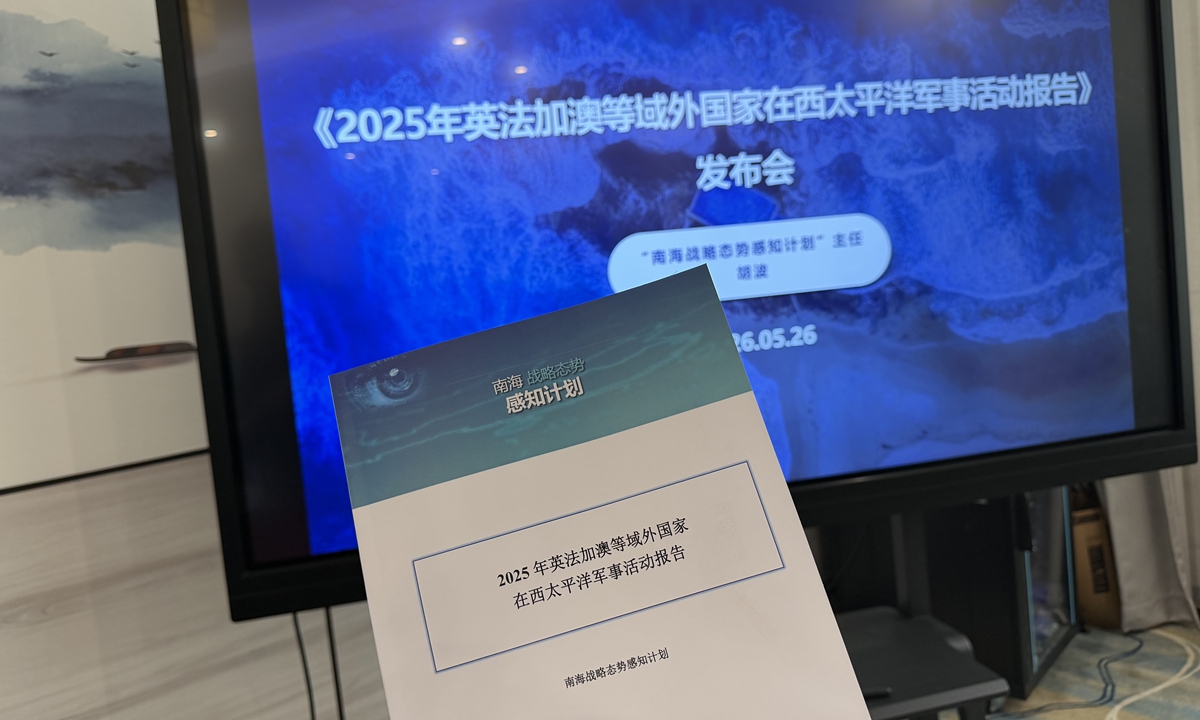
Think tank the South China Sea Strategic Situation Probing Initiative releases a report titled "Report on the Military Activities of Non-US Extra-Regional Countries in the Western Pacific in 2025" on May 26, 2026. (Photo: GT)
Political signaling
Hu said a major motivation behind the report was the increasing politicization of military activities in the region.
The report noted attempts by these countries to highlight their military presence mainly through deployments of large platforms or task groups, normalized declaratory activities, and increased participation in exercises and drills.
"The political signaling of such actions outweighed their actual military impact," it said.
The report said Taiwan Strait transits deserve particular attention. In 2025, Australia, Canada, the UK and New Zealand deployed six warships to transit the Taiwan Strait on five separate occasions, all accompanied by official public statements.
This marks a notable shift from previous years, when such transits were primarily led by the US with limited participation from other extra-regional countries, according to the report.
"It is not about the military operation itself but the political aspect behind it," Hu said.
Hu also said the politicization of military activities during peacetime is detrimental to regional stability. Disagreements over maritime rules, he added, should be resolved through consultation rather than military action.
Past inertia and emerging trends
The report noted that, unlike the US military, most of these countries neither have substantial geopolitical conflicts with China nor possess the capability to mount a significant military challenge in the region.
Although priorities vary by country, the report said their main objectives can generally be summarized as asserting a regional presence, strengthening ties with regional countries, upholding the so-called "Rules-Based International Order," or supporting US strategy.
Despite ongoing turmoil in other regions, the report suggested that multiple factors could reshape future military engagement in the Western Pacific.
The trend toward multilateralization and institutionalization is expected to deepen, with Japan and the Philippines serving as key pivots for extra-regional navies. Declaratory actions, such as "freedom of navigation" operations, are also likely to intensify, while the frequency, intensity and scale of military activities may continue to evolve.
Wang said the report provides an empirical foundation for anticipating such trends, managing risks and avoiding miscalculations.
(SCSPI, based at Peking University in China, is an open-source intelligence network established in 2019. It aims to track maritime activities and promote peace in the South China Sea.)