


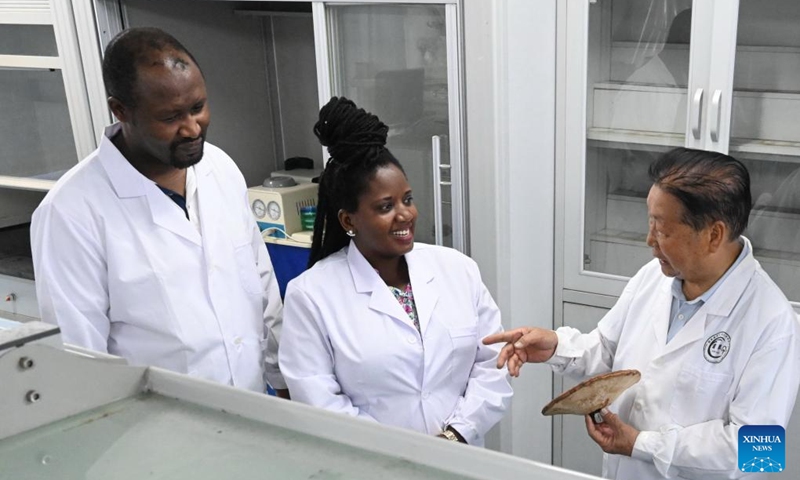
Lin Zhanxi (R) introduces Juncao technology to Rwandan students at Fujian Agriculture and Forestry University in Fuzhou, southeast China's Fujian Province, Aug. 26, 2024. (Photo: Xinhua)
The Global Partnership for Poverty Alleviation and Development (GPPAD), initiated by China together with 53 countries and nine international organizations, was formally launched on Wednesday, marking a major stride forward in the global cause of poverty reduction, the Xinhua News Agency reported on Wednesday.
The partnership was unveiled at the 2026 Global Poverty Reduction and Development Forum in Beijing that same day, where attendees hailed China's achievements in this field and efforts to share experience with other countries to tackle this global-scale challenge.
According to Xinhua, the GPPAD upholds the principles of mutual respect and mutual learning. It respects all countries' independent choices for poverty reduction and development strategies tailored to their national realities, facilitates exchanges of governance experience in poverty alleviation across the globe, and jointly explores fundamental solutions to eradicate poverty.
Guided by action and win-win cooperation, the alliance encourages members to carry out capacity building and practical cooperation based on their respective strengths, working together to improve the global poverty governance system. Staying committed to targeted, people-centered approaches, the alliance calls for targeted measures to eliminate poverty in all its forms and prevent falling back into poverty, Xinhua reported.
Embracing openness, inclusiveness and innovation while carrying forward proven practices, the GPPAD welcomes participation from governments, international organizations, the private sectors, academic institutions, media and other diverse stakeholders, to jointly foster a fair, inclusive, non-discriminatory and sustainable development environment, per the report.
James George, United Nations Development Programme (UNDP) resident representative ad interim in China, said at the forum that the launch comes at a critical moment. According to the official website of UNDP, 1.1 billion people across 109 countries live in multidimensional poverty and nearly 890 million of the world's most vulnerable continue to face the compounding burdens of poverty and severe climate hazards, George said..
"What is clear is that poverty eradication remains one of the defining development challenges of our time — and that no country can address these challenges alone," George said.
Mariano Assanami Sabino, deputy prime minister of the Democratic Republic of Timor-Leste told the Global Times on the sidelines of the 2026 Global Poverty Reduction and Development Forum that the establishment of this alliance is very important for the international community. "Today, many developing countries still face challenges such as poverty, food insecurity, and lack of infrastructure. No country can solve these problems alone. We need global cooperation and solidarity."
"China has shown strong leadership, not only by reducing poverty inside China, but also by sharing experience and development opportunities with many countries. We hope this alliance will become a platform for real action that can improve people's lives," Sabino said.
According to Xinhua, China declared in 2021 that it had eradicated extreme poverty, a remarkable achievement following decades of unremitting efforts by the world's most populous country. Having lifted 800 million people out of poverty, the country realized the poverty reduction goal set by the United Nations (UN) 2030 Agenda for Sustainable Development a decade in advance.
As a trailblazer in combating poverty, China has consistently shared its experiences and resources with other countries, fostering shared development that benefits all of humanity, Xinhua said. Over the years, China's commitment has been repeatedly evidenced through a range of projects, such as the Luban Workshop, the program of "Access to Satellite TV for 10,000 African Villages" and the "Africa Solar Belt" program, each widely embraced by locals.
Maximo Torero Cullen, chief economist of the Food and Agriculture Organization of the United Nations, said that he has been traveling to China almost every year for the past 20 years, and the changes in terms of poverty reduction works are impressive.
"China is not only focusing on poverty reduction but also on reducing inequality. Reducing inequality means paying attention to infrastructure development in rural areas. The infrastructure development has been incredible, along with significant progress in agricultural development, innovation in agricultural technologies, and investment in human capital. This includes access to quality water, healthcare, and education," he told the Global Times on Wednesday.
According to Torero Cullen, China has also built enormous research and development capacity in recent years, which he said is the right path because China is addressing not only monetary poverty but also the multidimensional nature of poverty, which helps reduce inequalities. "This approach makes the progress more sustainable," he added.