



A vegetable grower operates sprinkler equipment to water seedlings at a vegetable base in Aykol Town of Aksu, northwest China's Xinjiang Uygur Autonomous Region, March 22, 2024. (Photo: Xinhua/Ding Lei)
BEIJING, May 27 (Xinhua) -- Late one night in southwest China's Guizhou Province, Chen Yuguo lay awake in a hospital ward, worrying less about his illness than about the pigs back home.
The hospitalization had already plunged the rural villager into anxiety. Medical bills were mounting, his wife was staying by his bedside, and no one was left to feed the livestock that sustained the family's income.
Yet before the medical bills were even settled, local officials had already appeared at his ward. An abnormal spike in medical spending had triggered an alert by a provincial big data platform in Guizhou.
Within days, village officials verified the family's situation. Medical assistance was expedited, buyers were found for the unattended pigs, and longer-term support plans for employment and development were drafted.
"Without timely intervention, this family could easily have fallen back into poverty because of illness," said Chen Guowu, the village official who received the alert message. As Chen's household earnings were bound to fall and medical bills were mounting, annual per-capita net income risked slipping below 8,500 yuan (about 1,248 U.S. dollars), the threshold used to identify households vulnerable to a return to poverty.
Such interventions reflect how China's anti-poverty campaign continues to evolve after the country declared the elimination of absolute poverty in 2021, following an eight-year nationwide campaign that helped nearly 100 million rural residents shake off poverty.
China did not dismantle the mechanism built during the anti-poverty drive. Instead, it gradually repurposed it into a "more normalized and institutionalized" support system designed to hold poverty at bay, said Wang Sangui, director of the China Anti-Poverty Research Institute at Renmin University of China.
After the national campaign was declared a victory, China set 2021-2025 as a transition period, keeping key support measures largely stable on the new journey toward rural revitalization.
The outline of China's 15th Five-Year Plan (2026-2030), released in March, clearly emphasizes the need to consolidate and expand the gains of poverty alleviation and calls for establishing a long-term mechanism to prevent people from lapsing or relapsing into poverty.
From big-data analyses and household-customized assistance plans to tens of thousands of village-based officials dedicated to the cause, China's anti-poverty strategy has become what many describe as a dynamic and institutionalized safety net rather than a one-off campaign.
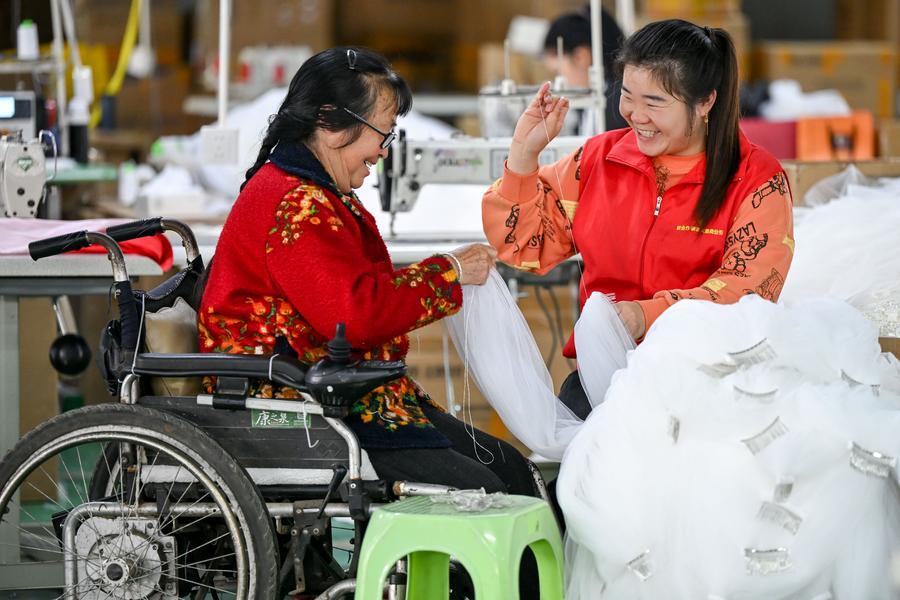
A community volunteer communicates with a disabled woman at a workshop in a relocation site for poverty alleviation in Zixing Subdistrict of Kaiyang County, southwest China's Guizhou Province, May 16, 2026. (Photo: Yuan Fuhong/Xinhua)
TOOLS IN THE CYBER AGE
Poverty is rarely defeated once and for all. For families living on narrow financial margins, a serious illness, a failed harvest, or the loss of a job can still push them back into hardship. In response, local governments across China are increasingly turning to cyber-age tools.
Few places illustrate that more clearly than Guizhou, which has long been one of China's poorest provinces. The mountainous province accounted for roughly one-tenth of China's formerly impoverished population.
In recent years, Guizhou, also known as one of China's fastest-growing big data hubs, has integrated information from public security, healthcare, civil affairs, and agricultural authorities into a province-wide big data platform that covers all rural residents. The system scans for warning signs ranging from catastrophic illness and sudden drops in income to housing problems and educational burdens.
When risks cross certain thresholds, alerts are automatically pushed to grassroots officials for verification. If problems are confirmed, households are quickly brought into targeted assistance programs.
"We use big data to ensure risks are identified early, interventions are made early, and problems are addressed early," said Zou Tao, head of the monitoring division at Guizhou's Department of Agriculture and Rural Affairs. "We don't wait until a household has already fallen back into poverty."
To ensure those warnings translate quickly into help, Guizhou has imposed a strict timetable, allowing no more than 15 days between the initial alert and the delivery of effective assistance.
By June 2025, the province had identified 853,000 people as being at such risks. With targeted assistance, roughly 72.8 percent have since stabilized their livelihoods.
Nationwide, China has identified and assisted more than 7 million people considered vulnerable to going back to poverty over the past five years.
"China is turning anti-poverty work from a passive response into proactive prevention," said Liu Yajun, a professor at Xiangtan University. "The key is to ensure that households in difficulty are discovered promptly, supported precisely and protected sustainably."
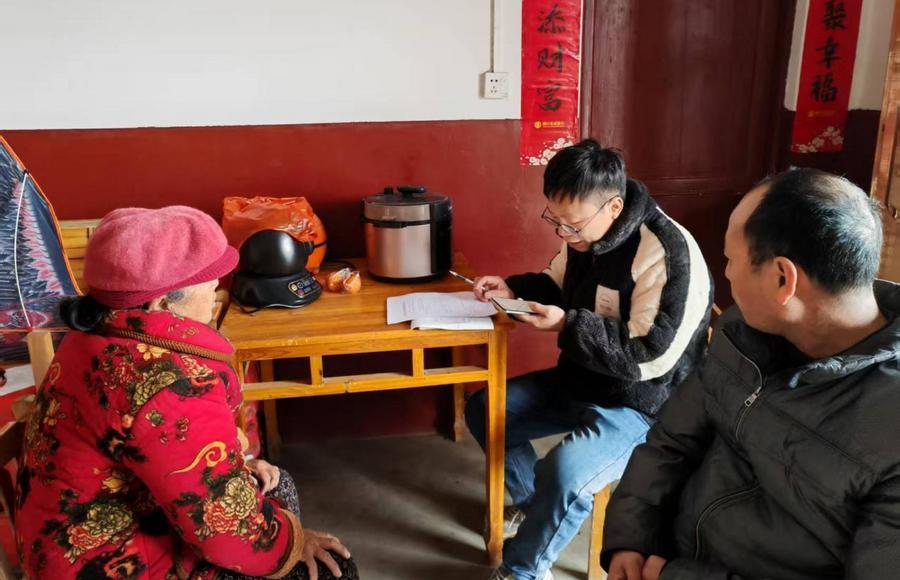
Village officials verify the household's situation in person with Xie Zhengqun's wife (1st L) after receiving the early warning data at Xinxing Village in Dongkou County, central China's Hunan Province, in February 2025. (Photo: Xinhua)
DYNAMIC SYSTEM
Yet early warning is only the first step. China's anti-poverty practices have shown that preventing a return to poverty requires long-term, tailored solutions and dynamic thresholds that evolve with changing economic conditions.
Instead of relying solely on broad-brush welfare policies, local governments turn to "one household, one profile" assistance. Using a combination of big-data screening and door-to-door verification, authorities build individualized digital records for vulnerable families.
Under the approach, each family is assessed individually, with support measures tailored to its specific circumstances. Some families struggle with medical debt, others with unstable jobs, tuition fees, or the lack of reliable local industries.
In Hunan Province, neighboring Guizhou, one such case unfolded. Xie Zhengqun, 59, a resident of Xinxing Village in Dongkou County, saw his family pushed to the brink last January after his wife was hospitalized with a sudden illness. Even after medical insurance reimbursements, the family still faced more than 20,000 yuan in out-of-pocket expenses.
Already in poor health himself and without a stable income, Xie was supporting a mentally disabled daughter and a grandson still in school, while relying largely on the wages earned by his younger daughter working outside the village.
"I felt overwhelmed looking at the medical bills," he recalled.
What surprised him was how quickly and precisely the local government responded. Shortly after his wife was discharged from the hospital, village officials arrived to verify the household's situation in person.
According to Zhou Weisheng, an official assigned to provide one-on-one assistance to Xie, township and village authorities completed verification within six days.
Within a month, a customized package of support measures had been rolled out, including medical assistance for his wife, subsistence allowances for his wife and grandson, and educational subsidies for his grandson.
More importantly, it included employment support for his younger daughter and incentives for the family to develop small-scale courtyard farming at home.
The assistance helped raise the family's annual per-capita income to around 17,000 yuan, while easing the burden of rigid household expenses. By April this year, local authorities concluded that the family's risk of falling back into poverty had been effectively removed.
"The policies came quickly, and every form of help addressed a real problem for our family," Xie said. "They helped our family get through the hardest time."
The standards used to identify vulnerable households are also dynamic. Rather than relying on a fixed poverty line, provinces now adjust thresholds annually to reflect changes in local income levels, inflation and broader economic development.
In Hunan, the annual per-capita income threshold for identifying households at risk of falling back into poverty has risen steadily from 6,500 yuan in 2021 to 8,700 yuan in 2025.
Guizhou has adopted a similar approach. Based on the 2020 poverty-alleviation benchmark, the province has raised its threshold by about 6 percent annually, while social assistance standards have steadily increased as well.
The average annual rural subsistence allowance in Guizhou rose by 12 percent to 6,818 yuan in 2024, and increased a further 6 percent to 7,226 yuan in 2025.
"The five-year transition period has helped China develop a relatively mature set of theories, mechanisms and methodologies for preventing poverty relapse," said Huang Chengwei, director of China's rural revitalization and development center under the Ministry of Agriculture and Rural Affairs. "Its effectiveness has fully demonstrated that China's poverty alleviation achievements can stand the test of both history and practice."