


On May 25, He Tingbo, Huawei's director of the board and president of its Semiconductor Business Department, published a paper titled "A Time Scaling Theory for Multi-Layer Electronic Systems" on ChinaXiv, a preprint platform of the Chinese Academy of Sciences for sharing scientific and technical papers. In this paper, He elaborated on the Tau (τ) Scaling Law that she presented at the 2026 IEEE International Symposium on Circuits and Systems (ISCAS) and unveiled Huawei's roadmap for releasing some of its Kirin and Ascend series chips.
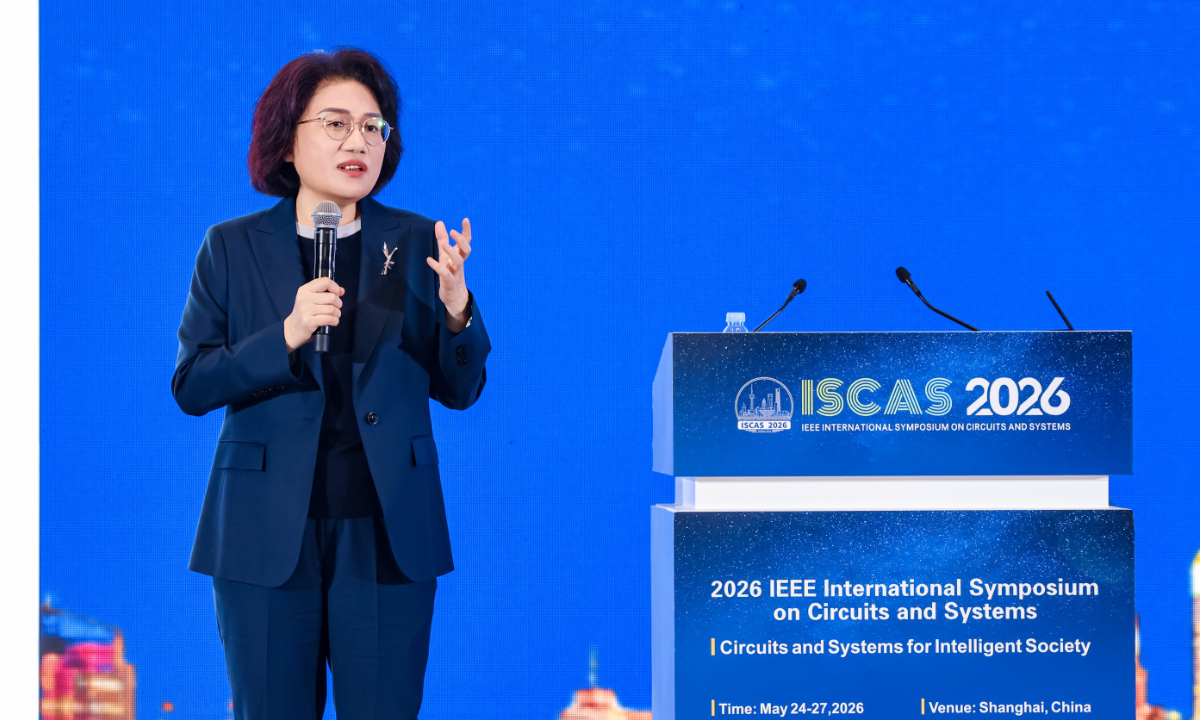
He Tingbo, a Huawei board member and president of the company's semiconductor business department, unveils the Tau (τ) Scaling Law, on March 25, 2026. (Photo: People's Daily/Lin Yuan)
The People's Daily recently sat down for an exclusive interview with He Tingbo. In May 2019, a public letter she wrote placed her in the spotlight. In this letter, she announced that Huawei's Plan B for chips that the company had been working on for years had suddenly become Plan A, and that the company would strive to ensure its self-sufficiency in technology. Now, seven years later, she is back in the public eye.
"Huawei hit the 'wall' earlier than our industry peers"
People's Daily: What's different about the new Tau Scaling Law?
He Tingbo: Before talking about our new law, let's first look at Moore's Law. Since its inception more than 60 years ago, Moore's Law has served as a sort of "pact" or industry agreement, guiding all players in the electronics industry to focus on the geometric scaling of chips. However, with Moore's Law now approaching its physical limits and related costs sharply rising, its evolution has slowed down. This means we need to return to science and find another path forward.
The Tau Scaling Law proposes replacing geometric scaling with time scaling as a new guiding principle for the evolution of both semiconductors and electronic systems. Based on this principle, innovative technologies such as LogicFolding can be used to continuously compress signal propagation delay and steadily improve transistor density, which will drive the ongoing evolution of semiconductors and electronic systems.
People's Daily: What were your considerations when proposing this law?
He Tingbo: For Huawei, there are two key constraints on chips. One is an inevitable constraint: Moore's Law will hit a "wall" of physical limits within the next 10 years. The other is a contingent constraint. Huawei encountered this "wall" earlier than our industry peers due to restrictions in the external environment. These constraints got me thinking: In essence, Moore's Law is not about compressing space, but about faster speeds, more functions, and more affordable prices. I'd like to explain with an analogy. If a city wants to build more parks, schools, and hospitals, it may become crowded, leading to longer commuting times. How can the city deal with this issue? Our answer is LogicFolding, a key technology of the Tau Scaling Law. It can be used to fold one area of the city on top of another, and install millions of elevators to connect these two areas based on logical relationships. As a result, the direct distance between the two areas of the city remains relatively short, time is saved, and more functions can be provided.
People's Daily: Guided by the Tau Scaling Law, what innovations and explorations has Huawei made?
He Tingbo: Over the past six years, we have independently developed 381 chips guided by this law. We have used this law to redesign chips for domains like optical communications, data communication, wireless communications, 5G, smartphones, and autonomous driving. This also includes our Kunpeng chips for general-purpose computing and Ascend chips for AI computing. Thanks to this work, we are able to bring our important products back to consumers and customers.
People's Daily: Can the Tau Scaling Law provide a new direction for the global chip industry?
He Tingbo: This law represents a breakthrough in Huawei's basic theoretical research. It's important not only for chips themselves, but for the entire semiconductor industry. Over the next five to 10 years, the semiconductor industry will encounter obstacles and will certainly seriously consider the path presented by the Tau Scaling Law. It took 10 years for Moore's Law to be fully accepted by the industry after it was proposed. As an engineer, I certainly don't want what I'm working on to remain a bottleneck forever.
We are now unveiling our practice and plan with the Tau Scaling Law. Overall, we feel confident – more confident than we have been at any time in the past six years. Some people may join our path three days from now, and others may not do so for three to five years. All those who are interested are welcome. More implementation will be needed to prove this law, and we hope our industry peers can join us to make it even better.
"It's okay to move slowly, as long as we are heading in the right direction"
People's Daily: What nanometer process is currently used by Huawei chips? This is a question that has attracted huge public attention.
He Tingbo: I think public attention toward this question is influenced by Moore's Law. The Tau Scaling Law can accelerate the evolution of chips. The new Kirin smartphone chips that Huawei plans to launch this fall will be the first chips to fully adopt the Tau Scaling Law. They will represent a huge leap from last year's chips in terms of performance, integration, and transistor density. We are confident in our ability to steadily move forward under the guidance of this law over the next five to 10 years. Compared with the other path, the Tau Scaling Law will accelerate our progress, enabling us to improve rather than lag further behind.
People's Daily: Innovation is like running a marathon. This is especially true for basic theoretical research. What do you think most motivates you to keep going?
He Tingbo: When difficulties come our way, we don't back down; we go all out to overcome them. We take pride in our commitment to placing faith in whatever we set our minds to and working hard to make it reality. It's okay to move slowly, as long as we are heading in the right direction. Keep walking; we will eventually find the right bridges and roads. We've already built a road – a highway so to speak – through our long-term efforts in basic theoretical research and practice.
Huawei is a company predominantly made up of engineers. An engineer's job is to solve problems. External restrictions have imposed very stringent constraints upon us. However, they also represent a purer motivation to work hard. Our team has spent most of our time working with determination and composure. This is because only when we are composed, focused, and free from distractions can we engage in sincere, open, and thorough discussions on problems, and thus find paths to solving them.
People's Daily: Do you think the most difficult times are now behind you?
He Tingbo: Sometimes, what seems to be an easy time may turn out to be the hardest. When things appear easy, one may become relaxed and complacent, turning a blind eye to the competition. I can only say that, from a technical and engineering perspective, the most difficult times are now behind us. But there are still other challenges we need to tackle.
"We remain committed to openness, collaboration, and shared success. Together, we can make the new path even better"
People's Daily: Your last public appearance was in 2019, when you wrote in a letter to employees that working on a Plan B for chips was like a heroic Long March for Huawei. Do you still feel that way now?
He Tingbo: The night I wrote that letter, I couldn't sleep. I was thinking about how we were going to survive if Huawei's supply was cut off. After May 2020, the many "cages" made for Huawei turned out to be far more restrictive than we had imagined. I often say that it's like we were sent back into the "Stone Age" overnight. The only shared language we still had with our international peers was Maxwell's equations, the Schrödinger equation, and Mendeleev's periodic table of elements; everything else was walled off. I had to return to the first principles of science and rethink our path from the ground up.
People's Daily: Seven years have now passed. Do you think you have delivered a satisfactory solution?
He Tingbo: I would say we have delivered a good solution, and we are very confident. Seven years ago, we didn't know what the path would be. But with no way back, success is our only way forward. That was our ambition and vision; making it a reality required a technical roadmap. Ultimately, the Tau Scaling Law is our solution.
People's Daily: As you are catching up with and surpassing others, what will this new path bring to numerous users around the world and to the industry?
He Tingbo: I haven't considered it much. First, at least for Huawei, it allows us to fulfill our commitments to customers and provide better products and services. Second, we have long benefited from the achievements of global academia and industry. Now, as a member of China's technology community, we are actively sharing our best practices to jointly address global challenges and pursue shared growth on this new path. In doing so, we can create greater value for customers, the entire industry, and society at large.
We remain committed to openness, collaboration, and shared success, and welcome our industry peers to join us to make this new path even better – because no single company can independently find all the answers.
(Reporters Lin Yuan and Wang Jingyuan contributed to this article.)