


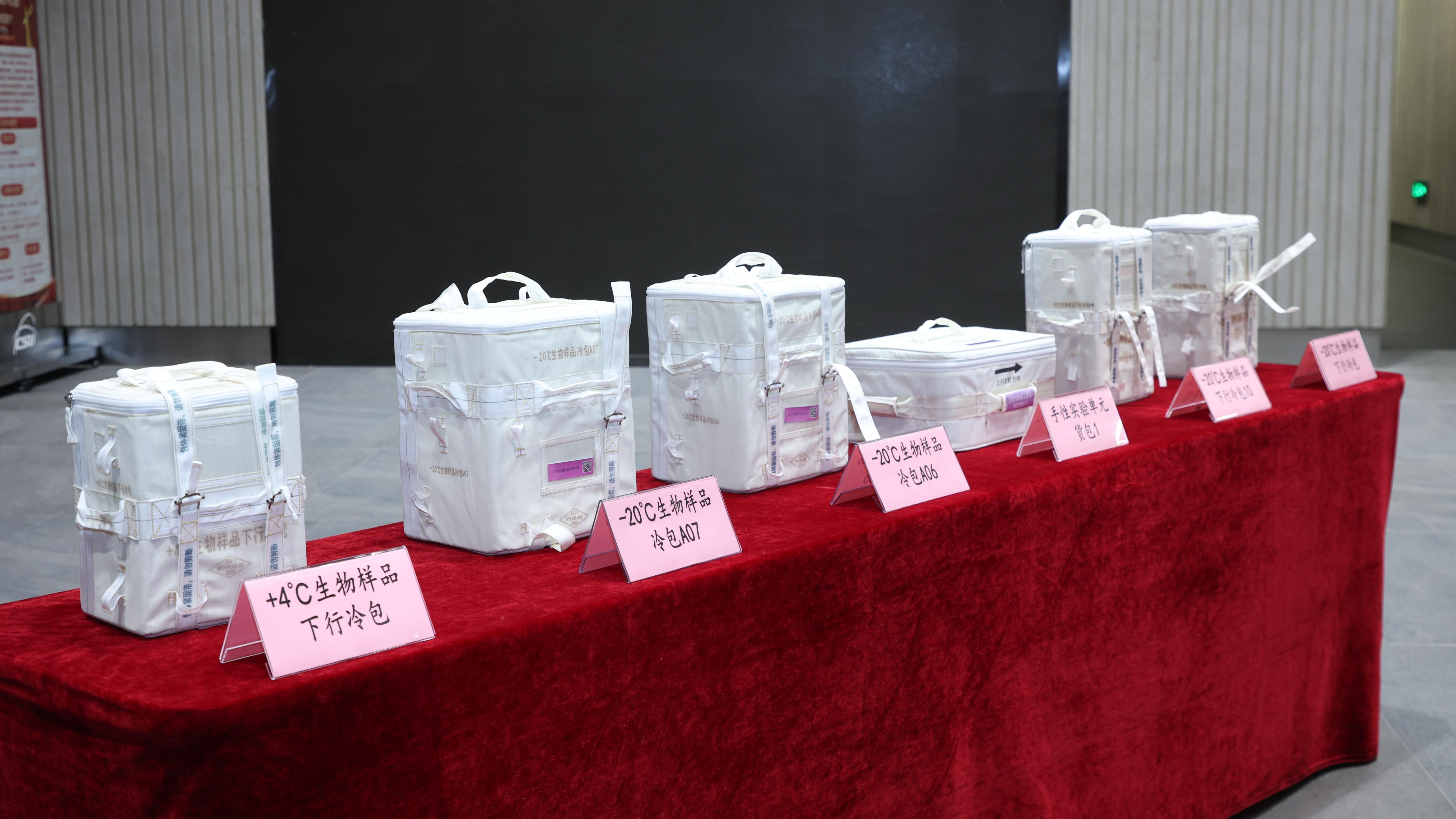
Scientific experiment samples from China's space station. (Photo: CMG)
Scientific experiment samples from China's space station made the journey to Earth on Friday aboard the Shenzhou-22 spacecraft.
The batch includes samples from 23 space science experiments. The payload weighs approximately 41 kilograms and consists of nine life science samples, 12 materials science samples and two combustion experiment samples.
Life science samples, including artificial embryos and brain organoids, have been transferred to the Space Utilization Engineering and Technology Center, an institute under the Chinese Academy of Sciences. Inspections confirmed the samples were in good condition, and researchers have begun preparing for detailed analysis.
Scientists plan to study how space affects the development of human artificial embryos and stem cell behavior. Researchers will use transcriptome sequencing, proteomics and other biological tests to reveal how microgravity influences embryonic development at the molecular level.
They will also examine how microgravity affects lab-grown 3D tissues like kidney organoids and evaluate whether specific gene knockouts can suppress kidney fibrosis, an excessive accumulation of scar tissue, under spaceflight conditions.
Materials science samples from the space station, which will be studied to design better spacecraft, consumer and industrial parts, include new titanium alloys, high-strength and high-toughness steel, and relaxor ferroelectric single crystals. Scientists will analyze the samples' microstructures, chemical compositions and distribution characteristics to understand how gravity influences material growth, element segregation, solidification defects and overall performance.
The findings could help develop advanced alloys, next-generation structural steels and other materials for applications in aerospace engineering, high-end manufacturing, precision sensing technologies and medical ultrasound imaging.
The combustion experiment samples, including burners, soot collection plates and collection covers, will also be examined with a fine-toothed comb. Researchers will study flame-synthesized semiconductor nanomaterials, soot samples and the formation characteristics of carbon nanoparticles in microgravity.
Results could support extraterrestrial nanomaterial production, the development of new energy systems, and space fire prevention technologies.
Part of the space station lab cargo was transported from the landing site to Beijing on Saturday and was handed over to scientists for follow-up studies. The remaining materials science and combustion experiment samples are expected to arrive in the Chinese capital later aboard the Shenzhou-22 return capsule.