


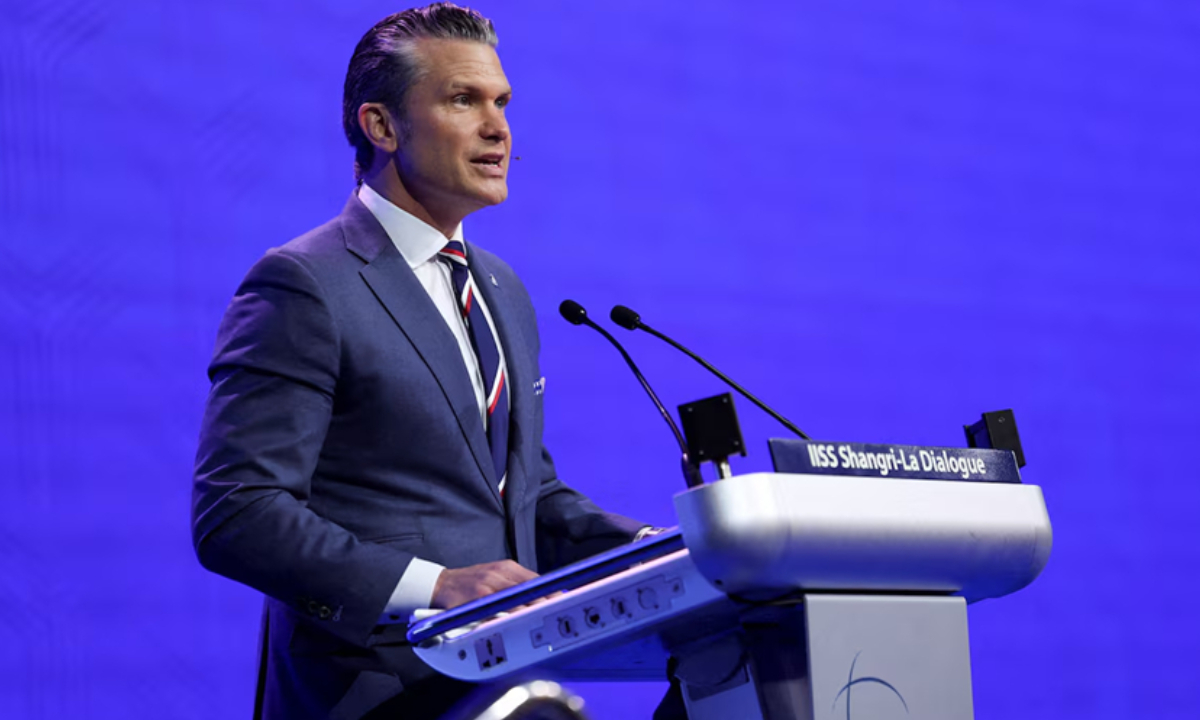
US Secretary of Defense Pete Hegseth speaks at the Shangri-La Dialogue in Singapore, on May 30, 2026. (Photo: screenshot)
Speaking at the Shangri-La Dialogue in Singapore on Saturday, US defence secretary struck a relatively balanced tone in his address, first acknowledging some progress in China-US ties before expressing the usual Western rhetorics over China’s military strength. Analysts note that Hegseth’s speech contained a relatively higher degree of positive remarks on the bilateral ties compared with previous years. However, these remarks were still accompanied by persistent stereotypes and flawed assumptions about China’s strategic intentions.
In his speech, the part addressing China began with the observation that relations between the two countries are better than they have been in many years. He said the current US administration is seeking a stable peace, fair trade, and respectful relations with China. “It's not a coincidence, but this has happened. Strong, quiet, but clear is the right recipe for stability,” Hegseth said.
During his speech, Hegseth touched upon the bilateral summit in Beijing earlier this month, saying the two countries agreed to build a constructive relationship of strategic stability.
Zhou Bo, a senior fellow of the Centre for International Security and Strategy at Tsinghua University and a frequent attendee of the Shangri-La Dialogue, shared his impression with the Global Times at the forum in Singapore. He found Hegseth’s tone was milder than last year’s. This is closely related to the recent summit between the two heads of state, he said.
Hegseth specifically referenced the “constructive relationship of strategic stability” in his speech – a framework established through the Beijing summit between the heads of state of the two countries. This highlights the importance the US attaches to this new concept proposed by China, Wang Dong, executive director of the Institute for Global Cooperation and Understanding at Peking University, told the Global Times.
Experts attending the forum noted a notable difference from previous years. This year, Hegseth did not specifically mention the Taiwan question or affairs related to the South China Sea in his speech. And following Hegseth’s address, Global Times reporters observed that journalists from multiple countries were eagerly contacting Chinese experts in search of their views and reactions.
When responding to a question from a Chinese Military Academy expert, Hegseth emphasized that mutual respect and communication between China and the US are of great importance to maintaining peace in the region and the world at large.
Hegseth said, he believes both sides respect each other, have a clear understanding of each other’s capabilities and strengths, and recognize how China and the US can most effectively cooperate in today’s world.
Nevertheless, observers noticed his remarks still featured familiar stereotypes and misguided prejudices about China.
"There is rightful alarm regarding China's historic military buildup and the expansion of its military activities in the region and beyond," Hegseth claimed.
"A Pacific dominated by any hegemon would unravel the regional balance of power," he said. "No state, including China, can impose hegemony and hold the security of our nation and our allies in question."
Zhang Junshe, a Chinese military affairs expert, told the Global Times on Saturday that a Cold War mindset in Washington continues to linger. Hegseth’s remarks show that the US is, under the guise of so-called “concern,” rallying countries in the region, positioning the US a so-called “protector” while advancing its containment strategy against China.
Zhang added that in the Asia-Pacific region, China has consistently advocated that all disputes – including maritime ones – should be resolved peacefully through bilateral consultations and negotiations. The long-term stability in the region demonstrates that Asia-Pacific countries possess the wisdom to preserve peace and stability, Zhang said.