


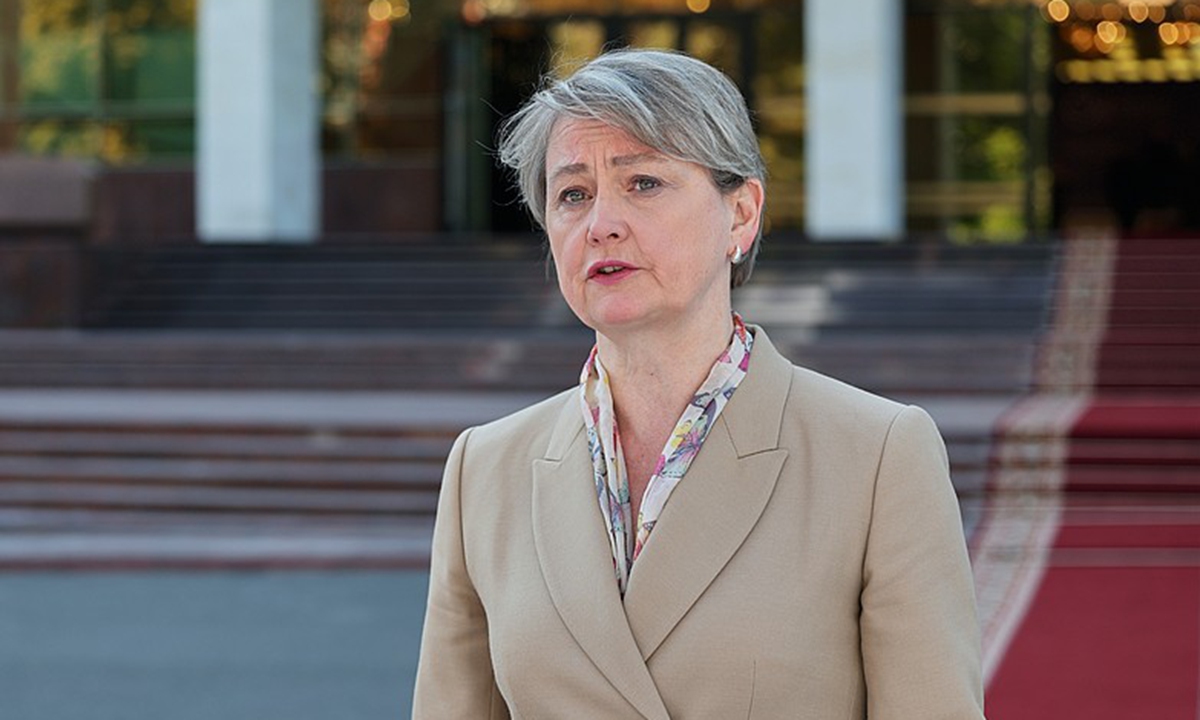
British Foreign Secretary Yvette Cooper. (Photo: VCG)
At the invitation of Member of the Political Bureau of the CPC Central Committee and Minister of Foreign Affairs Wang Yi, UK Foreign Secretary Yvette Cooper will visit China from June 1 to 3 and hold the 11th China-UK Strategic Dialogue, Chinese Foreign Ministry announced on Sunday. A Chinese expert noted that the trip reflects the UK's desire to maintain communication channels with major powers such as China amid mounting global uncertainties, while advancing the outcomes of UK Prime Minister Keir Starmer's earlier China visit.
Cooper is scheduled to meet Chinese officials in Beijing before traveling to the southern technology hub of Shenzhen on June 3 for a science and technology-focused program, Reuters reported on Saturday, citing the UK government.
According to Reuters, after visiting China, Cooper will then travel on to India, and discussions during the two trips are expected to focus on a range of global issues, including the Strait of Hormuz, the Russia-Ukraine conflict and the recent Ebola outbreak.
When asked about reports of Cooper's planned trip at a May 15 press conference, Chinese Foreign Ministry spokesperson Guo Jiakun said he had nothing to share at the moment, but he noted that both China and the UK are permanent members of the UN Security Council and major economies in the world. To develop a sustained and steady China-UK comprehensive strategic partnership is an important common understanding reached between the leaders of the two countries.
"China stands ready to maintain close exchanges and dialogue with the UK side and jointly work for continued development in our friendly exchanges and mutually beneficial cooperation," Guo said.
Cooper's visit to China comes just five months after UK Prime Minister Keir Starmer visited the country as his Labour Party attempted to rebuild Britain's partnership with Beijing after years of frostier relations under the Conservatives, according to German media DPA.
Feng Zhongping, director of the Institute of European Studies at the Chinese Academy of Social Sciences, told the Global Times on Sunday that he believes the trip reflects UK's desire to maintain communication channels with major powers such as China amid mounting global uncertainties. More practically, the visit is expected to focus on following through on and advancing the outcomes of Starmer's visit to China earlier this year.
"The visit is consistent with Starmer's government's more pragmatic approach toward China and the inclusion of Shenzhen, China's tech hub, in the itinerary suggests there may be discussions on further science and technology cooperation," Feng said.
According to Reuters, Cooper's travel to China comes at a time of heightened geopolitical tensions, soaring oil prices following the US-Israeli war on Iran, and as Britain struggles with sluggish economic growth.
Against this backdrop, Cooper's visit to China and the pursuit of pragmatic dialogue are conducive to enhancing policy coordination on international issues between China and the UK, both permanent members of the UN Security Council and major global economies, and are expected to advance deeper practical cooperation across a range of bilateral fields, especially in economic and trade cooperation, Feng said.
During his January visit to China, Starmer said he wanted a "more sophisticated" relationship and announced economic agreements to make it easier for British businesses to "grow their footprints in China," according to the Guardian.
"Although it remains cautious, particularly in areas involving new energy and advanced technologies, Britain clearly recognizes that China is an important partner in a multipolar world and a country with which it needs to engage economically," Feng noted.
According to SCMP, flight routes between Europe and China were crowded with political heavyweights including prime ministers, presidents and ministers, giving the impression of a continent pivoting eastward.
A flurry of visits that began late last year has seen political figures from European countries such as Spain, France, Britain, Ireland, Finland, and Germany visit Beijing.
Despite lingering reservations among some European countries, they have increasingly sought cooperation with China, recognizing the practical need for engagement, Feng said.