


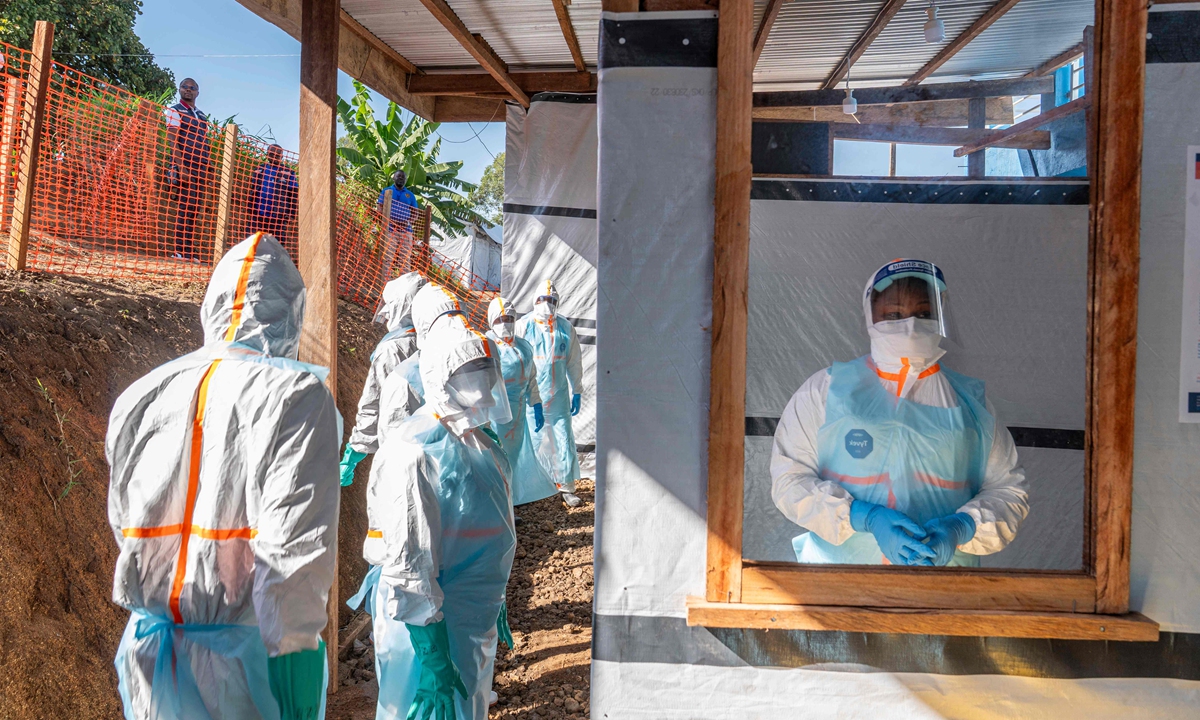
Health workers stand in a new Ebola treatment center during a visit of Tedros Adhanom Ghebreyesus, Director-General of the World Health Organization (WHO), in Bunia, in the northeastern Democratic Republic of the Congo, on May 31, 2026. (Photo: VCG)
Following a dramatic surge in Ebola cases in the Democratic Republic of the Congo (DRC) and the World Health Organization (WHO) update on epidemic situation and advisory, Chinese expert reassured the public that the risk for the virus to spread in China remains minimal and manageable.
In response to an inquiry from the Global Times on Sunday over the epidemic, the WHO attached a news link providing the latest updates on the outbreak in an email, which stated the Bundibugyo virus disease (BVD) outbreak in the Democratic Republic of the Congo and Uganda continues to evolve rapidly, with increasing case numbers, geographic spread, and ongoing cross-border transmission.
According to an article published by the Financial Times on Sunday and written by Jean Kaseya, director-general of the Africa Centres for Disease Control and Prevention, "As of May 30, the DR Congo and Uganda had reported 263 confirmed cases, with 43 confirmed deaths — with more than 1,100 suspected cases still being investigated. We must move at the speed of the epidemic."
The WHO update also said that "there is one confirmed case, an individual from the United States of America, who had treated patients in the Democratic Republic of the Congo and is currently receiving care in Germany."
On Saturday, WHO director-general Tedros Adhanom Ghebreyesus arrived in Bunia, the capital of the DRC's hard-hit Ituri province, to assess the situation firsthand, according to media reports.
Compounding the crisis is the nature of the pathogen. This particular outbreak is caused by the Bundibugyo virus, a rare and severe strain of Ebola for which there is currently no approved vaccine or definitive treatment, Al Jazeera said.
In response to the emergency, the WHO recommended prioritizing three experimental treatments for the Bundibugyo strain of Ebola, including Mapp Biopharmaceutical's MBP134, Regeneron's (REGN.O), maftivimab and Gilead Sciences' (GILD.O), antiviral remdesivir, Reuters reported.
The WHO said on Thursday the drugs and other candidate vaccines should be evaluated in clinical trials to generate data on their use. The agency and outside experts have been working to identify several candidates, the Reuters report said.
Despite the alarming spike in numbers in the DRC, a Chinese medical expert emphasized that the threat level to the Chinese public is quite low.
"This current wave of Ebola is a re-emergence of the Bundibugyo virus from years ago," Tao Lina, a Shanghai-based vaccine expert, told the Global Times. "It still spreads primarily through direct contact with bodily fluids, and there is no evidence of airborne transmission."
Tao believes even if imported cases make it into China, the situation is controllable, and there is no need for the public to worry.
The Chinese Center for Disease Control and Prevention had issued a notice on the prevention and control of Ebola virus disease. A search of the China CDC's official database by the Global Times confirmed that there are currently zero reports of Ebola infections within China.
To ensure domestic safety, Chinese authorities have already put multi-layered preventative measures into action.
China CDC reminded people returning from epidemic-affected countries and regions to undergo 21 days of health monitoring and see a doctor in cases of fever, headache, vomiting, diarrhea or unexplained bleeding. Medical institutions, if receive patients with such symptoms, shall ask their travel history and report to hospital's public health department and the CDC.
Previously, China's Ministry of Foreign Affairs and the Chinese Embassy in the Democratic Republic of the Congo said Chinese citizens should be cautious when traveling to the DRC in the near future and avoid traveling unless when it's necessary.
Commenting on the WHO's push for clinical trials of vaccines, Tao noted that "Mass public vaccination is unlikely to be necessary. Instead, a targeted approach will be used, prioritizing only high-risk groups. This includes public health personnel managing the outbreak response, medical staff treating infected patients, and individuals traveling to or working in high-risk zones."