


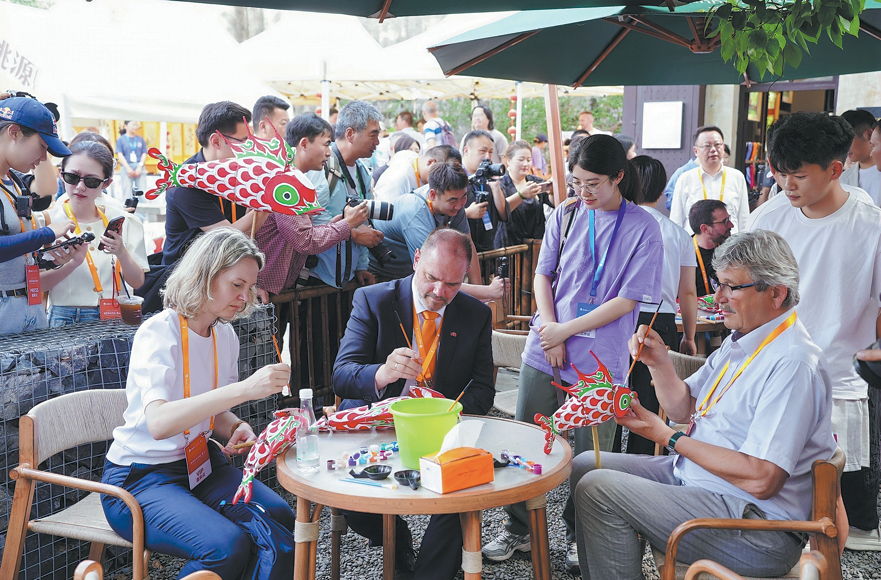
Officials from Stralsund, Germany, experience painting traditional Huizhou fish lanterns on the sidelines of the Global Mayors Dialogue in Huangshan, Anhui province, on Friday. (Photo: CHINA DAILY)
Heritage cities should embrace long-term prosperity rather than fleeting popularity, and take rigorous heritage protection as the cornerstone of sustainable urban development, said city leaders attending the Global Mayors Dialogue in Huangshan, Anhui province, which concluded on Sunday.
"In the protection and utilization of cultural heritage, pursuing only short-term development gains may bring quick economic returns. However, once the authenticity of heritage is damaged, heritage conservation will lose sustainability," said He Yi, mayor of Huangshan.
Themed "Mutual Learning among Civilizations, Epitomized by Cultural Heritage", the dialogue, which opened in the city on Friday night, brought together mayors and representatives from 10 countries and focused on sustaining urban cultural heritage and practicing smart governance, as well as empowering urban sustainable development through technological innovation.
The Huangshan mayor recognized that all heritage cities are seemingly trapped in a common dilemma: "To better protect cultural heritage, cities have to invest substantial resources and may have to abandon some highly profitable development projects in the short term.
"We cannot seal cultural heritage under a glass cover. Instead, we must let historical architecture and cultural spaces actively integrate into modern life. Only when protectors become beneficiaries can heritage preservation endure steadily," said He.
Huangshan boasts five world-class intangible cultural heritages and 24 national-level ones, with more than 1,800 professional inheritors.
With about 1.3 million residents, the city receives 100 million tourists annually, according to He, whose counterparts in the dialogue were from nine foreign countries.
Initiative released
In addition, the Huangshan Initiative was released at Friday's event. It proposes four global consensuses: adhere to heritage protection to consolidate civilization foundations, deepen cultural exchanges to promote cultural symbiosis, strengthen technological empowerment to advance urban governance and improve cooperation mechanisms to undertake common responsibilities.
Before and after the dialogue, officials toured Huangshan and continued their communication and interaction.
Jelena Medakovic, the secretary of culture of Belgrade, the capital of Serbia, said: "What impresses me most is the perfect duality of Huangshan's development — firm heritage protection on one hand, and bold technological innovation on the other."
Andrea Crescentini, mayor of Serravalle, San Marino, emphasized that all urban innovation must be based on the protection of historical and artistic heritage.
Dhana Raj Acharya, mayor of Pokhara, Nepal, said, "We must ensure that technology serves cultural inheritance rather than weakens it," adding that modern technology is a double-edged sword.
Gradara, a small city in Italy with only 5,000 residents, which receives over 500,000 tourists annually, has also been facing enormous pressure on urban development and cultural sustainability, according to Filippo Gaspari, the city's mayor.
"Tourism should serve and empower local communities rather than replace them. It should create jobs, polish local craftsmanship and support sustainable heritage maintenance," he said.
Gaspari added that public participation and refined management are the key. "Activating the initiative of locals is the core for heritage protection and sustainable urban development."
Alexander Badrow, mayor of Stralsund, Germany, said that future urban development hinges on three core priorities: full ecological protection, diversified cultural heritage preservation and technological innovation to improve people's livelihoods.
For Badrow, autonomous driving will be a practical solution for historic old towns. "This innovative technology will completely reshape urban traffic patterns and solve the long-standing parking and travel problems in historic old towns," he said.
Dian Lakshmi Pratiwi, head of the culture office of the Yogyakarta special region in Indonesia, shared Yogyakarta's challenges in heritage governance and praised Huangshan's advanced models in cultural inheritance and modern governance.
"Heritage is the core identity of a city. If people cannot perceive the connotation behind heritage sites, these precious cultural treasures will gradually fade away," she said, adding that living heritage cities face rigorous tests.
"We are confronted with multiple pressures, including urban development coordination, high-risk disaster management, transportation optimization and residential settlement improvement," said Pratiwi.
Timea Sotakowa, vice-mayor of Michalovce, Slovakia, said that cultural heritage can never survive without the recognition and participation of local residents.
Sotakowa said she believes that protecting heritage does not mean freezing history. "The key to inheriting historic cities is to transform ancient monuments into vibrant spaces for people to live, work and create," she said.