


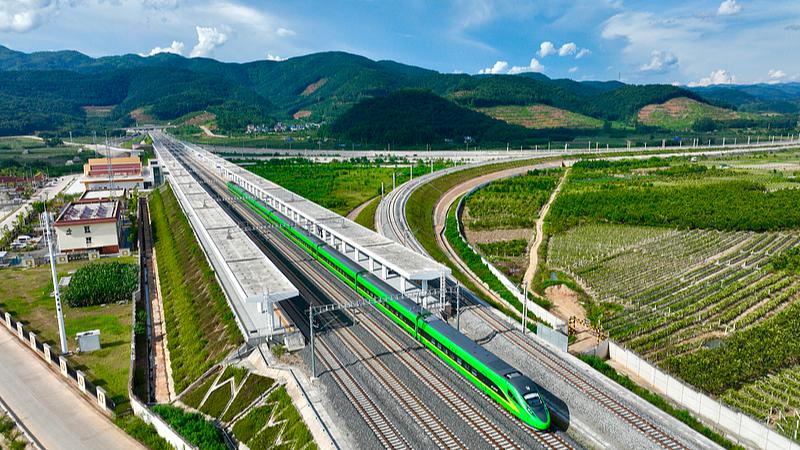
File photo of a bullet train running past the Wild Elephant Valley Station on the China-Laos Railway in Laos. (Photo: VCG)
When a refrigerated freight train packed with fresh durians and mangosteens arrived at the Chinese rail station of Mohan after journeying from the Lao border town of Boten on May 25, it marked a notable economic milestone.
The arrival officially pushed the volume of cross-border fruits transported via the China-Laos Railway since the start of the year past the 100,000-tonne mark, hitting 107,900 tonnes, in a sharp year-on-year increase of 30%.
Inaugurated in December 2021, the railway connecting Kunming in southwest China's Yunnan Province with Laos' capital Vientiane has become a powerful engine for bilateral trade, practical cooperation and cross-border tourism.
Thriving trade
The launch of the China-Laos Railway has established a stable, efficient cross-border logistics corridor between Kunming and Vientiane, cutting transit times from three to seven days to just one or two days.
According to a World Bank report, the route has slashed shipping costs between the two countries by 40% to 50% and reduced domestic logistics expenses within Laos by 20% to 40%.
Thanks to this rail link, Southeast Asia's seasonal fruits and local specialties including durians, mangosteens and beer can now be shipped rapidly to China and Europe. Meanwhile, China's new energy vehicles, lithium batteries and photovoltaic products – collectively known as the high-tech, green "new three major products" – are gaining faster access to Southeast Asian markets.
As of April 7, 2026, the variety of goods transported via the railway has expanded from over 500 categories at launch to more than 3,800. It now serves over 6,000 Chinese enterprises and covers 19 countries and regions, including Laos and Thailand.
A flagship project aligning the China-proposed Belt and Road Initiative with Laos' strategy to transform from a land-locked nation into a land-linked hub, the China-Laos Railway has grown into a major transport artery connecting China and Southeast Asia.
Data from the China Council for the Promotion of International Trade shows that in the first quarter of 2026, the railway's total import and export volume reached 6.81 billion yuan (about $1 billion), surging 62.7% year on year and setting a new record for the same period.
Speaking at a storytelling event celebrating the China-Laos Railway in April, Lao official Somsavath Phongsa noted that the railway has fueled rapid growth in bilateral trade and freight flows.
It has created numerous jobs and delivered unprecedented travel convenience for the Lao people, he added, hailing it as a "golden route" that brings tangible benefits to communities on both sides of the border.
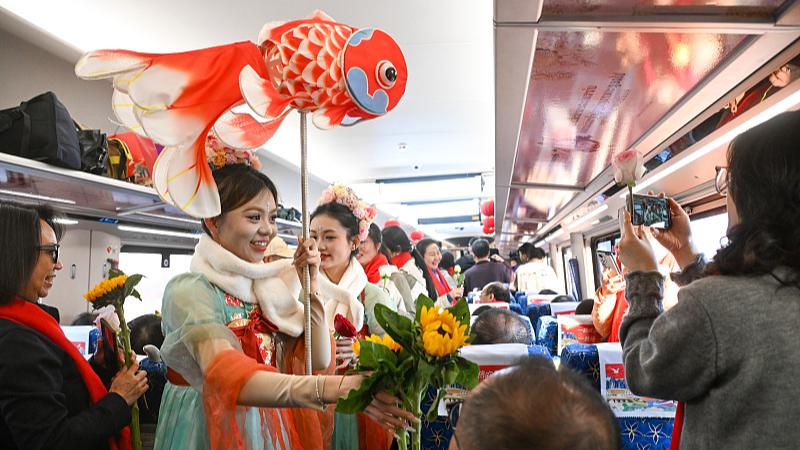
Workers greet passengers with flowers and blessings aboard a train running on the China-Laos Railway as part of celebrations ahead of the Spring Festival, February 4, 2026. (Photo: VCG)
Connecting hearts
Beyond cargo transport, the railway has forged a strong bond between the two peoples.
Tourism is among the sectors transformed most visibly. Linking popular destinations such as Kunming, Xishuangbanna, Luang Prabang and Vientiane, it has spawned a new travel trend: touring Laos and China's Yunnan Province by bullet train. In 2025, the railway carried around 19.51 million passengers in total, including 282,000 cross-border travelers.
In the first quarter of 2026, cross-border passenger trips stood at 112,000, a year-on-year rise of nearly 33%. The growth has driven consumption up by over 35% at scenic spots, hotels, restaurants and other related businesses along the line.
Currently, four international passenger trains run daily between Kunming and Vientiane. The number of seats for international services has risen from an 250 in the beginning to 420 now. Customs clearance at railway ports has also been shortened to roughly 50 minutes, greatly improving the efficiency and experience of cross-border travel.
Addressing the same April event, Chinese Ambassador to Laos Fang Hong praised the railway as a landmark model of high-quality Belt and Road cooperation. She noted it has undergone steady progress: evolving from basic connectivity to seamless transit, then to accelerated development, and finally into a thriving comprehensive corridor.
Fang added that the event shared touching stories of how the railway has deepened bilateral ties, promoted cultural exchanges and brought people closer. She stressed that this "golden corridor" has truly become a path toward development, happiness and friendship for people of both countries.