


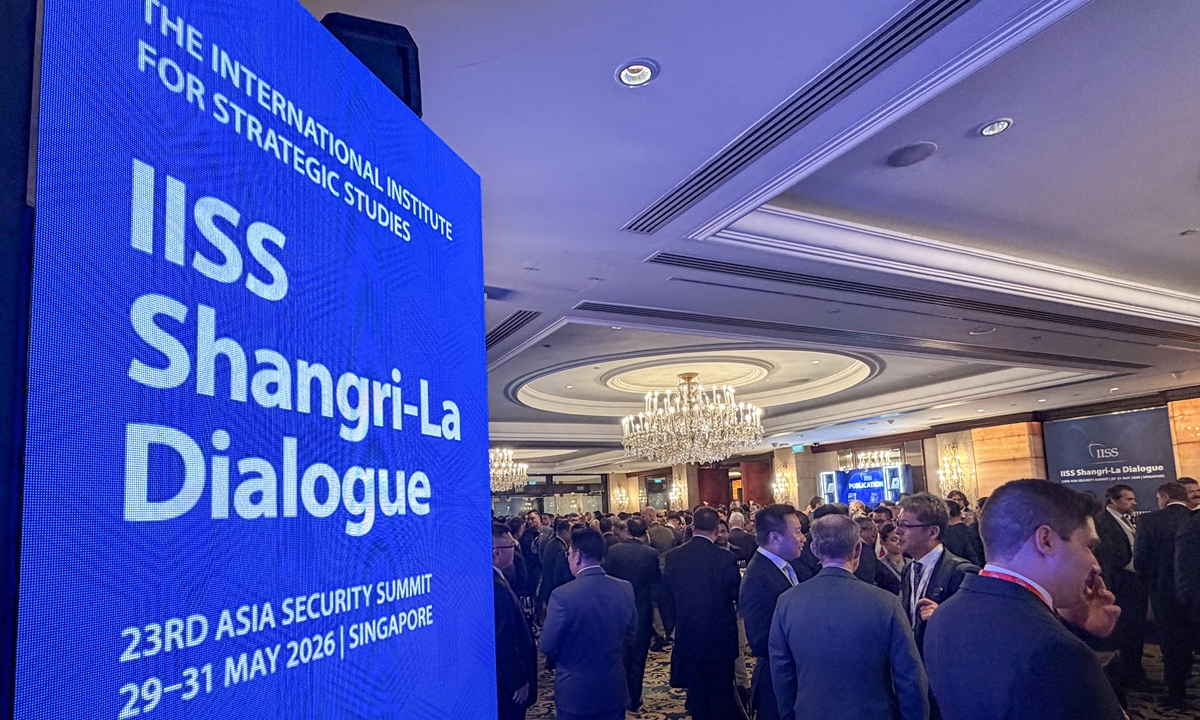
Participants attend the 23rd Shangri-La Dialogue in Singapore on May 29, 2026. (Photo: Su Yaxuan/GT)
On Saturday, the lobby of Singapore's Shangri-La Hotel buzzed with media conducting interviews and live streaming.
Earlier, US Secretary of Defense Pete Hegseth had just finished his speech, and for many regulars of the annual Shangri-La Dialogue, the moment he stepped down from the podium marked the conclusion of the main session. Though the event spanned three days, Hegseth's speech was undoubtedly among the most watched.
This was not what the organizer, the UK-based International Institute for Strategic Studies, had envisioned. They had scheduled another key speech on Sunday. The plenary session theme was supposed to focus on "China's partnerships in the Indo-Pacific," with China's defense minister as the speaker. Since he did not attend the dialogue, the plan was disrupted.
Da Wei, director of the Center for International Security and Strategy at Tsinghua University, told the Global Times that the organizer had hoped both US and Chinese defense ministers would attend. He noted that China and the US are the key players in the dialogue, and interest in China continues to grow. Da first attended the dialogue in 2010, when the forum was still regional, and China had not yet risen to the center of the global stage. Now, however, the topics are highly focused on China and the US. Given China's rising prominence, the Chinese delegation's participation each year is closely scrutinized, and often hyped, by foreign media.
This year, China was represented by officials from the Chinese People's Liberation Army research institutes and the navy, led by Major General Meng Xiangqing, a professor at the National Defense University. Foreign outlets like Singapore's Lianhe Zaobao reported that this was China's lowest-level delegation since 2007. Such claims of "downgrades" have recurred multiple times in the past.
"China dispatching whatever kind of delegation is normal," Yang Yujun, former spokesperson of the Chinese Defense Ministry, told the Global Times. "The event itself is a 'track 1.5' dialogue involving both officials and scholars. Whether China sends high-level delegations or expert groups, it aligns with the forum's requirements."
Traditionally, the keynote speaker at the first plenary session of the Shangri-La Dialogue has been the US secretary of defense. This year marked Hegseth's second appearance at the Shangri-La Dialogue, and it is notable that the US, a "regular guest" of the dialogue, strikes a different tone this year.
Despite the absence of scheduled interaction with the Chinese side on this year's agenda, attention remained focused on how Hegseth would address China in his speech. As many observers had anticipated, his remarks were moderate and positive about the development of China-US relations.
This marked the most positive tone a US defense secretary has taken toward China at the Shangri-La Dialogue since Global Times reporters began covering the event on-site in 2015. One foreign journalist joked, "the smell of gunpowder between China and the US is gone, and that has slowed down our work pace."
Ei Sun Oh, a senior fellow at the Singapore Institute of International Affairs, noted that China and the US are cooperating while competing, and this is welcomed by all parties, especially ASEAN countries, which will not be forced to take sides or fall into a difficult dilemma.
At the same time, however, improved China-US relations do not make every country happy. For countries such as Japan and the Philippines, it is not necessarily good news. Even the tone adopted by their military leaders during speeches at the forum appeared to be influenced by Washington's position. As analysts had predicted, Japanese Minister of Defense Shinjiro Koizumi avoided directly naming China in his address on Sunday and instead sought to defend Japan against accusations of "neo-militarism."
"As a US ally, Tokyo takes its cues from Washington on many issues," Zhou Bo, a senior fellow of the Center for International Security and Strategy at Tsinghua University, told the Global Times at the venue. Unlike Japan, Philippine Defense Secretary Gilberto Teodoro launched a full-scale attack on China during his lengthy speech, apparently attempting to use the Shangri-La Dialogue as a platform to change the situation of what is portrayed by Manila as "being intimidated by China."
"No one really cares about what the Philippines has said," Zhou said. It is clear that Teodoro's restlessness was also linked to the position taken by the US defense secretary. Zhou believed that the improvement in China-US relations, coupled with Washington's push for allies to increase defense spending and shoulder greater security responsibilities, has unsettled the Philippines, which had been banking on the US taking a tough stance against China.