


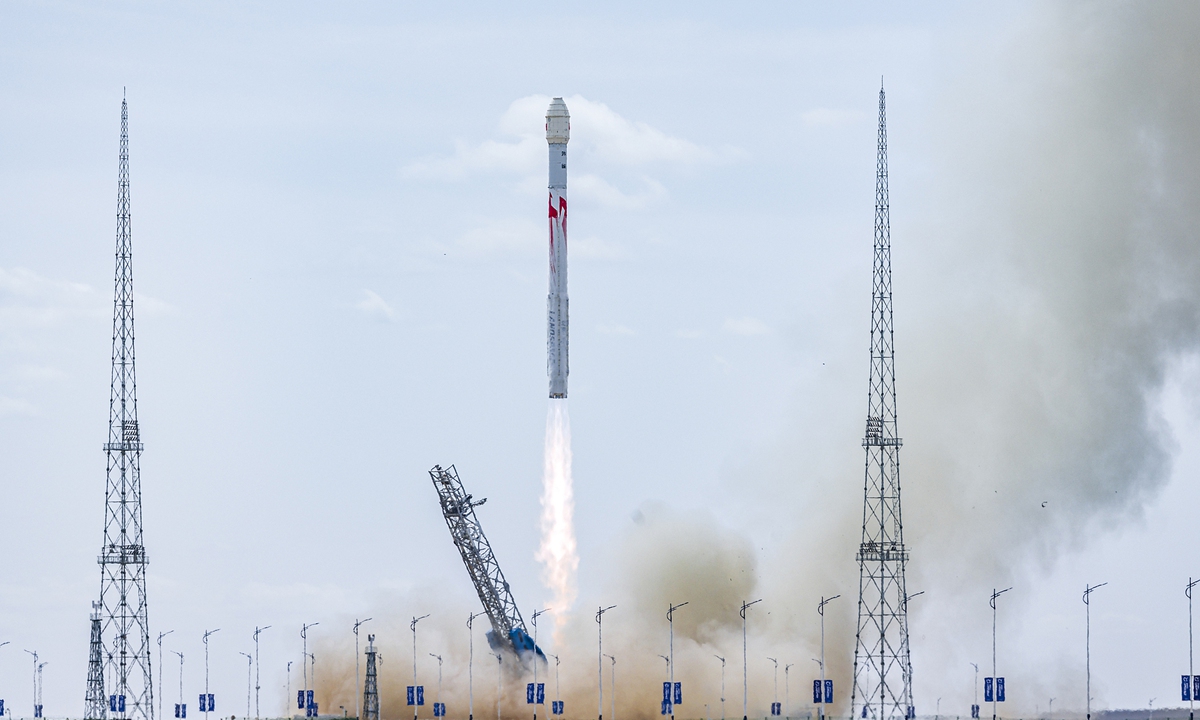
China successfully launches a Zhuque-2E Y5 carrier rocket into space from the Dongfeng commercial space innovation pilot zone in Jiuquan, Northwest China's Gansu Province on May 14, 2026. (Photo: VCG)
On an October morning last year, at the Jiuquan Satellite Launch Center in Northwest China, the roar of rocket engines and blazing exhaust trails pierced the sky as the "Beibu Gulf No.1" satellite soared into orbit. Moments later, when mission control confirmed the satellite had successfully entered its designated orbit, applause erupted in a conference room of Fangchenggang City Investment Development Group Co in South China's Guangxi Zhuang Autonomous Region.
The "Beibu Gulf No.1" satellite is owned by the company and carries its independent intellectual property rights. The satellite was developed under the overall management of AIRSAT Technology Group. Its remote-sensing capabilities provide Fangchenggang city with autonomous access to high-resolution synthetic aperture radar (SAR) imagery on a weekly basis and support monthly coverage of Guangxi and the broader Beibu Gulf region.
This momentous launch also symbolizes the rise of the aerospace industry in Fangchenggang. Located on Guangxi's southwestern coast, the city's low-latitude coastal position offers distinct natural advantages for developing a commercial aerospace sector, allowing it to ride the strong boom of China's overall commercial space market.
Industry observers noted that, driven by policy support, technological innovation and capital investment, China's commercial aerospace sector is entering a period of rapid growth, and Chinese coastal cities like Fangchenggang are increasingly leveraging their low-latitude advantages and transportation connectivity to develop commercial aerospace industrial clusters.
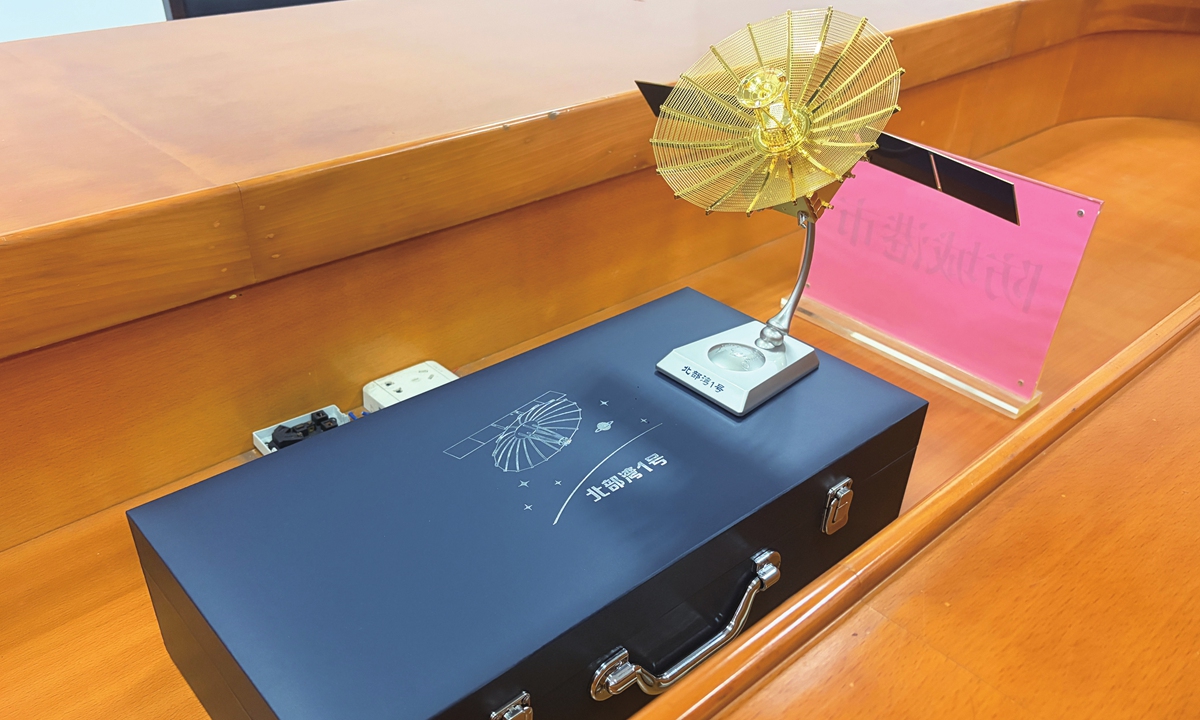
A model of "Beibu Gulf No.1" satellite is displayed at the Fangchenggang Science and Technology Bureau on May 19, 2026. (Photo: Tao Mingyang/GT)
The Global Times recently visited AIRSAT's headquarters in Fangchenggang. The exhibition hall featured models of various aerospace equipment, but the standout attraction was the large screen in the mission control room, which displayed the real-time orbital position of "Beibu Gulf No.1." Launched in October 2025, the satellite has now been operating steadily in orbit for over 240 days.
The satellite can monitor marine environments by collecting sea surface temperature, ocean current and sea-condition data. Satellite imagery can also be used to analyze factors such as dissolved oxygen levels and other ecological conditions critical to fish habitats, enabling fish-stock forecasting and providing guidance for fishing operations, according to Dong Weidong, chief designer of satellite models at AIRSAT.
Dong said the company plans to launch an additional two to three satellites to establish the full AIRSAT constellation, significantly improving observation precision and upgrading services from "three-day-old data" to near real-time monitoring.
The company's orbital resources are primarily focused on serving Southwest China and ASEAN markets. It has already launched projects including palm plantation growth-cycle monitoring for Indonesian clients and data-service operations for Malaysian clients, while clients in Vietnam have also expressed demand for remote-sensing services.
AIRSAT is part of Fangchenggang's growing commercial aerospace industry. Due to its geographic location, the city enjoys more than 300 suitable launch days annually and possesses extensive maritime areas capable of supporting emerging commercial aerospace activities such as sea-based launches and rocket recovery, the Global Times learned.
Qi Tuoye, an official from the Fangchenggang Science and Technology Bureau, told the Global Times that the city serves as a frontline gateway for China's opening-up and cooperation with ASEAN, providing efficient access to both domestic and international markets and resources. This strategic position can help aerospace companies rapidly expand into ASEAN markets and other countries participating in the Belt and Road Initiative, Qi said.
Qi said the city has planned a 1,200-mu (80 hectares) commercial aerospace industrial park to attract upstream and downstream satellite and rocket manufacturing projects. Long-term plans also include the development of a commercial aerospace launch port, while the city has already secured and fulfilled commercial orders involving the export of complete satellites to Malaysia.
Broader trendChina's total number of space launches is expected to exceed 100 in 2026, including more than 60 commercial launches, with private rocket companies undertaking over 30 missions, according to a report by the Securities Times. Industry analysts said that as launch demand continues to rise, expanding beyond China's existing launch sites and developing new launch locations will become an important direction for future industry growth.
Wang Ya'nan, editor-in-chief of Beijing-based Aerospace Knowledge magazine, told the Global Times that transportation infrastructure and safety conditions are key factors for regions seeking to develop commercial aerospace industries, which can be met by China's coastal cities.
On May 28, an aerospace industry cluster, the Aerospace Town, in Guangzhou, South China's Guangdong Province, inaugurated its ground-breaking ceremony. It marked another major industrial layout in the Guangdong-Hong Kong-Macao Greater Bay Area and highlighted China's accelerating push toward large-scale development of the commercial aerospace industry, according to Guangzhou Daily.
The project carries a total planned investment of 5 billion yuan ($696 million) and will focus on reusable space transportation systems, satellite manufacturing and related applications. Total industrial output value is expected to reach 50 billion yuan. The first phase is scheduled for completion in July next year.
Shanghai has also announced plans to build a full-chain commercial aerospace industrial cluster in Minhang district covering research and development, manufacturing, launch services, operations and applications. According to a January report by Jiefang Daily, the city aims to establish a one-stop production, manufacturing and launch-service system by 2030 with annual capacity of 150 rockets and 500 satellites.
In October 2025, East China's Shandong Province issued a package of measures to accelerate the high-quality development of its commercial aerospace industry. The plan targets the establishment of a relatively complete industrial chain by 2027 with a commercial aerospace industry valued at 50 billion yuan, the Xinhua News Agency reported.
At the national level, China's National Space Administration has set up a commercial space development department to oversee the nation's rapidly growing commercial space industry, a positive move that an expert says will promote healthier, high-quality development and benefit the entire industrial chain.
According to estimates by Soochow Securities, China's commercial aerospace market is expected to expand from 1.2 trillion yuan in 2024 to 4.8 trillion yuan by 2027, with the market size likely exceeding 7.8 trillion yuan by 2030.