


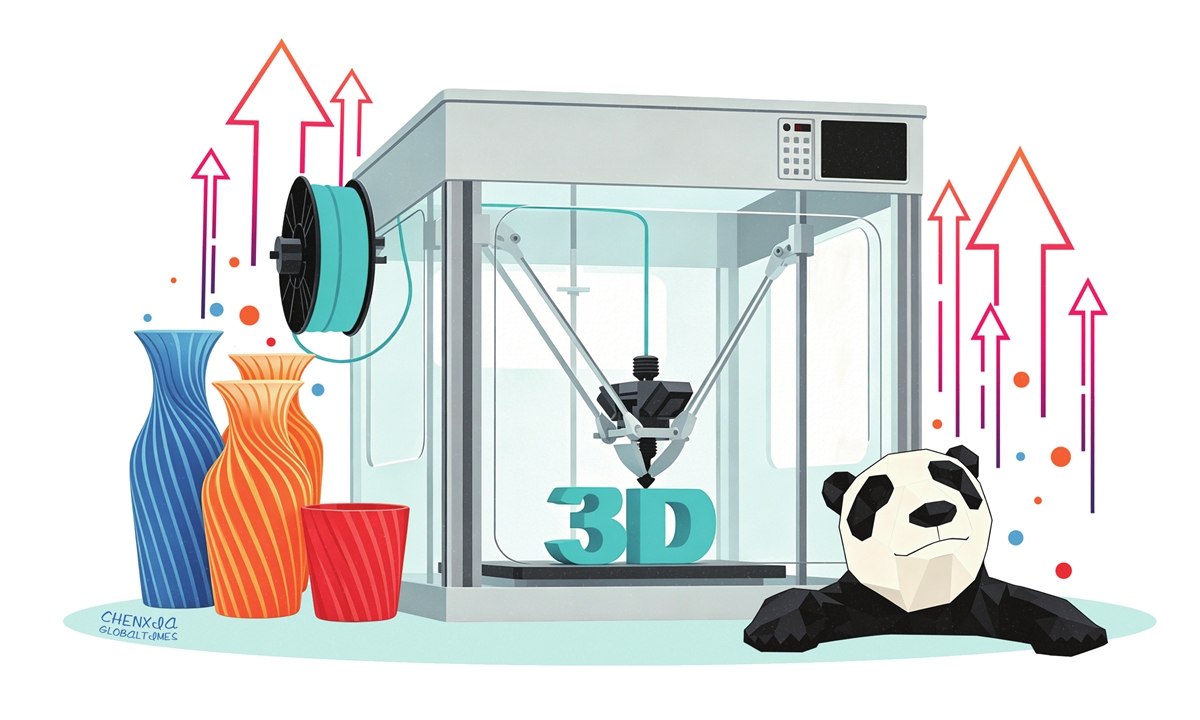
Illustration: Chen Xia/GT
The high performance and cost-effectiveness of 3D printers made in Shenzhen, South China's Guangdong Province, mean that they are gaining global popularity and capturing nearly 90 percent of the world's consumer-grade 3D printer market, CCTV News reported on Tuesday.
What advantages have enabled Shenzhen to become a leading hub for the 3D printing industry? The city's rapid growth in the sector is being driven by its full industrial chain advantages, efficiency advances and technological innovation, enabling its products to gain strong competitiveness in overseas markets.
To lower the entry barrier for the use of 3D printers and improve the consumer experience, many companies in Shenzhen have increased investment in research and development, while integrating cutting-edge technologies such as artificial intelligence, according to CCTV News.
Across the world, the growing trend of home-based do-it-yourself manufacturing is creating substantial incremental demand for consumer 3D printing. Chinese producers have seized on this trend, from industrial production to individual consumption. The strategic significance of this shift goes far beyond exports.
China exported 2.46 million 3D printers in the first four months of this year, valued at 6.106 billion yuan ($903 million), representing year-on-year increases of 100.3 percent and 110.4 percent, according to China's General Administration of Customs.
Beyond this growth, these figures reveal that China's high-end small-scale intelligent manufacturing equipment industry has gained the ability to define product forms and shape application scenarios in the global consumer market. The next phase of Chinese intelligent manufacturing's globalization is being written by these highly sophisticated small devices.
In reality, 3D printers are not a sudden breakout category this year, but rather one of the fastest-growing segments in China's foreign trade in recent years. According to customs data, China exported 5.03 million 3D printers in 2025, a year-on-year increase of 33.2 percent.
Unlike traditional foreign trade, which relies on cost advantages to meet existing demand, the new generation of Chinese intelligent manufacturing products represented by 3D printers relies more on independent innovation and a complete industrial chain. By creating new product categories and cultivating new scenarios, they have generated new demand. China's foreign trade is shifting from "following the market" to "defining the market."
In the past, Chinese companies mainly sold products to the world. Today, a growing number of firms are bringing something broader: new lifestyles, new ways of creation, and new consumption experiences to global markets.
Taking consumer-grade 3D printing as an example, Chinese companies have continuously upgraded their technologies, transforming originally complex industrial equipment into consumer-electronics-like products and significantly lowering the entry barrier. According to market research firm CONTEXT, Chinese manufacturers accounted for 95 percent of global entry-level 3D printer shipments in the first quarter of 2025.
The 3D printers' strong performance in overseas markets reflects a profound transformation in the growth drivers of China's foreign trade. The momentum is shifting from scale and cost advantages toward innovation-driven growth centered on technological innovation, product innovation, and brand building, with the overall structure steadily upgrading toward higher quality development.
This transformation is not confined to any single product. Rather, it is unfolding simultaneously across multiple emerging manufacturing sectors, gradually forming an innovation-oriented export system with scalable growth potential.
From new-energy vehicles to drones, and from robotic vacuum cleaners to 3D printers, more and more Chinese companies are gaining technological discourse power and product definition power in global niche markets.
This positive transformation is not taking place in a stable external environment. Rather, it is unfolding amid rising global trade uncertainty, increasing protectionism, and the accelerating restructuring of global supply chains.
Under such pressure, China's foreign trade sector has not relied simply on traditional growth pathways. Instead, through the continuous emergence of new products and technological applications, it has formed new growth anchors driven by technological and product innovation.
This structurally upgraded resilience is the fundamental source of China's stability and vitality in foreign trade amid a complex external environment, contributing to greater stability in global trade as a whole.