


China speeds up rocket propellant tank production with new technology
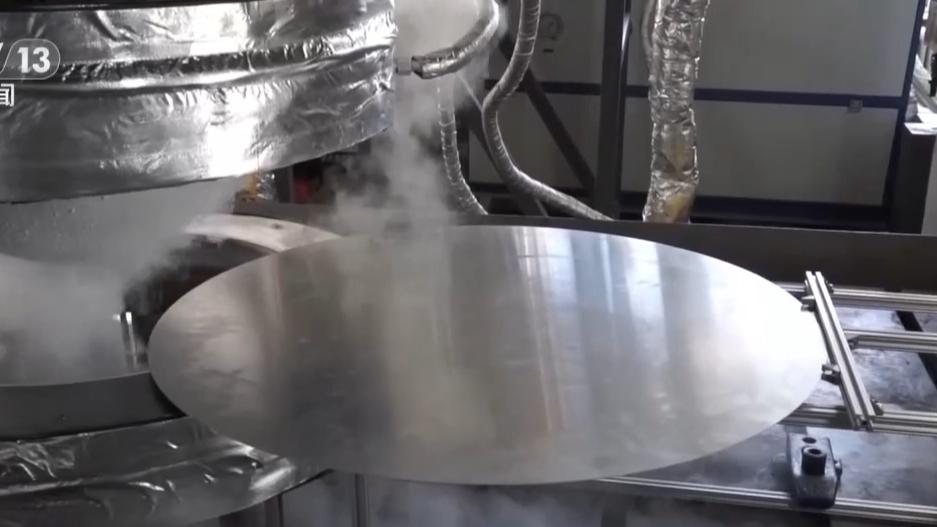
A bottom dome of rocket propellant tanks. (Photo: CMG)
Chinese researchers have achieved mass production of a key rocket component using a domestically developed cryogenic forming technology, significantly shortening manufacturing time and potentially boosting the efficiency of the country's growing commercial space sector.
The breakthrough centers on the bottom dome of rocket propellant tanks, a critical structure that determines, to a large extent, the production pace of launch vehicles. In the aerospace industry, satellite launches often depend on rocket availability, while rocket production can be constrained by the manufacturing speed of propellant tanks and their components.
A research team from the School of Mechanical Engineering at Dalian University of Technology has recently realized mass production of propellant tank bottoms measuring more than two meters in diameter. The achievement is based on an internationally pioneering ultra-low-temperature forming technology developed by the team.
The newly manufactured component resembles a giant metal lid, measuring over two meters in diameter while being only four millimeters thick. Despite its lightweight structure, it must withstand intense vibration and impact during launch while supporting hundreds of tonnes of propellant pressure, which means extremely high demands on manufacturing precision and reliability.
For decades, conventional production methods have faced trade-offs. Welded structures often contained multiple joints that could affect reliability, while integral machining methods resulted in substantial material waste and lengthy production cycles.
To address these challenges, the research team developed the world's first large-scale ultra-low-temperature forming system. Working with domestic aerospace companies, the team has established an annual production capacity of approximately 1,000 integrally formed "smooth-sheet" tank bottoms.
Using the new equipment, a 4-millimeter thick aluminum alloy sheet can be transformed into a finished tank bottom in a single forming process. The resulting product maintains a wall-thickness deviation of less than 0.3 millimeters, meeting the stringent requirements of aerospace applications.
The technology has also dramatically improved production efficiency. Manufacturing time has been reduced from more than a week using traditional methods to just a few hours, cutting the production cycle by over 90%.
The new tank bottoms have already been flight-tested on several missions, including the maiden flight of the Long March-12 rocket and the recent launch of the Long March-7A Y14 carrier rocket.
Researchers say the breakthrough could help lower costs and increase production capacity for China's commercial space industry, supporting the high-frequency launch demands of future satellite constellation projects.