


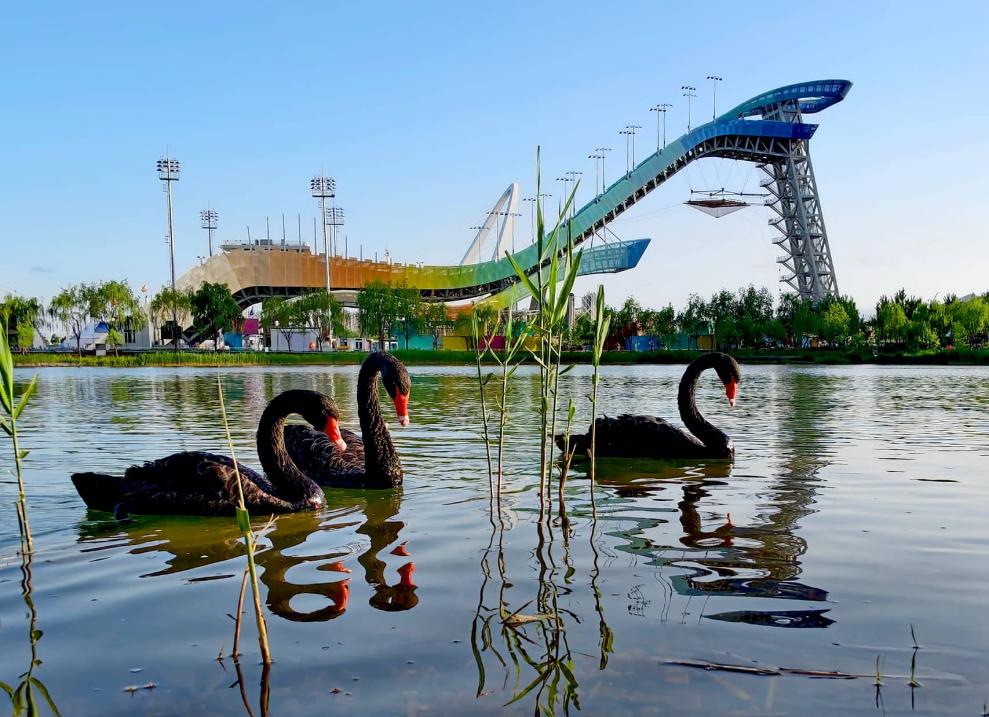
Black swans are observed on a lake at Shougang Park in Beijing. (Photo/Li Wenming)
Located along the East Asian-Australasian Flyway, Beijing has become one of the world's most biodiverse major cities. The Chinese capital is now home to 531 recorded bird species, more than 1/3 of all bird species found in China -- earning it the reputation as a true "city for birds."
Why has the number of bird species in Beijing continued to rise in recent years? And how is the city preserving its rich avian diversity?
At Changzinying Wetland Park in Beijing's Daxing district, dense greenery surrounds clear waterways filled with birdsong. So far, 162 species of wild birds have been recorded in the park, including 25 species under second-class or higher national protection. More than 5,000 migratory geese and ducks spend the winter there each year.
In March this year, park staff spotted several common pochards feeding and resting in the park's wetlands.
"Common pochards are highly sensitive to habitat conditions and only live in clean waters with high water quality and abundant aquatic vegetation," said Chen Zhihui, a forestry official with the industrial development service center of Changzinying township, Daxing district. "Their appearance shows that the park's water quality has improved significantly and that the ecosystem can now provide sufficient food resources."
The park has created a self-sustaining habitat through a series of ecological measures. These include expanding green ecological spaces, planting food- and nectar-producing species such as hawthorn, mulberry, alfalfa and wild roses along forest belts and waterfront transition zones, preserving large areas of reeds and wetland grasslands, and adopting a three-stage water purification system combining sedimentation, biological treatment and cascading water filtration.

Herons forage in Shahe Wetland Park in Changping district, Beijing. (Photo/Shi Jiamin)
"With the upgrading of the forest-lake-grassland ecosystem, more and more rare bird species that once appeared only temporarily are now staying year-round and even breeding here," Chen said.
To reduce human disturbance, the park has established dedicated biodiversity conservation zones. Artificial shelters made from stones and fallen branches have been installed around forest edges and wetland areas, while ecological monitoring systems enable discreet wildlife observation.
Since 2012, Beijing has launched two large-scale afforestation campaigns covering more than 667 square kilometers. The city has also built more than 100 urban and suburban parks, established 79 nature reserves and designated 47 important wetlands at the municipal level, creating a relatively comprehensive and widely distributed network of protected natural areas. These efforts provide birds with reliable conditions for feeding, nesting and migration.
The city has also created natural ecological corridors and installed artificial nests to provide shelter for birds. Carefully designed vegetation belts and fish restocking programs have further strengthened local food chains.
At the same time, Beijing has intensified habitat protection efforts along key points of the East Asian-Australasian Flyway, including Miyun Reservoir and Yeyahu Wetland in Yanqing district, providing safe stopover sites for nearly three million migratory birds every year.
Bird conservation is now increasingly integrated into Beijing's urban planning and infrastructure development as well.
"For example, the Yongding River restoration project was deliberately adjusted to protect nesting habitats for sand martins, allowing their population to grow from just dozens to more than 300 birds," said Jiang Hongxing, director of China's National Bird Banding Center.
At Cuihu Wetland, planners preserved dense trees on an island in the middle of a lake to create nesting grounds for grey herons and cormorants. The site now contains more than 300 nests and has become known locally as a "heron community."
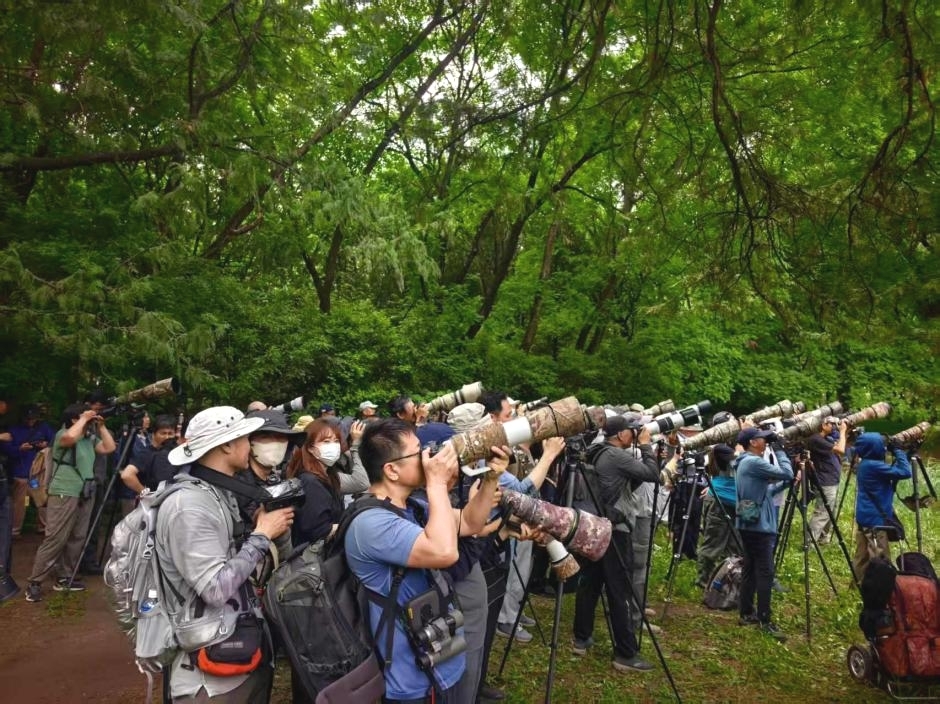
Birdwatchers take photos of birds at Tiantan Park in Beijing. (Photo/Du Yifei)
As bird populations continue to grow, public enthusiasm for bird conservation in Beijing has also become increasingly strong.
Early in the morning at Nanyuan Forest Wetland Park in Fengtai district, more than 20 birdwatchers can often be seen quietly waiting with cameras in hand for birds to skim across the water.
"Most of them are nearby residents who enjoy birdwatching and bird photography," said Guo Wei, an operations manager at the park. "We invited 15 of them to form a volunteer birdwatching team and established with them a long-term cooperation mechanism."
The team has offered suggestions on park construction and ecological protection while also gently reminding visitors not to disturb birds unintentionally.
During this year's bird protection week, districts across Beijing rolled out distinctive activities.
In Changping district, themed publicity was held at Baifuquan Park. Authorities released birdwatching maps, arranged popular science lectures and bird nest donation events, and mobilized joint conservation efforts through the forest chief system.
Huairou district organized science outreach and legal awareness campaigns on bird protection. Shunyi district hosted birdwatching competitions for primary and secondary school students, helping foster environmental awareness among younger generations.
Wild birds are widely regarded as an important indicator of a city's ecological health, while biodiversity forms the foundation of sustainable urban development.
"If urban planning leaves a little more room for wilderness, if engineering projects allow a little more room for nature, if river restoration incorporates more ecological thinking, and if society works together to protect birds, cities can truly become shared homes where humans and birds coexist harmoniously," Jiang said.