


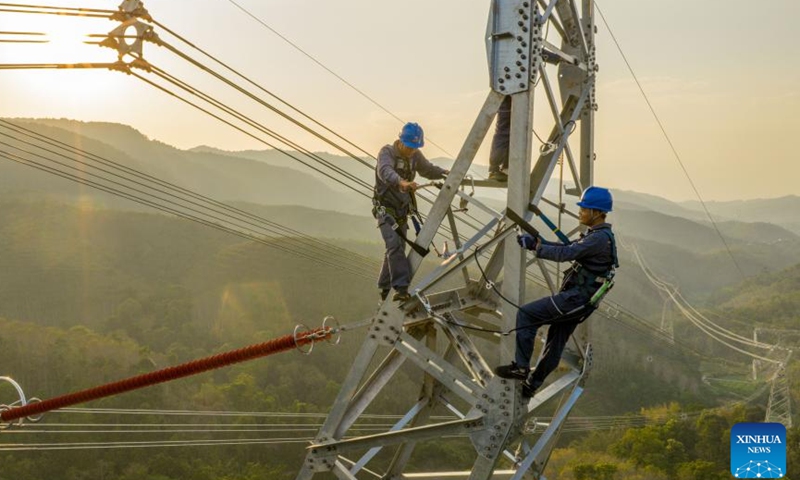
A drone photo shows technicians inspecting a section of power transmission line of the China-Laos 500-kV interconnection project in Xishuangbanna Dai Autonomous Prefecture, southwest China's Yunnan Province, April 14, 2026. (Photo: Xinhua)
The Datong-Huailai-Tianjin South 1,000-kV ultra-high voltage (UHV) project - China's new west-to-east power transmission line and a major initiative under the country's 14th Five-Year Plan for power development - has completed a critical construction milestone. It successfully completed a crossing over the existing 1,000kV UHV Xilang I and Xilang II lines, marking its entry into the full-scale conductor stringing phase, local media Hebei Daily reported on Thursday.
At the construction site in Yutian County, Tangshan, North China's Hebei Province, following operational directives, the new transmission lines were steadily pulled toward the top of the 170-meter-plus high pylons by tensioning equipment. After nearly four hours of work, the new lines successfully spanned over the Xilang I and II lines on Tuesday, according to the report.
Organized by State Grid Jibei Electric Power Co., Ltd., the operation marked the first implementation in China of a "double-circuit crossing double-circuit" construction operation on the same UHV tower. The challenge lay in crossing existing double-circuit lines with newly built double-circuit lines on the same tower structure.
During the operation, a total of 48 conductors were sequentially strung, tensioned and crossed in mid-air, creating a complex spatial intersection that required precise control by the operators, it said.
"This crossing operation was particularly challenging," said Shi Kai, deputy director of the Construction Department of State Grid Jibei Electric Power Co., Ltd. "The power outage window was halved compared to standard operations, and the working height is equivalent to a 60-story building. With tighter schedules and greater heights, we added more workers and equipment to ensure the success of the crossing in one attempt," he said.
The operation represents a new leap in China's ability to organize and execute complex UHV crossing projects and provides valuable experience for implementing high-difficulty intersections within narrow time windows.
To ensure safety, the construction team utilized multiple high-definition surveillance cameras and monitoring devices to provide real-time, comprehensive coverage of key areas, including high-altitude tower operations, tensioning equipment zones, and the spanning sections.
Electronic fencing and personnel positioning systems were also employed to effectively safeguard the site. Additionally, centralized intelligent tensioning and stringing equipment was used to monitor key data such as traction force, stringing speed, and conductor sag in real time, ensuring both the precision of the new line crossing and the safety of the transmission channels below.
Upon its scheduled completion and commissioning in June 2027, the project will serve as a major energy artery connecting the energy bases of North China's Shanxi Province and Hebei with the load center of North China's Tianjin. Once operational, the project is expected to transmit more than 14.6 billion kilowatt-hours of clean electricity to the Beijing-Tianjin-Hebei region annually, equivalent to replacing 4.45 million tons of standard coal and reducing carbon dioxide emissions by 11.81 million tons, according to the report.