


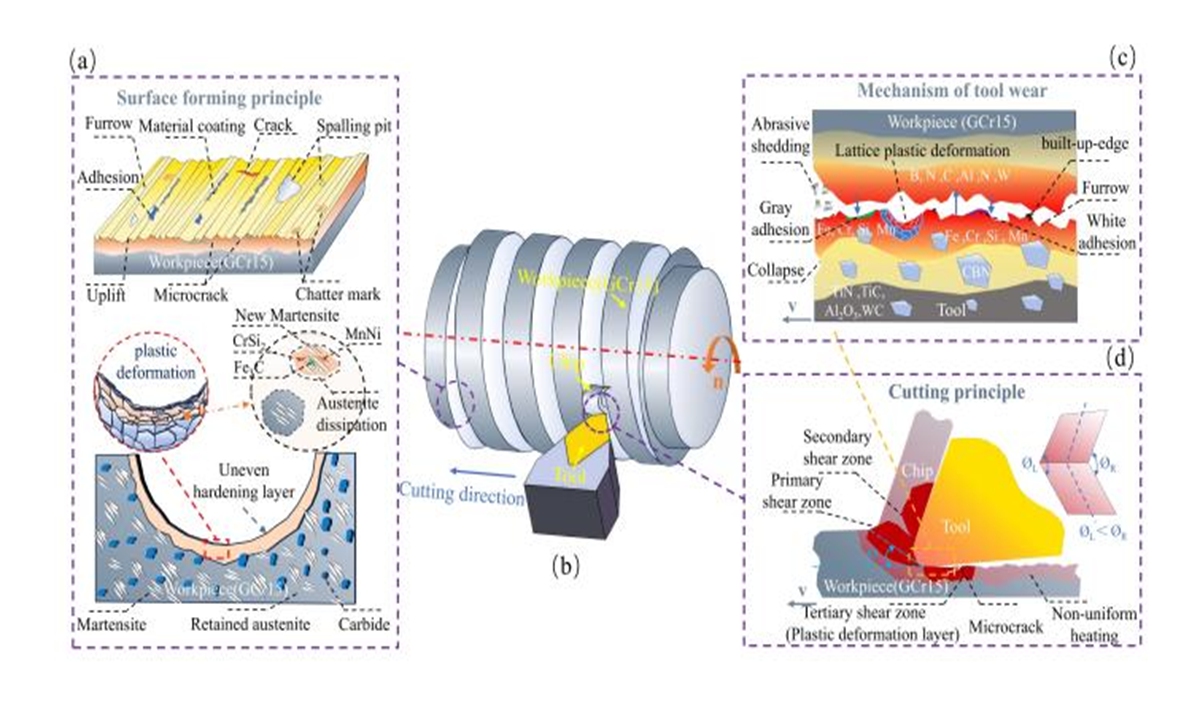
Schematic diagram of dry hard turning of large-pitch Gothic-arch ball screws by Peng Ruitao's team (Photo: Screenshot from chinanews.com)
Chinese scientists have made a major breakthrough in precision machining research for humanoid robot "joints," expected to promote greener, more efficient production of high-end precision transmission components.
A research team led by Peng Ruitao, professor from Xiangtan University in Central China's Hunan Province, has recently published a new research paper in machining for large-pitch gothic-arch ball screws, the core transmission components of humanoid robot joint actuators, in the Journal of Manufacturing Processes, chinanews.com reported on Thursday.
According to Peng, ball screws, as key precision transmission components in humanoid robot joint actuators and other high-end equipment such as industrial robots, directly affect the dynamic response and service life of the entire system.
Despite high transmission efficiency and high load-bearing capacity, large-pitch gothic-arch ball screws face significant machining challenges due to their complex helical surface geometry, Peng said.
Given that traditional grinding processes are hindered by low efficiency, high cost and heavy cutting-fluid use, greener and more efficient production of this type of high-end precision transmission component has been limited.
However, the research team's study offers a theoretical foundation and process reference for overcoming key challenges in green and efficient manufacturing of this high-end precision transmission component by revealing the mechanisms behind various machining issues in this precision transmission component.
Meanwhile, the research team has closely focused on common technical challenges in the field of high-end power equipment manufacturing, continuously conducting systematic research on core areas of high-end precision component machining, and has gradually built a complete research framework ranging from mechanism understanding and process optimization to engineering validation, according to chinanews.com.