


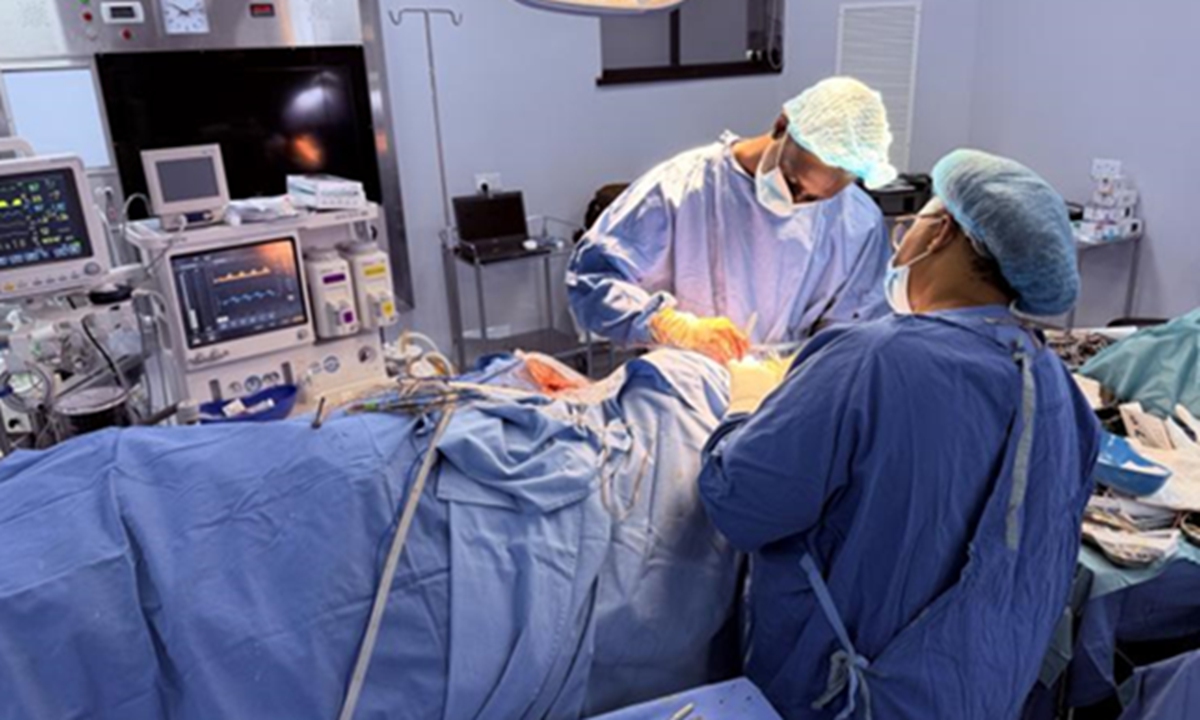
Photo shows Dr Nathaniel Zimani from the Zimbabwean medical team performs deep brain stimulation surgery in Milton Park Hospital, Harare, Zimbabwe on May 28, 2026. (Photo: Courtesy of Neuromodulation Joint Working Group of China-Africa Hospital Alliance)
A Chinese medical team has assisted Zimbabwe in completing the country's first Deep Brain Stimulation (DBS) surgery and first Spinal Cord Stimulation (SCS) procedure, marking a breakthrough in the country's treatment of complex neurological disorders. Following several days of post-operative observation, both patients remain in stable condition and the surgeries were deemed a success.
Speaking to the Global Times on Thursday, doctors from both the Chinese and Zimbabwean medical teams highlighted the significance of the milestone and the broader impact of China-Zimbabwe medical cooperation.
The two operations were successfully carried out on May 28 and 29. The surgeries were led by Dr Nathaniel Zimani, Consultant Neurosurgeon of the Zimbabwean medical team, with assistance from Dr Chen Yanliang, chief surgeon at the Central Hospital of Xiangtan in Central China's Hunan Province, according to information provided by the Neuromodulation Joint Working Group of the China-Africa Hospital Alliance and the Chinese medical team in Zimbabwe.
Explaining the significance of the procedures, Chen told the Global Times that DBS and SCS are forms of neuromodulation therapy used to treat a range of neurological and psychiatric disorders that are often difficult to control with medication alone, including Parkinson's disease, dystonia, drug-resistant epilepsy, post-stroke rehabilitation conditions and chronic pain.
"Overall, development of this field in Africa remains relatively limited, with only a few countries such as South Africa and Egypt having previously carried out such therapies," Chen said.
Zimbabwe had never before performed surgeries of this kind, he noted. "The DBS implantation surgery and SCS implantation surgery we carried out have filled a technological gap in Zimbabwe and ended a situation in which local patients had to travel abroad for treatment," Chen said.
The operations also marked the first formal deployment in Africa of advanced neuromodulation technology developed by Tsinghua University and commercialized by Beijing PINS Medical Co., Ltd. According to Chen, the technology has reached internationally advanced standards while being significantly more affordable than comparable products from the US, making it better suited to the healthcare accessibility needs of African countries.
For Zimbabwean doctors, the achievement was not only a medical breakthrough, but also a demonstration of an effective model for long-term healthcare development.
During the interview, Dr Zimani highly praised the cooperation model in which Zimbabwean surgeons take the lead while Chinese doctors provide support and technical guidance.
"This is an excellent model for sustainable healthcare development, because it prioritizes this knowledge transfer rather than dependence," he said, adding, "It's teaching us how to fish, then giving us fish."
Reflecting on the impact of the cooperation, he went on to say, "If China wasn't there, we may get this technology 20 years from now. Because of this collaboration, we've advanced such medical technologies by 20 years in our country," Dr Zimani told the Global Times on Thursday.
According to Chen, the surgeries were completed with the support of the 23rd Chinese medical team dispatched to Zimbabwe. The team arrived in the country in March this year.
According to the Xinhua News Agency, China first dispatched a 14-member medical team from Hunan Province to Zimbabwe in 1985. Over the past four decades, China has sent 23 medical teams to the African country. The latest team, composed of 10 doctors from major hospitals in Hunan, arrived in Zimbabwe in March and will carry out a one-year medical assistance mission.
Dr Zimani said he has participated in cooperation projects with Chinese medical teams on multiple occasions. "It goes a long way back," he said, recalling that he traveled to Beijing for training in 2014. "Almost every year, a local Chinese team comes to Zimbabwe to offer its expertise, training," he noted, adding that such exchanges have given him the confidence needed to perform complex procedures independently.
The latest breakthrough reflects the broader evolution of China-Zimbabwe healthcare cooperation.
According to Xinhua, Zimbabwean Minister of Health and Child Care Douglas Mombeshora said on March 5 that contribution of the Chinese medical team forms an integral part of Zimbabwe's broader journey toward a more resilient health system.
Speaking at a handover ceremony in Harare, the country's capital city, between the 22nd and 23rd Chinese medical teams, Mombeshora said the medical team's contributions to epidemiology, infectious disease prevention and control, and health system planning will support Zimbabwe's strategic shift toward a prevention-centered, data-driven healthcare delivery system.
"This cooperation has been proactive, responsive to our needs and aligned with our national priorities. Chinese medical teams have complemented our national efforts to reinforce clinical services," he added.
For his part, Chinese Ambassador to Zimbabwe Zhou Ding said that since the first Chinese medical team arrived in Zimbabwe in 1985, what began as a medical assistance mission has grown into an enduring symbol of solidarity and brotherhood between China and Zimbabwe, according to Xinhua.
"China remains committed to building a global community of health for all. Africa, including Zimbabwe, has always been a priority partner in China's international health cooperation," he added.