


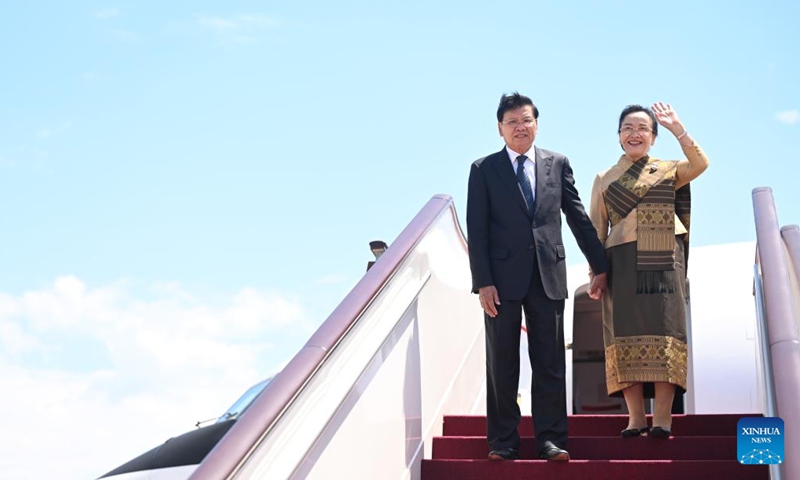
General Secretary of the Lao People's Revolutionary Party Central Committee and Lao President Thongloun Sisoulith arrives in Beijing, capital of China, June 4, 2026. Thongloun is in China for a five-day state visit. (Photo: Xinhua)
General Secretary of the Lao People's Revolutionary Party Central Committee and Lao President Thongloun Sisoulith concluded his visit to East China's Zhejiang Province and arrived in Beijing on Thursday to continue his state visit in China.
In the afternoon, he visited the Party School of the CPC Central Committee, where 26 years ago he studied in an exchange program for one month, as well as the China Academy of Space Technology, Xinhua News Agency reported.
Chinese observers said Thongloun's itinerary - covering innovation, ecology, party-to-party exchanges and aerospace - reflected a comprehensive effort to draw on China's development experience. "By learning from China's governance, green development and technological advances, Laos aims to better develop its agricultural, forestry and mineral resources and support its transformation from a land-locked to a land-linked country."
The Party School of the CPC Central Committee is the Party's highest institution for training officials and a key platform for exchanges and cooperation on governance. Thongloun, who attended a one-month exchange program at the Party School in 2000, made a special visit during this trip. He toured the dormitory where he stayed, and met with Chinese instructors, organizers and Lao participants for exchanges, Xinhua reported.
According to China News Service, during his visit to the Party School, Thongloun returned to the dormitory where he stayed during his studies and remarked that "26 years have passed in the blink of an eye." Looking around, he said, "If I have the opportunity to come again, I would like to stay here."
During the warm interaction with teachers, white-haired educators shook hands with him. One teacher asked, "Do you still remember that time?" Thongloun placed his hand on his chest and replied firmly, "Of course," while expressing gratitude to the teachers for imparting their knowledge, China News Service reported.
On Thursday afternoon, Thongloun also visited the China Academy of Space Technology. This institute is a major force in China's space technology exploration, with spacecraft developed covering fields such as manned spaceflight, deep space exploration, navigation, communications, remote sensing, space science, and technology experiments, per Xinhua.
Gu Xiaosong, dean of the ASEAN Research Institute of Hainan Tropical Ocean University, told the Global Times that returning to the Central Party School leverages alumni ties to deepen inter-party exchanges, continues sharing governance and grassroots governance experiences, and uses mature cadre exchange mechanisms to solidify bilateral political foundations, ensuring the steady implementation of various cooperation projects.
The visit to the aerospace research institute builds on existing satellite cooperation to leverage remote sensing and navigation technologies for assisting Laos in resource exploration, land management, and infrastructure development, said Gu.
Combining Thongloun's itinerary over the past two days — from intelligent manufacturing in Hangzhou and ecological development in Anji to visits to the Party School and the China Academy of Space Technology — the trip appears aimed at drawing lessons from China's development experience, Gu said.
The visits to robotics and digital economy projects in Hangzhou were intended to help Laos advance industrial upgrading, smart logistics and resource processing by leveraging the China-Laos Railway, while the Anji stop highlighted China's green development model and rural revitalization practices, offering references for Laos to better utilize its agricultural, forestry and ecological resources and pursue more sustainable growth, Gu added.
Meanwhile, Xinhua reported Thursday that the expansion and renovation of Boten Station on the Lao section of the China-Laos Railway has officially commenced, marking the first large-scale capacity expansion and renovation project on the railway's Lao section since it began operations in December 2021. The project is expected to enhance the station's train-handling capabilities and improve the efficiency of cross-border freight operations, per the report.
The China-Laos Railway has opened an important land corridor for Laos, which has no sea access, connecting it with China. This means Laos' fruits and minerals can flow continuously into the Chinese market, according to Gu.
According to China's Foreign Ministry, China-Laos economic and trade ties have continued to deepen in recent years, with China now serving as Laos' largest source of foreign investment and second-largest trading partner.
Bilateral trade reached $9.82 billion in 2025, up 19.3 percent year-on-year. China's exports to Laos totaled $4.32 billion, an increase of 17.6 percent, while imports from Laos rose 20.7 percent to $5.5 billion. China mainly exports machinery and electronic equipment, steel products, transport equipment and components, and chemical products to Laos, while importing potash, rubber, wood pulp and paper products, according to the ministry.
"The steady expansion of China-Laos cooperation could serve as a model for wider regional collaboration, strengthening connectivity and supply-chain integration across the Indochina Peninsula and the Lancang-Mekong region, while providing fresh impetus for multilateral cooperation in Southeast Asia," the expert added.