


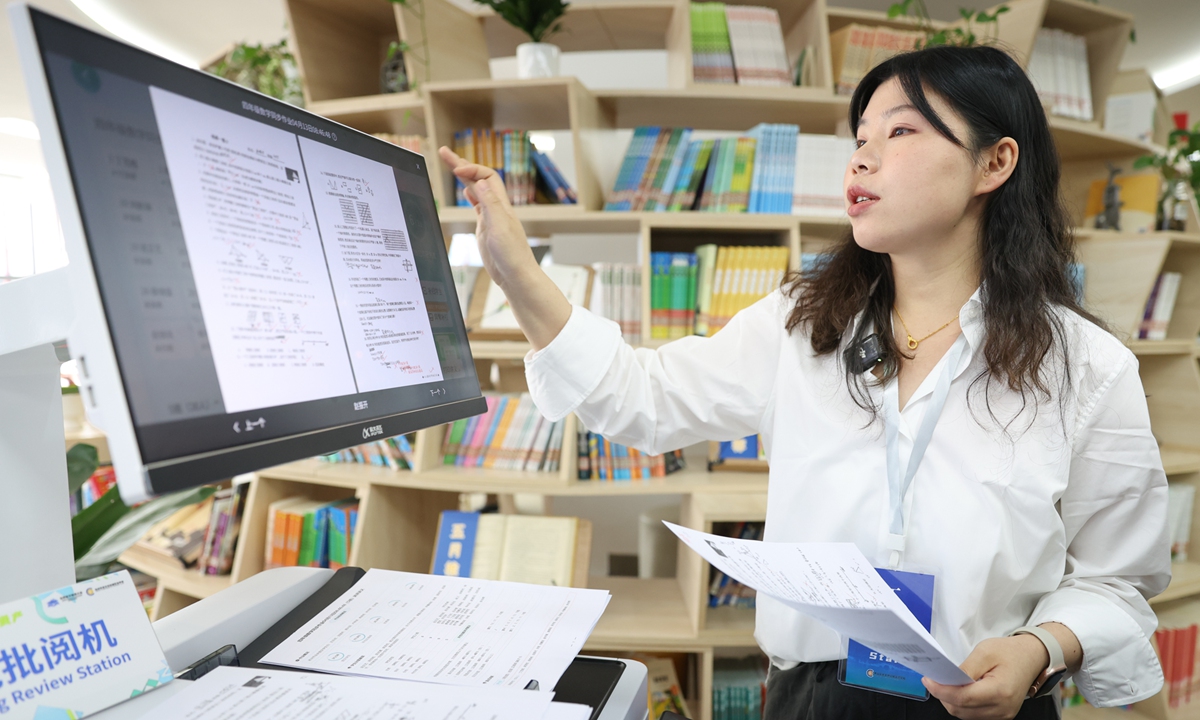
A woman displays a smart marking machine at the 2026 World Digital Education Conference in Hangzhou, Zhejiang Province, on May 11, 2026. (Photo: VCG)
As generative artificial intelligence technology moves faster into education, the annual gaokao season, China's college entrance examination period, is also seeing new changes.
For some students and teachers, AI may have begun to move beyond the role of a simple answer-finding tool. In certain study scenarios, it can be used to help students review mistakes, understand knowledge points, polish essays or receive revision suggestions. But this may also raise new questions for schools during the exam preparation period.
On Friday, the Ministry of Public Security's cyber police bureau said in a WeChat post that police in Yichun, Jiangxi Province, had handled a case in which a suspect used videos of so-called "gaokao exam paper bags" to claim he had access to "leaked 2026 gaokao questions and answers." The suspect allegedly attempted to sell the fake papers for 2,000 yuan ($281) each, and the account was shut down, according to the post.
China's Ministry of Education issued a warning on June 2, reminding students and parents to be alert to false advertising such as "famous teacher predicted exam questions" and "AI predicted exam questions," the China News Agency reported.
At the same time, several AI platforms in China have announced or indicated corresponding adjustments during the gaokao period to prevent the technology from being used for exam cheating, media reports said.
The discussion around AI and the gaokao has just begun.
AI use on campusIn daily exam preparation and classroom tutoring, some teachers and students in China have already begun exploring how AI technology can be used in practice.
In Shanghai, where educational resources are highly developed, frontline teachers are beginning to test the practical boundaries of AI in language teaching, while also seeing its limitations.
Wu Xinyi, an English teacher at a high school in Shanghai, told the Global Times that AI can be used to revise essays.
"I think it is acceptable to use AI to polish an essay. You can input a specific prompt, and it can make the language sound more advanced. In fact, some teachers now also use AI to assist with essay grading," Wu told the Global Times.
"Sometimes, we deliberately compare essays written by AI tools with those written by students. You can see that it does have some very good, even impressive parts, but many parts appear rigid and formulaic," she said.
Compared with discussions in more developed regions over AI-generated text, compliance and depth of thinking, the application of such technology in less-resourced grassroots schools faces more basic thresholds.
Xiao, a teacher at a county-level high school in East China's Shandong Province, told the Global Times that AI has been included in some teaching-related tasks, and relevant departments have been actively advocating its use. But in actual grassroots teaching, implementation remains difficult.
A document Xiao showed the Global Times about an AI competition organized by local education authorities suggested that local schools are being encouraged to explore AI-related teaching practices.
"Every step is a hard threshold, from improving teachers' understanding and changing their mindset to upgrading the school's overall hardware facilities, especially for rural county-level schools with limited resources like ours," Xiao said.
Meanwhile, overreliance on AI in relation to gaokao has also drawn warnings.
China's Ministry of Education issued a warning on June 2 for the 2026 gaokao, reminding students and parents to be alert to false advertising such as "famous teacher predicted exam questions" and "AI predicted exam questions," to take the exam with integrity and strictly observe legal boundaries, the Xinhua News Agency reported.
The ministry said gaokao questions have continued to undergo reform in recent years, with directions and exam content constantly changing and innovating. Relying on AI or "experts" to predict questions in order to obtain high scores is unrealistic, the ministry said.
Fairness in the exam room
Photo: VCG
Sichuan-based Red Star News recently reached out to several AI platforms in China. For instance, Doubao customer service said that Doubao could be used normally during the gaokao period, but photo-based question answering and similar functions would be unavailable, with specific arrangements subject to the actual page display during the exam.
A Tencent staff member said that, during last year's gaokao, Tencent's Yuanbao had made clear that it would not answer exam-related questions. An iFlytek staff member also said there was no definite information yet, but that large models would likely have their limits. Baidu's relevant business department said it had not yet received notice of restrictions on some Wenxin functions during the gaokao period, the report said.
According to a report by Xiaoxiang Morning Herald based in Central China's Hunan Province, in 2025, some users posted online that Tencent Yuanbao could not be used normally during the gaokao period.
After users sent image-recognition summary requests, Yuanbao replied that "this function is unavailable during gaokao hours." Other common AI tools such as Kimi, DeepSeek and Doubao also had related arrangements during the gaokao period.
The Ministry of Education reminded candidates that bringing a mobile phone, smart watch or bracelet, smart glasses and any other banned device into an exam room constitutes cheating, even if the device is switched off.
In April, the "AI + Education" action plan was issued by the Ministry of Education and other government departments, requiring in particular that AI applications be safe, trustworthy and controllable, the Beijing Youth Daily reported.
The report quoted Xie Yongjiang, director of the Institute of Internet Governance and Law at Beijing University of Posts and Telecommunications, as saying, "If there is even the smallest loophole in the organization of the exam, AI tools could magnify it infinitely and cause incalculable negative consequences. Restricting AI answering functions is meant to block the possibility of AI-assisted exam-taking and ensure absolute fairness in the exam."
From the perspective of international comparison and academic ethics, Estelle Qiu, a young scholar based in Australia, said AI is challenging intellectual property and human thinking while offering convenience.
Qiu told the Global Times that at the Australian university where she works, undergraduate students are allowed to use AI. In principle, the school allows them to first complete their own writing and then use AI for polishing, but students must clearly declare such use.
"However, there are two major pain points in AI use. First, it may undermine confidentiality to some extent. Second, when it comes to deeper academic papers, AI still cannot really get how the human mind works," she said.
The Beijing News said in a recent commentary that AI is evolving rapidly, with computing power and algorithms constantly improving and technological dividends being released. "But the faster it develops, the more necessary it is to respect rules and uphold bottom lines," the commentary said.