


With China's national college entrance exam, also known as gaokao, set to kick off this weekend, around 12.9 million candidates will potentially have access to more academic options, following the introduction of a raft of new majors.
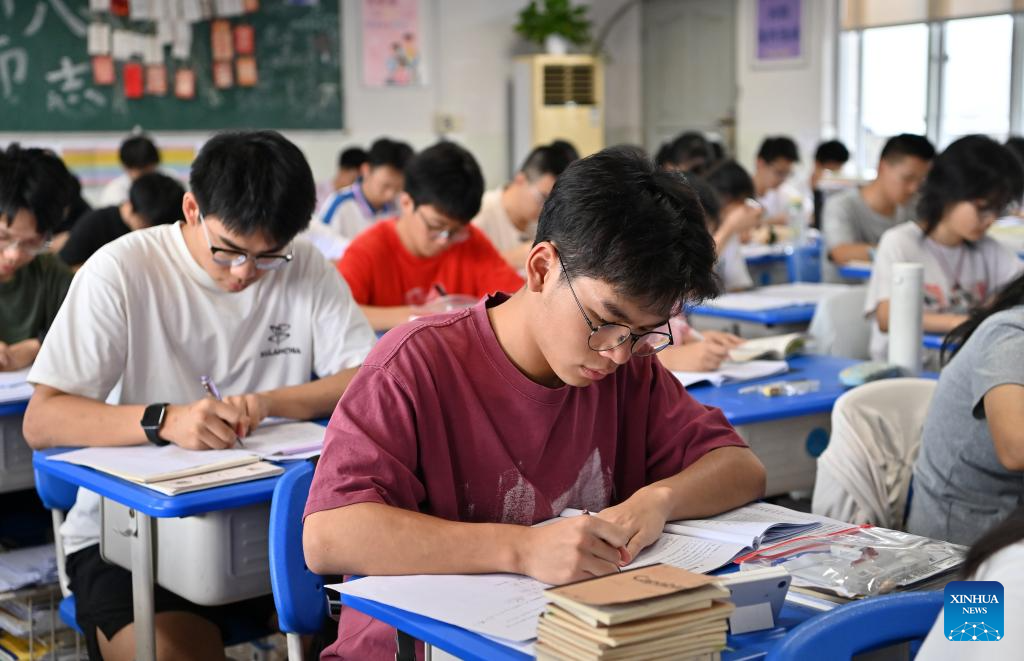
Students prepare for the upcoming national college entrance exam at a high school in Liuzhou, south China's Guangxi Zhuang Autonomous Region, June 4, 2026. This year's national college entrance exam, also known as the gaokao, will start from June 7. (Photo: Xinhua)
Multiple Chinese universities have rolled out new undergraduate programs such as embodied intelligence, low-altitude economy and management, and marine intelligence and unmanned technologies, in seeking to meet the country's emerging strategic and industrial needs, noted an updated catalog recently issued by the Ministry of Education (MOE).
The addition of these new majors underscores continued improvement in the structure of academic disciplines, said Zhang Nanxing, director of the Institute of Higher Education at the China National Academy of Educational Sciences.
The outline of China's 15th Five-Year Plan (2026-2030) for economic and social development calls for an orderly expansion of enrollment in high-quality undergraduate and graduate education, with a focus on science, engineering, agriculture and medicine-related programs.
In an earlier interview with Xinhua, Education Minister Huai Jinpeng said that China will establish a coordinated talent cultivation mechanism that aligns sci-tech innovation, industrial development and national strategic needs.
China will further adjust and optimize academic disciplines and majors, and explore new models for nurturing top innovative talent in strategically critical fields like artificial intelligence and integrated circuits, Huai said.
In this year's catalog, Sichuan University in southwest China was approved to launch a major in semiconductor process and equipment, the first program of its kind in the country.
Yang Yang, dean of the university's School of Electronics and Information Engineering, said this new major is designed to provide a strong pipeline of talent to support self-reliance across the entire integrated circuit industrial chain.
As demand grows for talent with cross-disciplinary expertise, the latest catalog has added 15 interdisciplinary majors, including embodied intelligence and brain-computer science and technology.
Harbin Institute of Technology (HIT) in northeast China is among the universities approved to launch the embodied intelligence major. Jin Jing, a doctoral supervisor at HIT, said the program is designed to equip students with theories and engineering approaches related to the field, while developing systems thinking and interdisciplinary innovation skills needed for next-generation intelligent technologies.
Notably, new programs also carry a strong focus on people's livelihood, such as Tai Chi to support public health, smart landscape design to promote high-quality urban and rural living environments, and art therapy to enhance the mental health service.
A Beijing resident surnamed Zhang, whose son is set to sit the college entrance exam starting on Sunday, said the new majors are expected to be highly sought-after by college applicants this year. "I will introduce the programs to my son," Zhang told Xinhua, "but whether he chooses them or not is up to him."
In recent years, the MOE has explored a fast-track mechanism for establishing strategically important and urgently needed majors, opening a dedicated channel for qualified universities to launch such programs.
According to education officials in Heilongjiang Province, northeast China, the province has capitalized on the growth of its ice-and-snow economy, supporting local colleges to launch a major focused on ice-and-snow dance performance, and fostering talent in ice- and snow-related industries.
At Anhui University in east China, nearly 80 percent of undergraduate programs directly serve Anhui Province's emerging industries. "The priority of a regional university should be closely aligned with local socio-economic development, focusing on training talent that meets the region's needs," said Cai Jingmin, a researcher at the university.
The ultimate goal of academic program planning is to improve the quality of talent cultivation, experts explained, suggesting universities push for closer industry-education integration, reshape curricula and optimize the allocation of resources.
"We have established a number of industry-education integration clusters, bringing together undergraduate institutions, vocational colleges, enterprises and research institutes," said Jiang Yunfang, an education official of Chongqing Municipality in southwest China.
Xi'an Jiaotong University, located in northwest China, allows students to choose from different curriculum approaches focusing on scientific research, interdisciplinary integration and entrepreneurship, with each major offering a rich selection of courses spanning these three domains.
As a parent, Beijing resident Zhang called for greater integration in basic disciplines, believing this will help achieve breakthroughs in basic scientific research and further drive innovation.