


Some 12.9 million people across China sat for the annual college entrance exam, or gaokao, on Sunday, a pivotal milestone for generations of young Chinese.
The figure, in sharp contrast to 5.7 million at the exam's reinstatement 49 years ago, marks a slight drop from last year's 13.35 million participants. The test will last two to four days, depending on the subjects chosen.
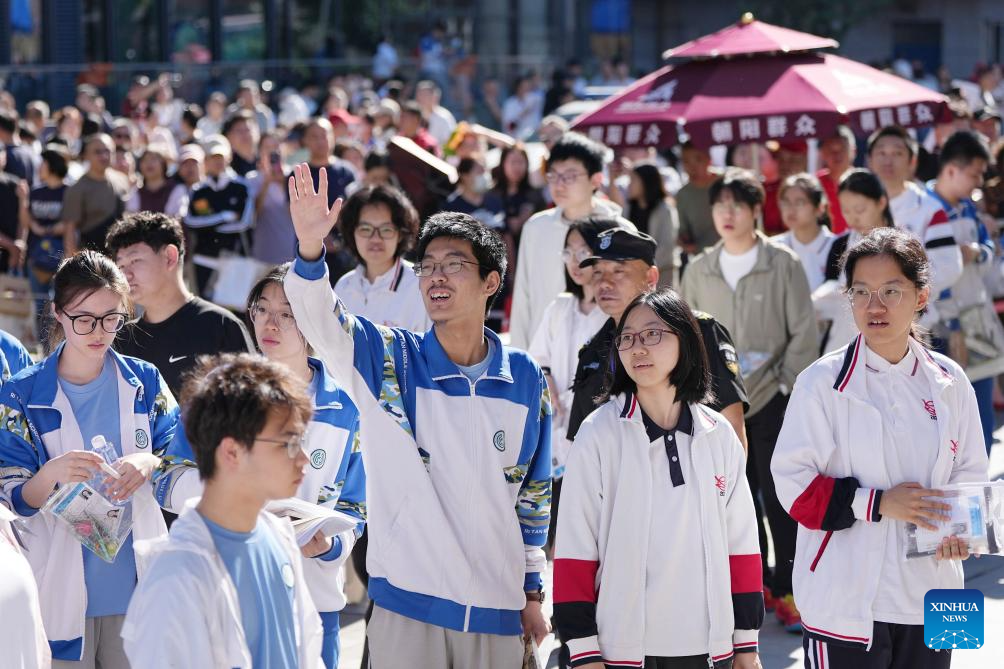
Students walk toward a national college entrance examination site in Beijing, capital of China, June 7, 2026. This year's national college entrance exam, also known as the gaokao, kicked off Sunday nationwide. (Photo: Xinhua)
From 7 a.m. onwards, examinees began arriving at the test site at Beijing 101 High School, where teachers who had seen the students off had already lined up to greet each candidate with hugs and high-fives as a morale boost.
This year, the school has prepared 27 formal test rooms and 3 backup rooms to host a total of 810 test-takers. A 200-meter wind-and-rain-proof corridor has been erected outside the test area, along with a rest lounge fitted with over 1,000 seats for candidates to take breaks between exam sessions. Designated waiting zones for accompanying parents are also available, each equipped with six sunshades.
Buses have been rerouted, and construction operations have been silenced, as authorities have implemented measures to reduce noise at the city's test sites during the four-day exam period.
"Lovely weather this morning, and the drive over was smooth," said Ms. Li, a parent of a student at the nearby High School Affiliated to Beijing Institute of Technology. Wearing a red Chinese cheongsam, also known as qipao, she watched her son disappear into the examination hall.
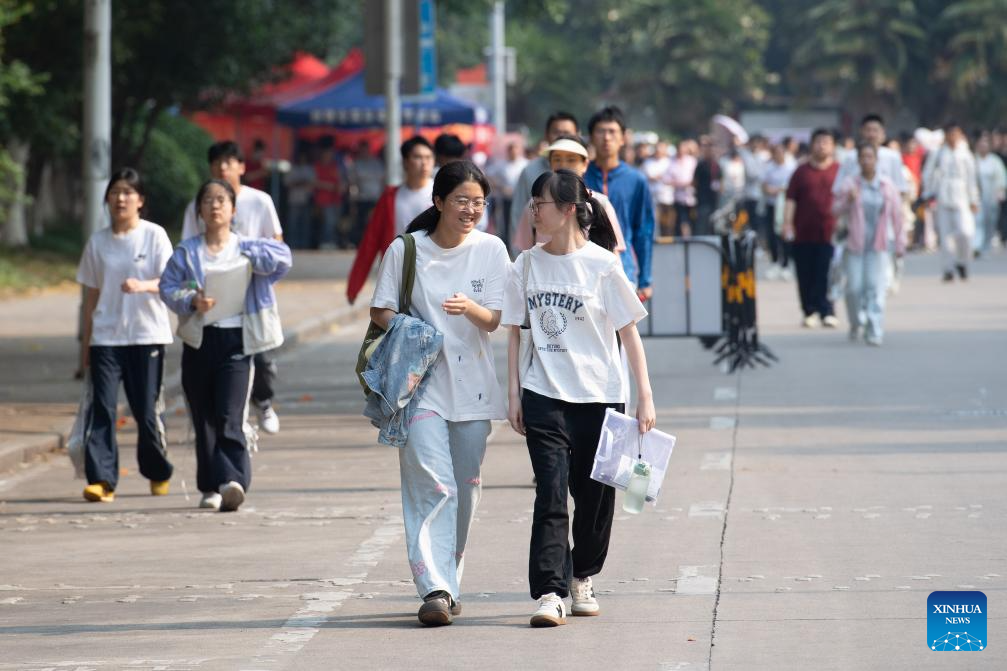
Students enter a national college entrance examination site in Hefei, east China's Anhui Province, June 7, 2026. (Photo: Xinhua)
Outside the school, many mothers had put on such traditional dress whose name echoes "qikaidesheng," an auspicious Chinese phrase meaning a victorious start.
EVOLVING WITH TIMES
In Nanchang, capital of east China's Jiangxi Province, 79-year-old Gan Fubao was one of the 5.7 million test-takers for the first restored national college entrance exam in 1977.
Eleven years ago, in 1966, when he was on the cusp of graduating from middle school, university admissions were suspended nationwide, shattering his dream of pursuing higher education. He later took a job as a frontline factory worker.
"In 1977, when gaokao resumed, our enthusiasm burst forth like a volcano," he recalled, the excitement still palpable in his tone. "We were absolutely elated. Even though I was already in my 30s, I was eager to compete on the same stage as younger candidates, to do my part for our motherland."
With no full set of learning materials, he rummaged through old textbooks and copied down key points by hand for revision. During the day, he worked in his factory while studying in the early morning and late at night.
"As a science-track candidate, the Chinese language exam felt relatively simple: we were asked to write an essay titled 'unforgettable moment,'" Gan said. "For me, the most unforgettable moment of my life was holding that exam admission ticket, one that had been 11 years in the making."
He was eventually admitted to the physics department of then Jiangxi University. The exam rewrote the trajectory of his life: after graduation, he landed a job as a technician at a local television manufacturing factory.
In the decades that followed, he collected each year's gaokao test papers, from which he witnessed changes in the exam.
Early exam content was closely related to industrial and agricultural production, as well as everyday life. Math and physics drew heavily on farm machinery, irrigation and mining, while chemistry centered on fertilizer and household chemicals. Foreign language tests debuted in the 1978 gaokao alongside China's opening-up drive.
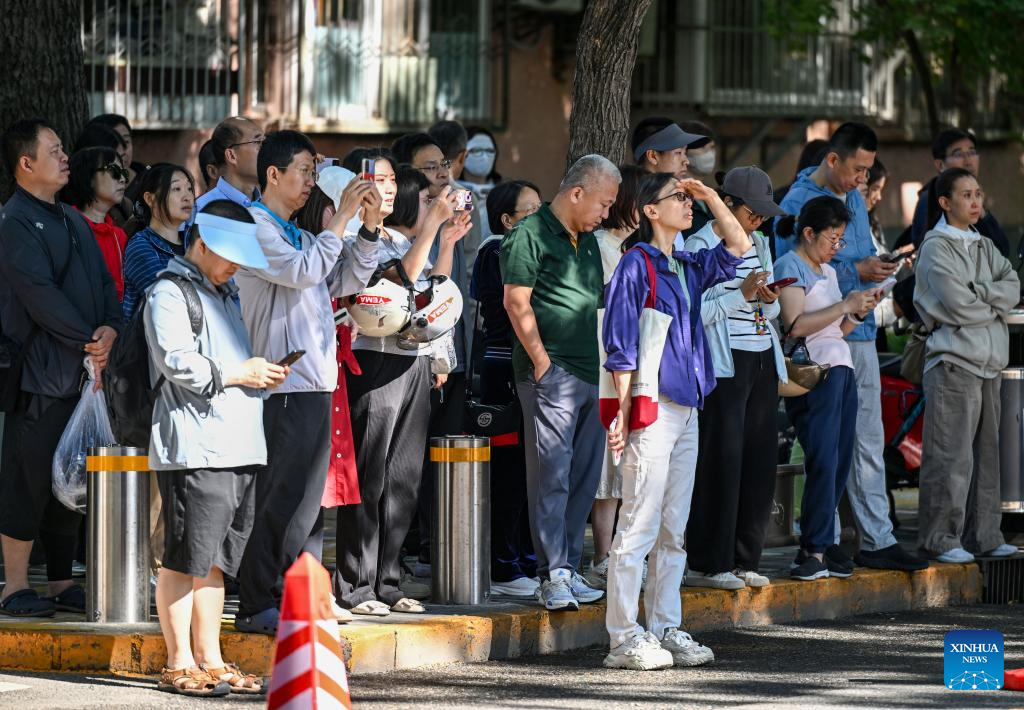
Parents watch students enter a national college entrance examination site in Beijing, capital of China, June 7, 2026. (Photo: Xinhua)
Nearly five decades on, the gaokao, dubbed the world's biggest annual standardized talent assessment, continues to evolve from score-driven screening toward all-round evaluation that matches the nation's shifting economy and society.
"The college entrance test has undergone a crucial transformation from its traditional function of exam-centered talent selection to one that supports personalized education development, positioning the exam as a supportive ladder on the growth paths of young people, and helping them realize their full life potential," said Chu Zhaohui, a researcher with the China National Academy of Educational Sciences.
Chinese policymakers aim to build a future workforce equipped with core skills: critical thinking, problem-solving and adaptability. "Accordingly, the gaokao has shifted focus from rote memorization of fixed formulas to evaluating students' observation and practical problem-solving in real-life contexts," said Hu Xiangdong, director of the educational measurement center at Central China Normal University.
FRESH ACADEMIC PATHS
As outlined in China's 15th Five-Year Plan (2026-2030), the country's leading universities, often compared to America's Ivy League schools, will create over 100,000 new undergraduate enrollment spots over the five-year period.
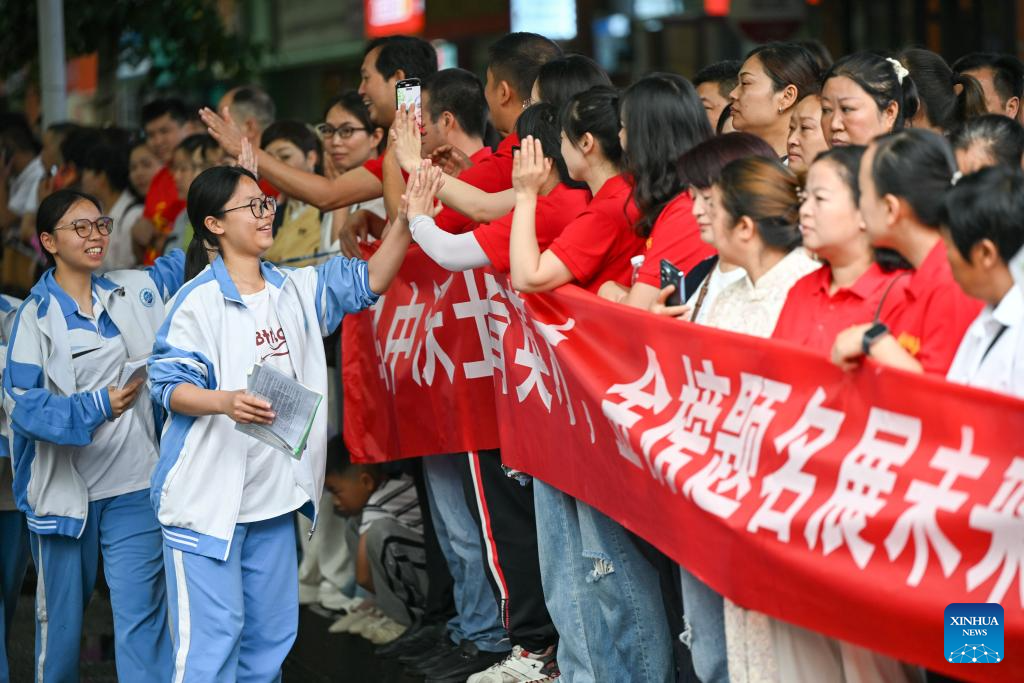
Students clap hands with teachers outside a national college entrance examination site in Guiyang, southwest China's Guizhou Province, June 7, 2026. (Photo: Xinhua)
In 2025, 29 new undergraduate majors, including carbon neutrality science and engineering, low-altitude technology and engineering, and industrial software, were added to the national higher education catalog, while programs such as general marketing and Japanese language studies were phased out in many schools.
A further 38 new majors, including embodied intelligence, and rare earth science and engineering, were added to the 2026 catalog, as part of a strategic push to steer higher education toward addressing the country's most pressing workforce gaps.
Jiangxi University of Science and Technology, located in Jiangxi's Ganzhou City, is the first university in the country to offer a major in rare earth science and engineering.
"Expanding the reserve of undergraduate talent in rare earth-related majors is expected to help improve the industry's talent echelon structure and address the talent gap for mid-to-senior positions," said Xiao Yanfei, executive dean of the School of Rare Earths at the university.
Xiao said that China is the world's leading supplier of rare earth minerals, and that Jiangxi has gathered China's leading enterprises, forming an industrial cluster worth hundreds of billions of yuan.
To spark middle-school students' interest in the new major, university faculty have hosted outreach lectures at local campuses, where students huddled around displayed mineral specimens, peppering instructors with curious questions.
"With such a fascinating major right on my doorstep, my goal for the college entrance exam feels so much clearer now," said Li Jialin, a middle school student in Ganzhou.
For college students who have finalized their majors, there are also flexible options to adjust and refine their learning pathways on campus. Many universities now offer micro-majors and modular courses in cutting-edge, high-demand areas ranging from artificial intelligence to the low-altitude economy, helping students develop skills aligned with fast-growing industry needs.
Zhang Linsheng, a 20-year-old sophomore at Longdong University majoring in mechanical design, manufacturing and automation in Qingyang City of northwest China's Gansu Province, was thrilled to learn that his university had launched a new micro-major in unmanned aerial vehicle (UAV) technology and low-altitude economy.
As one of China's eight national computing hubs in the country's integrated computing power network, Qingyang is undergoing a digital boom and is building the province's first "low-altitude economy city."
A UAV enthusiast, Zhang failed to find such a major at the universities he applied to for his undergraduate studies. "Back then, I could only teach myself about the relevant industries by reading books and looking up information online. I had no idea where to start, and held a lot of misconceptions about the field," he recalled.
He signed up for the new micro-major, passed the selection process, and was enrolled in the low-altitude economy cohort at the start of this semester.
"These new programs and courses have given me more opportunities to engage directly with enterprises and get hands-on exposure to the market and the wider industry. I now have a much clearer idea and firmer plan for my future career path and long-term life goals," Zhang said.
"China is revamping its undergraduate majors around core areas, including hard tech for national strategic priorities, the new economic sectors, technology for upgrading traditional industries and cultural sectors," said Chu Zhaohui.
This is more than just an expansion of the major catalog, but marks a strategic move by China's higher education system to proactively optimize supply, reshape talent cultivation, and support national technological self-reliance and high-quality development, he said.
Recalling his gaokao experience, Gan Fubao said that the exam has selected numerous ambitious, talented young people for the country and provided a life-changing platform for countless people to pursue their aspirations over nearly 50 years.
"To this year's examinees, my advice is simple: treasure your privileged schooling, stay grounded, and strive for your utmost. The gaokao is your stage to turn dreams into reality," he said.