


In Baoxing county in Ya'an, Southwest China's Sichuan Province, where the giant panda was first discovered, panda-themed elements can be seen throughout the county, reflecting its deep connection with the iconic species.
Along winding mountain roads leading into the Dengchigou scenic area, the giant panda origin camp comes into view amid lush greenery.
"This is where the giant panda was first discovered. The discoverer was the French naturalist Armand David, and this café is named after him," said barista Chen Yi while recounting the story of the giant panda's discovery inside a café at the camp.
Located in the transitional zone between the Sichuan Basin and the Qinghai-Xizang Plateau, Baoxing possesses exceptionally rich biodiversity and abundant rare wildlife resources.
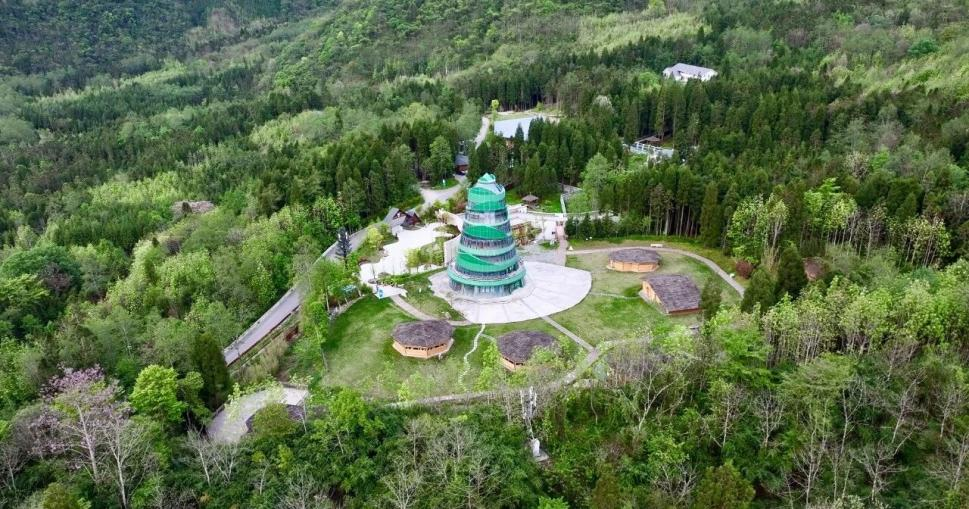
Photo shows the giant panda origin camp in Baoxing county, Ya'an, Southwest China's Sichuan Province. (Photo provided to People's Daily)
In 1869, while in Dengchigou, David encountered a distinctive black-and-white animal hide in the home of a local family, sparking further investigation. Through extensive research, the previously unknown species was identified and named the giant panda, heralding its formal scientific recognition and subsequent conservation efforts.
As China accelerates the development of its national park-based protected area system, critical ecosystems, iconic landscapes, invaluable heritage sites and biodiversity-rich regions are being incorporated into this framework. Decades of panda conservation efforts have resulted in the establishment of multiple nature reserves. In 2021, China officially launched its first batch of five national parks, including the Giant Panda National Park.
In Baoxing county alone, 2,545.53 square kilometers, or 81.7 percent of the county's total land area, have been incorporated into the Giant Panda National Park. Protecting the authenticity and integrity of natural ecosystems remains the top priority in national park management.
According to Wang Shuangquan, director of Baoxing county's forestry bureau, patrols and monitoring are conducted along 48 fixed survey routes within the park, and bamboo has been planted across 133.3 hectares as a food source for giant pandas.
In addition, relevant authorities have shut down 16 mines and phased out 27 small hydropower facilities within the park, rehabilitating a total of 10,600 hectares of giant panda habitat and constructing 42 kilometers of ecological corridors.
But conservation extends beyond pandas.
"The giant panda is a flagship species for global biodiversity conservation and has what we call an umbrella effect," explained Zhang Jindong, deputy dean of the College of Environmental Science and Engineering at China West Normal University.
"Protecting panda habitats also shelters other rare species that share the same ecosystem, including red pandas, Sichuan golden snub-nosed monkeys, dove trees and katsura trees."
Among these is the Chinese monal, a national first-class protected bird and a wild neighbor of the giant panda. After more than 30 years of conservation and research, Baoxing now sustains a scientifically managed, self-regenerating population of these birds, enabling their purposeful reintroduction into the wild.
Today, under the giant panda's umbrella effect, 1,837 species of higher plants and 1,083 animal species thrive in Baoxing county.
Under China's national park law, national parks are divided into core protected areas and general regulated areas. Core protected areas are subject to strict protection measures, while appropriately designated sections of the general regulated areas allow well-planned public outreach, recreational visits and eco-experience programs.
The Giant Panda National Park has effectively become a "classroom in nature." Inside the giant panda origin camp, circular wooden cabins scattered across the landscape serve as educational workshops.
"Visitors can make steamed buns for pandas at a dietary workshop and gain a deeper understanding of pandas' eating habits," said Chen Yang, a natural education instructor at the camp.
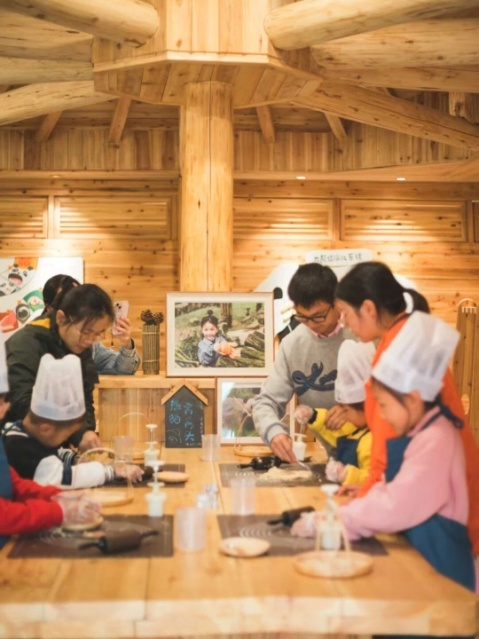
Children make handicrafts at the giant panda origin camp in Baoxing county, Ya'an, Southwest China's Sichuan Province. (Photo provided to People's Daily)
According to Chen Yang, delivering nature education programs inside the Giant Panda National Park helps raise public awareness of biodiversity conservation while promoting mutually reinforcing development in ecological preservation and cultural tourism.
"In the past, young people here either left for jobs elsewhere or stayed home farming," Chen Yang said. "Now, the giant panda origin camp and Dengchigou scenic area have created a variety of jobs, including science interpreters, educational instructors and homestay managers, attracting many young people back."
Born and raised in Baoxing, barista Chen Yi previously worked in the beverage industry in Chengdu, the capital of Sichuan province.
"After the Giant Panda National Park was established, I quit my job in the city and joined the café, securing a stable job close to home," Chen said.
Outside working hours, Chen Yi also studies environmental education courses alongside instructors and occasionally helps lead experiential programs, becoming part of this "classroom in nature."
"We are promoting coordinated development between ecological conservation and improvements in people's livelihoods through measures such as creating ecological management jobs and developing ecotourism and environmental education," Wang said.
"These efforts continue to strengthen local residents' sense of gain and happiness associated with the national park," he added.
In 2025, Baoxing received 4.63 million tourist visits and generated more than 4.08 billion yuan (about $602.32 million) in tourism revenue, with ecological and cultural tourism becoming an important engine of local economic growth.

Photo shows giant pandas in Baoxing county, Ya'an, Southwest China's Sichuan Province. (Photo courtesy of the media center of Baoxing county)