


As artificial intelligence (AI) accelerates the transformation of global industries, a new form of digital trade is emerging in the southern Chinese city of Shantou: exporting computing services measured not in physical goods but in AI tokens.
In late April, Shantou, Guangdong Province completed full-chain verification for token exports, a model in which computing power remains within China while high-value AI services are delivered to overseas users. Within just one month, average daily token usage surged from 100 million to the tens-of-billions level.
The practical application of this model is already well underway.
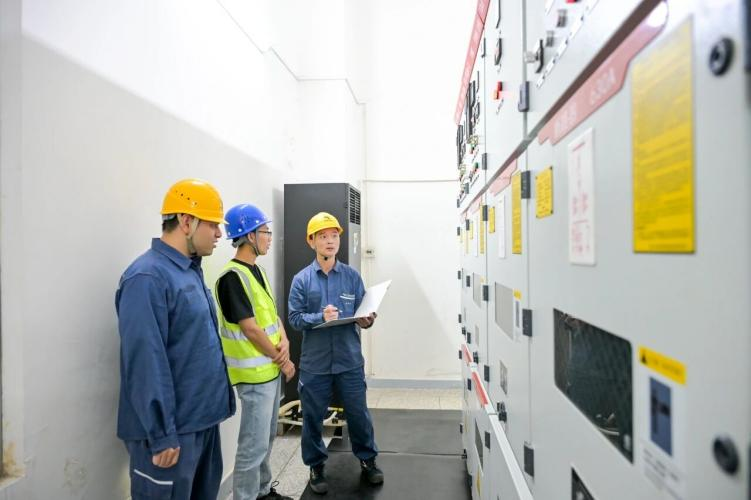
Staff from China Southern Power Grid's Haojiang Power Supply Bureau in Shantou, South China's Guangdong Province, inspect power consumption conditions at the Shantou international submarine cable landing station. (Photo provided to People's Daily)
Recently, when a user in Singapore activated an AI-powered toy and gave a simple command: "Tell me a fairy tale." The spoken request traveled through the network directly to a dedicated overseas computing zone inside a computing center in Shantou.
Locally deployed AI agents completed speech recognition in under one second and generated customized story content, sending the finished audio back to the Singapore-based toy device in as little as 0.1 seconds.
The user repeated the process multiple times, eventually listening to five stories in total. Approximately 100,000 tokens were consumed during the interaction and billed in real time at a rate of 2 yuan (about $0.30) per one million tokens.
When payment arrived, a complete commercial cycle was achieved, marking the successful realization of Shantou's token export model.
Tokens represent the smallest discrete calculation unit used by large AI models to process information. They have become a key indicator of intelligent computing capacity and, increasingly, a new carrier of value in the digital economy.
Inside the China (Shantou) Pilot Zone for Economic and Cultural Cooperation with Overseas Chinese, token exports are already transforming the economics of electricity.
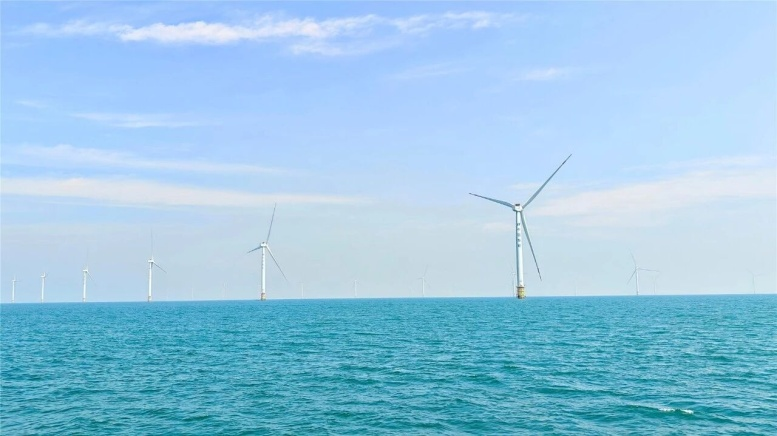
Photo shows an offshore wind farm in the waters south of Nan'ao county, Shantou, South China's Guangdong Province. (Photo: Shantou Daily)
Today, overseas users across multiple countries and regions in Southeast Asia are accessing token services generated in Shantou.
"Data flows in from abroad and all processed outputs head back overseas, with zero compromise to the end-user experience," explained Cai Qichen, an engineer at the Shantou branch of wireless carrier China Mobile. "Token costs have already been integrated into product service packages, making future usage more convenient."
According to estimates from toy manufacturer SHOWMAC, based in Shenzhen, Guangdong province, using Shantou's computing services reduces costs by more than 30 percent compared with directly purchasing overseas computing resources.
Meanwhile, inside computing centers, turning electricity into AI tokens delivers dramatic value appreciation. A kilowatt-hour of electricity, which costs roughly 0.5 yuan (about $0.07), can be transformed through AI computing into tokens and then exported at a price of 11 yuan (about $1.60), representing a twenty-two-fold increase in value.
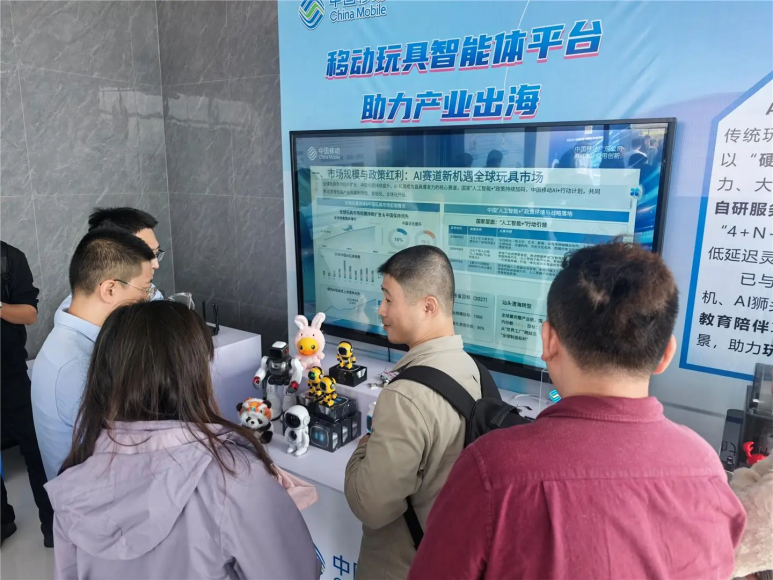
Information about AI toys is shared at a recently concluded conference on the AI toy industry ecosystem held in Shantou, South China's Guangdong Province. (Photo courtesy of the China (Shantou) Pilot Zone for Economic and Cultural Cooperation with Overseas Chinese)
As one of eastern Guangdong's major offshore wind power bases, Shantou has already connected 1.2 million kilowatts of installed capacity to China's power grid.
The electricity itself does not need to cross borders. Computing power remains within China. What gets exported instead are high-value digital services, turning electricity into a form of hard currency for cross-border digital trade.
Ultra-low network latency forms the technical backbone that makes token exports feasible.
"More than half of China's outbound bandwidth carried by international submarine cables lands in Shantou, and the city is also home to five undersea trunk cables linking destinations worldwide," said Hong Zhebin, chief technology officer of the international submarine cable landing station operated by the Shantou branch of wireless carrier China Telecom.
"The latency between Shantou and Singapore is only 32.7 milliseconds, quicker than the blink of an eye," Hong added.
Hong Yu of the Shantou branch of China Mobile added that Shantou's overseas computing services offer stable response speeds, regulatory compliance and substantial cost advantages.
"Our pricing is only one-third to one-half that of mainstream international platforms, while customer retention exceeds 70 percent," Hong told People's Daily.
Yet building a complete end-to-end system is only the starting point. Shantou is now attempting to transform itself from a transit city for digital infrastructure into an ecosystem hub.
Leading computing companies and developers are gathering rapidly. Pilot platforms have passed acceptance reviews. Commercial closed loops have already emerged in applications ranging from AI toys to intelligent manufacturing, with large-scale operations expected soon.
Shantou's Chenghai district has long been known as the toy capital of China. As AI becomes increasingly integrated into the toy industry, the city has launched an AI Toy Innovation Center and the Shantou AI Laboratory, striving to become the AI toy capital of China.
At the exhibition space of a local tech firm sits Amy, an AI desktop robot capable of fluid multilingual conversation.
"It is equipped with a multilingual intelligent voice interaction system capable of real-time recognition and conversation in dozens of languages," said the company's general manager, Chen Ruifeng.
The technology has already been integrated into multiple AI toy products exported to countries including the United Kingdom, Russia and Japan.
Shantou's token export model allows AI toy manufacturers to access domestic large language models at costs far below those of overseas alternatives.
"The cost of using overseas AI models can be dozens of times higher than domestic models," Chen said. The company's AI toys currently run on Chinese large models including DeepSeek and Doubao.
"Token exports have significantly increased both product value-added and international competitiveness," he said.
The Shantou branch of wireless carrier China Unicom, together with a Guangdong-based tech firm, has established dedicated lines connecting Shantou and Vietnam, delivering cross-border computing services to Aachen SV, a Chinese-invested fiber-optic company operating in Vietnam.
Vietnamese users accessing large models such as DeepSeek and Qwen experience extremely low latency with zero packet loss. "In less than a month, more than a dozen companies have approached us for consultations," an employee of the Guangdong-based tech firm said.
Meanwhile, the Guangdong branch of China Mobile has launched an OpenClaw intelligent agent framework, providing integrated AI service packages that allow traditional toys to complete intelligent upgrades in as little as 15 days.
From toys to textiles, cross-border e-commerce and high-end manufacturing, tokens are increasingly becoming the digital fuel powering Shantou's industrial upgrading.