


BEIJING, June 8 (Xinhua) -- China's State Council has released a plan for the modernization of the country's emergency response system during the 15th Five-Year Plan period (2026-2030), outlining tasks aimed at workplace safety, and disaster prevention, mitigation and relief.
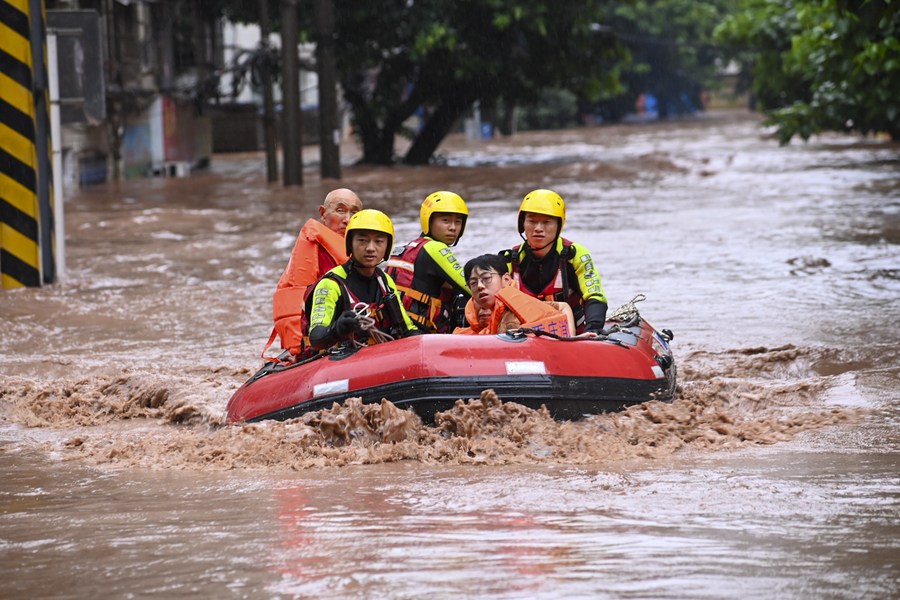
Rescuers transfer flood-trapped residents in Wanzhou District, southwest China's Chongqing Municipality, July 4, 2023. (File photo: Xinhua)
The plan emphasizes a people-centered development philosophy, prioritizing people's lives and safety, and pursuing a holistic approach to national security. It sets the theme of supporting high-quality development with high-level security, focuses on shifting the governance model toward pre-emptive prevention, and takes reform and innovation as the fundamental driving force, to comprehensively enhance the capabilities for disaster reduction, prevention, control and relief.
Efforts should be made to advance whole‑chain safety rectification in key industries, the plan says. It calls for resolutely curbing major and catastrophic accidents, minimizing losses from natural disasters, and safeguarding people's lives, property and social stability.
According to the plan, by 2030, significant progress will be achieved in modernizing the emergency management system and capacity.
A governance model that focuses on pre-emptive prevention will be effectively established, and the centralized, unified, efficient and authoritative emergency management system with Chinese characteristics will be further refined, according to the plan.
Command mechanisms under a comprehensive security and emergency framework will become more robust, and both the capacity to handle major emergencies and grassroots emergency response capabilities will be markedly strengthened. The law-based, scientific and smart emergency management will be substantially enhanced, and the work related to workplace safety, and disaster prevention, mitigation and relief will advance steadily.
An emergency management system with Chinese characteristics that is compatible with a major country that has basically achieved socialist modernization will be established by 2035, according to the plan. Law-based, scientific and smart emergency management, and virtuous interaction between high-quality development and high-level security will be fully realized.
The plan sets out five core tasks which include deepening emergency management reform and innovation to foster a comprehensive security and emergency framework; prioritizing risk control at source to accelerate the transition of governance model toward pre-emptive prevention; optimizing the layout of emergency forces to improve response to major disasters; strengthening all-factor support to bolster the guarantee system for major emergencies; and consolidating grassroots emergency foundations to enhance the capabilities of the whole society for disaster prevention and risk avoidance.
Notably, the plan lists a total of 17 key projects in five categories.