


Atlantic salmon dart through the tanks of a land-based aquaculture facility at Taowan Marine Ranch in Binhai county, an unlikely home for fish that naturally inhabit high-latitude seas where water temperatures rarely exceed 10 degrees Celsius.
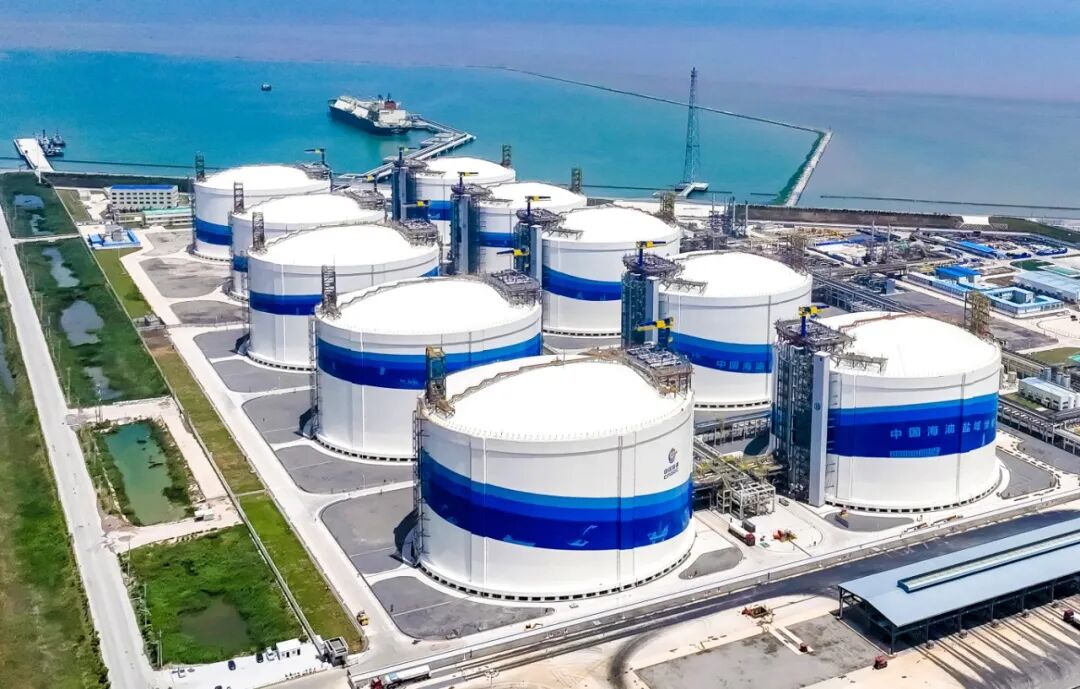
Photo shows LNG storage tanks operated by China National Offshore Oil Corporation at Binhai Port, east China's Jiangsu province. (Photos from Binhai Daily)
The county's coastal waters average above 20 degrees Celsius: far too warm for salmon. The solution lies 10 kilometers away at Binhai Port, where China National Offshore Oil Corporation operates the country's largest liquefied natural gas (LNG) reserve base, receiving about 3 million tons of LNG annually.
LNG is stored at minus 162 degrees Celsius and must absorb heat from seawater to convert back into gas for use. That process transfers enormous quantities of cold energy into the seawater: 50 kilowatt-hours per ton of LNG, or roughly 150 million kilowatt-hours a year at Binhai's throughput.
"The heat from seawater warms the gas while the LNG transfers its cold energy to the seawater," said Liu Decan, director of Binhai county’s development and reform commission.
Releasing that volume of chilled water directly into the sea would damage marine ecosystems. In June 2024, Binhai county partnered with the Yellow Sea Fisheries Research Institute of the Chinese Academy of Fishery Sciences to redirect it instead into aquaculture.
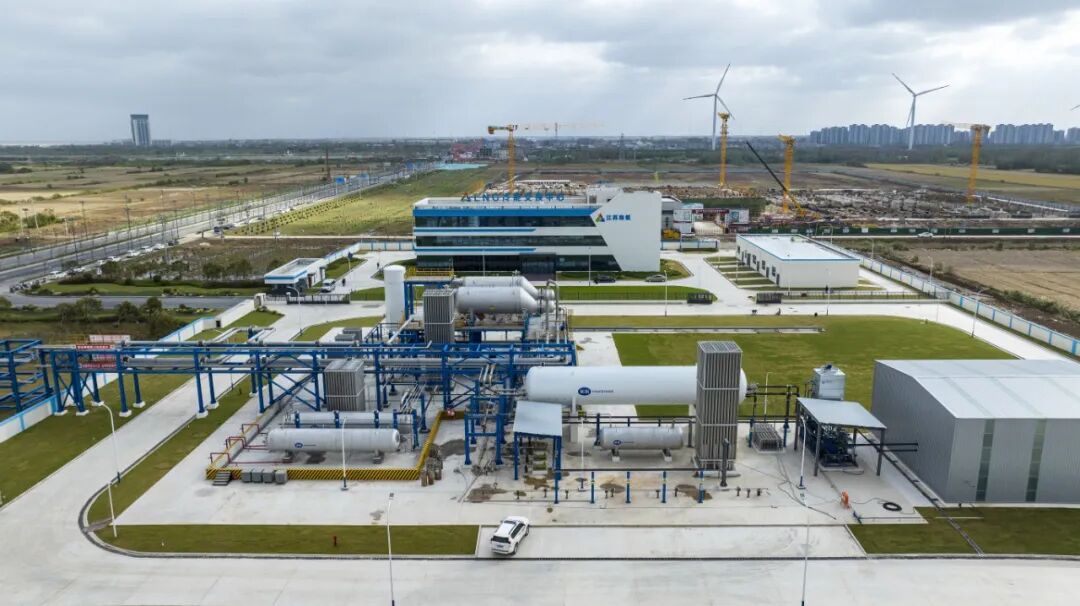
Photo shows the "cold energy hub" at Binhai Port, east China's Jiangsu province. (Photos from Binhai Daily)
Real-time temperature sensors along the delivery pipelines keep the breeding ponds at around 16 degrees Celsius.
"We expect market-ready salmon by late this year, priced over 100 yuan ($14.78) per 500 grams," said Wang Chenhao, a fish technician with over a decade of experience in freshwater species.
The first phase is already operational and the second phase will begin this year, according to Lyu Haijun, chairman of Binhai county agriculture and tourism group.
"Once fully operational, the facility will supply 3,000 tons of cold-water fish annually, generating around 200 million yuan ($295,612) in output," he said.
Aquaculture is one application among many. At the center of the Binhai Port Economic Zone stands a large silver-gray cold energy exchange hub connecting the LNG storage tanks to a broader industrial demonstration area.
With the capacity to process 2 million tons of LNG cold energy annually, the hub converts the cold energy into liquid carbon dioxide, then distributes it at different temperature ranges to facilities across the zone.
Inside the production workshop of Jiangsu Qinghe Freeze-Drying Technology Company, liquid carbon dioxide delivered at minus 46 degrees Celsius is used to dehydrate strawberries at low temperatures ‒ preserving their shape and nutritional content while commanding a significant price premium.
The freeze-dried product sells for 180,000 yuan ($26,605) per ton and is exported to European and American markets.
"Freeze-drying enterprises are major energy users," said Xu Da, assistant general manager of Jiangsu Qinghe. "Electricity accounts for half the production cost. Using cold energy reduces drying time from 22 to 18 hours, cutting costs by one third.
"After being officially put into operation this fall, we expect 7,200 tons of freeze-dried products annually, with sales reaching 1 billion yuan ($148 million)."
The zone encompasses facilities across a wide temperature range: quick-freeze cold storage at minus 40 degrees Celsius, cold chain logistics at minus 30, recreational ice facilities at minus 18, and constant-temperature manufacturing workshops at 10 degrees Celsius.
Some are still under construction. Others are already operating.
Among new projects, a marine intelligent computing center completed its main structure last year and is now fitting out.
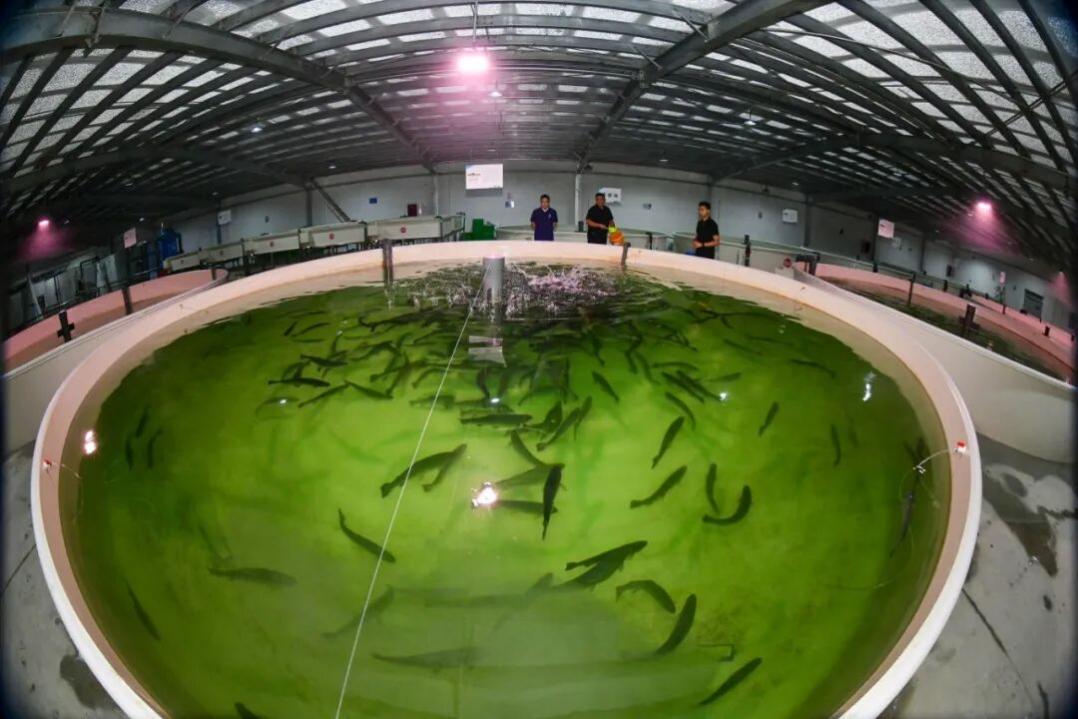
Cold-water fish are bred at a land-based recirculating aquaculture facility of Taowan Marine Ranch in Binhai county, east China's Jiangsu province. (Photos from Binhai Daily)
"The cold energy pipeline network has been linked up to the site," said Wang Huan, deputy director of the administrative committee of Binhai Port economic zone. "It will deliver reliable cooling for 3,000 server racks with an information technology computing load of 30 megawatts."
Beyond general computing, the center is intended to support offshore wind farm maintenance and marine science research simulations.
According to Kong Hui, deputy mayor of Binhai county, the cold energy industry is projected to reach 10 billion yuan ($1.48 billion) in output during the 15th Five-Year Plan period (2026-2030).