


Ahead of the G7 leaders' summit that will run from June 15 to 17 in France, French President Emmanuel Macron, whose country holds the Presidency of the G7 for 2026, is set to host a video call between the group and China to address global trade imbalances, according to Politico, citing four officials from three G7 countries familiar with preparations for the meeting.
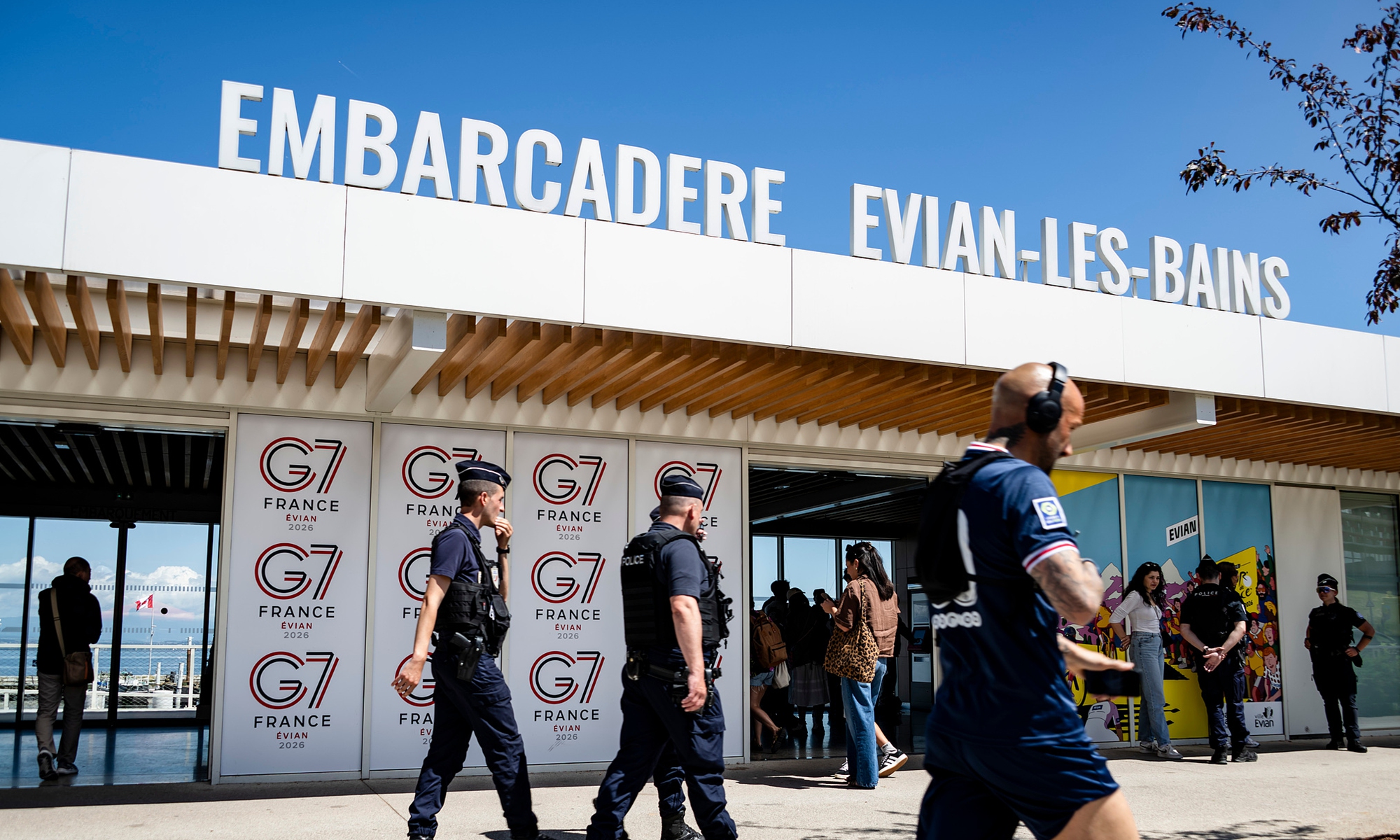
French police officers walk in front of a G7 banner in Evian-les-Bains, France, June 6 2026. The 52nd G7 Summit will take place from June 15 to 17, 2026 in Evian-les-Bains. (Photo: VCG)
As of press time, the Global Times reporters have yet to see any official statement from the Chinese side on whether China will participate in the video call.
Some Chinese analysts said that resolving China-EU trade issues calls for proactive cooperation from Europe to work together with China, while one-sided trade restrictions are unlikely to help Europe tackle its own challenges.
Two of the four officials, all of whom were granted anonymity to discuss sensitive diplomatic planning, said the call would take place Thursday ahead of next week's G7 leaders' summit in the lakeside resort of Evian-les-Bains, Politico reported.
The US media outlet commented that the call is "a notable step" for a group of Western democracies that has in recent years taken an increasingly confrontational stance toward China.
But France, which has made tackling economic imbalances a key aim of its G7 presidency this year, has taken "a more conciliatory approach" when it comes to dealing with China, Politico said. French officials argue that underinvestment in the European Union and overconsumption in the US as well as the so-called "Chinese overproduction" contributed to the current situation, according to Politico.
Dong Yifan, an associate researcher at the Institute of Country and Regional Studies at Beijing Language and Culture University, told the Global Times on Tuesday that discussions over economic and trade ties with China have gained growing traction among the US, Europe and the broader Western countries.
Noting that while it is challenging for the G7 to align on shared positions, Dong said that France could look to use the forum to test out more collaborative approaches and advance its priorities as the rotating host.
The latest development comes as China and Europe are undergoing a changing dynamic over trade-related issues. According to Reuters on Friday, the European Commission is weighing legislation that could force companies in sensitive sectors to cut reliance on single suppliers - notably in China - and diversify to at least three sources, European Trade Commissioner Maros Sefcovic claimed.
However, since late last year, leaders from multiple European countries have visited China in succession, underscoring a notable trend among European leaders to "look East."
According to a survey released in May by the European Union Chamber of Commerce in China, more European companies are maintaining or expanding their supply chains in Chinese mainland to remain competitive globally, CNBC reported.
Dong noted that opinions on China often vary among EU member states. Many European countries' views on trade with China may stem from worries about competition, and some tend to look at trade issues with geopolitical and ideological mindsets. Some within the EU are calling for stricter trade protectionist measures on China, yet these policies may not effectively address the EU's own domestic issues.
Echoing Dong, Jiang Feng, a researcher at Shanghai International Studies University and president of the Shanghai Regional Studies Association, told the Global Times on Tuesday that China has no intention of chasing a trade surplus, and finding solutions to China-EU trade issues requires efforts by the EU to work together with China. Frequent sanctions and pressure alone from Europe are unlikely to resolve existing differences.
China has made clear its position on trade-related issues between China and the Europe multiple times. At a regular press conference on June 4, Chinese Foreign Ministry spokesperson Mao Ning said that the trade cooperation between China and Europe is built on common interests. It is in essence a result of both comparative advantages and participation in market competition. Complementarity is not a risk, and convergence of interests is not a threat.
Over the past five decades or so, the annual trade volume between China and Europe has soared by over 300 times, with two-way investment totaling nearly US$260 billion. The figures are a strong testament to the robust momentum and promising prospects of China-EU cooperation, Mao said.
"Trade protectionism is against the laws of economics and serves no one's interests. We hope the European side can view our trade ties in an objective and rational manner, and work with China to shorten the list of problems and make the pie of cooperation bigger for win-win results," the spokesperson noted.