


Held in Shenyang, Liaoning Province in Northeast China on Tuesday, the 2026 ASEAN-China Media Cooperation Forum gathered some 150 delegates from governmental bodies, media institutions, think tanks, enterprises and international organizations. Participants exchanged views in a cordial atmosphere and held thorough discussions on ways to further expand bilateral media engagement and collaboration.
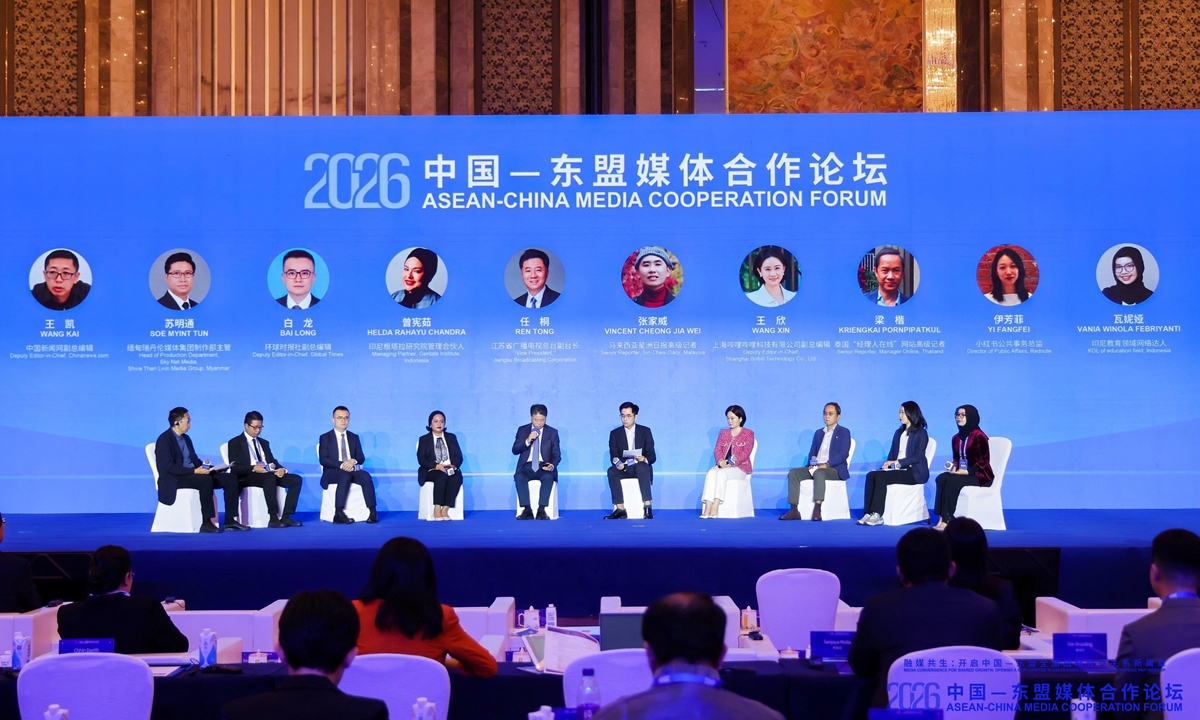
Participants attend the 2026 ASEAN-China Media Cooperation Forum in Shenyang, Northeast China's Liaoning Province on June 9, 2026. (Photo: Courtesy of CICG)
Under the theme "Media Convergence for Shared Growth: Opening a New Chapter in the ASEAN-China Comprehensive Strategic Partnership," the forum was held at a significant moment: The year 2026 marks the 35th anniversary of the establishment of China-ASEAN Dialogue Relations, as well as the fifth anniversary of the China-ASEAN Comprehensive Strategic Partnership.
First launched in 2018, the event is co-organized by the China International Communications Group and the China-ASEAN Center. Now in its ninth year, it has grown into a vital institutional platform for media interaction and collaboration between China and ASEAN.
President of CICG Chang Bo delivered the opening address on Tuesday. He noted that media plays a unique role in deepening mutual understanding and fostering emotional connections between peoples. He voiced the hope that closer media cooperation will foster a sound public opinion environment for ASEAN-China collaboration, strengthen people-to-people bonds and solidify the friendship between the two sides.
Khammone Chanthachith, a deputy head of the Propaganda and Training Committee of the Central Committee of the Lao People's Revolutionary Party, shared similar views. He noted that media acts as an essential bridge for building trust and enhancing understanding, and expressed confidence that deeper media cooperation will usher in a new chapter for ASEAN-China relations.
Undersecretary of State at Cambodia's Ministry of Information Prak Thaveak Amida said digital transformation and technological progress have brought new opportunities alongside challenges such as misleading content and disinformation. He stressed the need to bolster cooperation frameworks and called on media from China and ASEAN to uphold professional credibility, leverage new media platforms, and jointly present inspiring stories of ASEAN-China friendship.
On Tuesday, two round-table dialogues were also held during the forum, themed "Social Responsibility and the Media's Mission in Our Times" and "Innovative Practices and Diversified Development in the Digital Age," respectively.
Participants agreed that media organizations from both sides should step up exchanges and cooperation to reinforce mutual trust and friendship, and contribute to building a closer ASEAN-China community with a shared future. In the digital media landscape, they also pledged to advance sound public opinion governance, improve the global media ecosystem and amplify the voice of the Global South.
Besides, two new initiatives were unveiled at the forum: the ASEAN-China Social Media Content Creators Programme and the 2026 ASEAN-China Youth Cultural Heritage Tour Series.
According to organizers, the programmes aim to encourage young people across China and ASEAN to create innovative digital stories, so that the long-standing friendship between the two sides can reach wider audiences.
Nararya S. Soeprapto, a deputy secretary-general of ASEAN, hailed ASEAN-China relations as one of the most dynamic partnerships worldwide. He pointed out that China has been ASEAN's largest trading partner for 17 consecutive years, while ASEAN has ranked as China's top trading partner over the past six years.
Nararya also underscored media's value in nurturing mutual trust, deeper understanding and friendship.
In an interview with the Global Times, he said he has decades of experience working on ASEAN affairs. Over the past 30 years, he has witnessed remarkable progress in all-round exchanges between China and ASEAN. Media has been instrumental in strengthening bilateral relations by covering people-to-people exchanges as well as trade and investment cooperation.
"People to people connectivity is one of the most important elements in building a comprehensive strategic partnership between China and ASEAN," he remarked, adding that people want to learn about one another through news and stories, and media serves as a crucial channel to spread these stories and further cement our bilateral ties
He urged media outlets on both sides to keep fostering rapport and collaboration to enhance mutual understanding across all sectors, adding that the annual media forum is an important undertaking that should be continued.
Buji Babiera, a Filipino content creator with 3.8 million followers on TikTok, told the Global Times on the sidelines of the forum that he is impressed by China's rapid development and advanced technologies, and hoped his vlogs about China would help more people form an objective and rational perception of the country, instead of being misled by politicians' nationalist rhetoric.
Showing Instagram posts that capture his friends' travels in Southwest China's Yunnan Province, he asked the reporter: "Have you visited these spots? I truly hope to go there someday."