


China's JUNO publishes first physics result in Nature
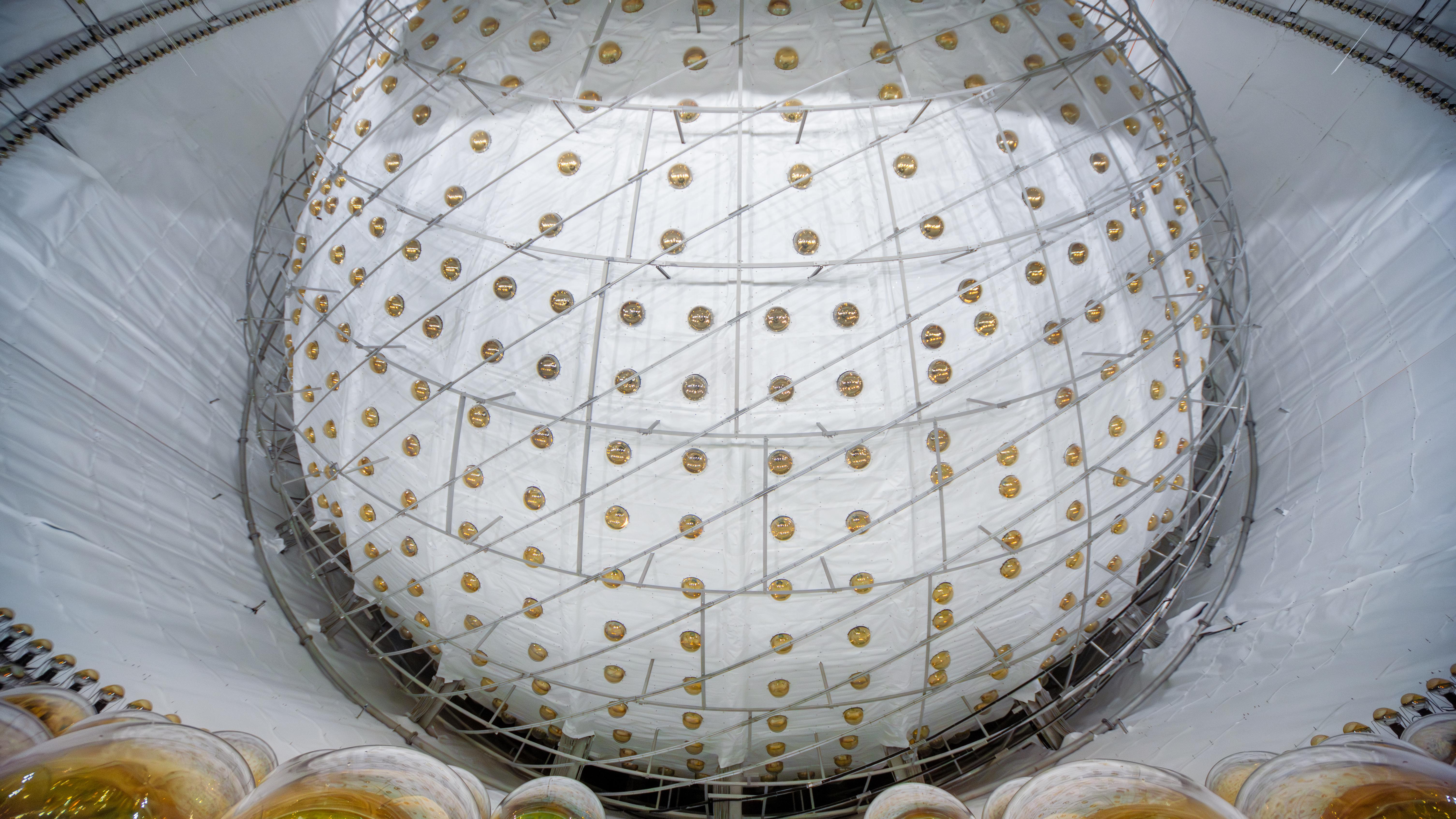
The Jiangmen Underground Neutrino Observatory. (Photo: CMG)
The Jiangmen Underground Neutrino Observatory (JUNO) has published its first physics result in the journal Nature, with the study appearing as a cover article on Wednesday.
Titled Precise Measurement of Two Neutrino Oscillation Parameters, the paper reports high-precision measurements based on 59 days of effective data collected between August 26 and November 2, 2025. The research team achieved precision levels 1.6 times better than those obtained from the combined results of multiple experiments conducted over the past several decades.
The two oscillation parameters can be measured using either solar neutrinos or reactor neutrinos. Previous measurements obtained through these two approaches differed by about 1.5 standard deviations, a discrepancy known in the scientific community as the "solar neutrino tension."
Using reactor neutrino data, the JUNO experiment confirmed that the discrepancy still exists. Researchers said the result demonstrates that the detector has achieved its design performance and is capable of conducting high-precision physics research.
Neutrinos are electrically neutral particles with extremely small masses. They interact only through the weak nuclear force, giving them extraordinary penetrating power and making them notoriously difficult to detect. Among the known fundamental particles, neutrinos remain some of the least understood.
JUNO, one of China's major scientific facilities, officially began operations in August 2025. Its primary scientific objective is to determine the neutrino mass ordering. The experiment is also designed to precisely measure three of the six neutrino oscillation parameters with better than one percent precision, while supporting studies of supernova neutrinos, geoneutrinos, solar neutrinos and atmospheric neutrinos.
Located 700 meters underground in south China's Guangdong Province, the detector is centered on a 20,000-tonne liquid scintillator contained within a 35.4-meter-diameter acrylic sphere. The detector is immersed in a 44-meter-deep water pool and supported by a stainless-steel structure measuring 41.1 meters in diameter.
The facility is equipped with 20,000 20-inch photomultiplier tubes and 25,000 3-inch photomultiplier tubes. Working together, these sensors detect flashes of light produced when neutrinos interact with the liquid scintillator and convert them into electrical signals, enabling highly precise measurements of neutrino energy and oscillation parameters.
JUNO has now been operating steadily for nine months. Researchers expect that as more data are collected, a series of new findings will follow, helping scientists gain deeper insights into the properties of neutrinos and the fundamental workings of the universe.