


BEIJING, June 12 (Xinhua) -- The Three Gorges new waterway project, China's first major project launched during the 15th Five-Year Plan period (2026-2030), is set to unlock the full development potential of the Yangtze River, the world's busiest inland waterway, a guest speaker said during the latest episode of China Economic Roundtable, an all-media talk show hosted by Xinhua News Agency.
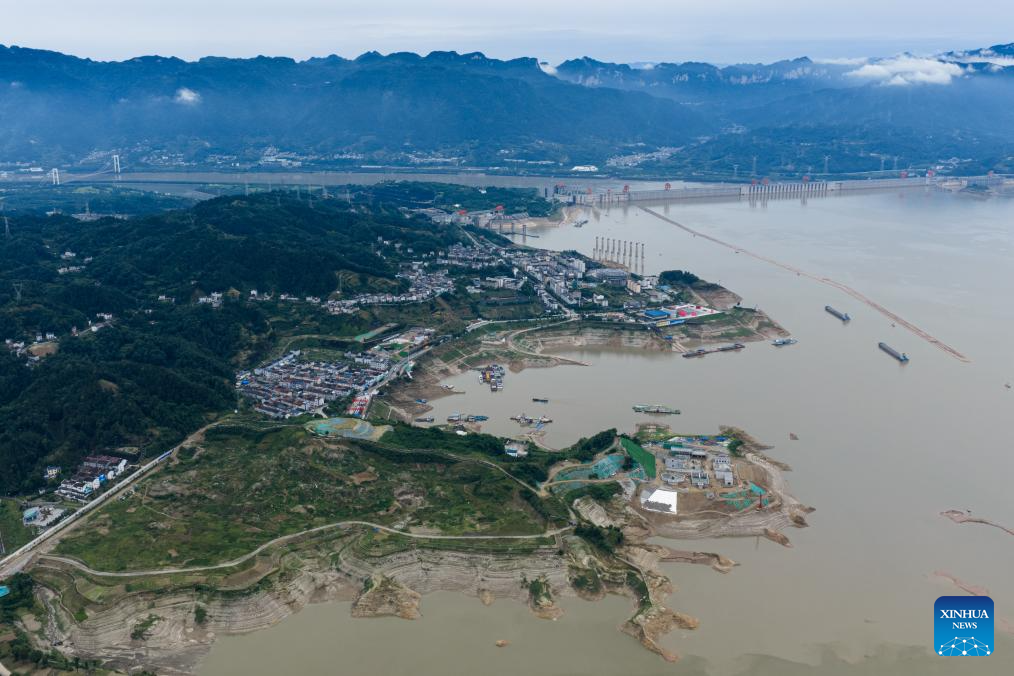
An aerial drone photo taken on June 8, 2026 shows the construction site of a new ship lock and its approach channels of the Three Gorges new waterway project in Yichang, central China's Hubei Province. (Photo: Xinhua)
This project will amplify the Yangtze's function as a transport artery connecting China's eastern coastal regions and western inland areas and also enhance interconnectivity between the Yangtze waterway and China's north-south transport arteries, forming an integrated multidimensional transport network, said Niu Xinqiang, an academician of the Chinese Academy of Engineering.
Upon completion, the annual throughput capacity of the Three Gorges will rise to 336 million tonnes from the current 170 million tonnes, while that of the Gezhouba Dam will reach 360 million tonnes, enabling 10,000-tonne vessels to sail directly from southwest China's Chongqing to Shanghai at the Yangtze estuary in east China.
Furthermore, the project will strengthen the Yangtze's role as a key interface between China's domestic and international circulations, Niu added.
Niu said that the project will improve connectivity between the Yangtze River Economic Belt and the Belt and Road Initiative, enhance the supply chain resilience of enterprises in the Yangtze River Delta, and enable made-in-China products to access global markets more smoothly.
Gao Peng, deputy chief engineer of the China Three Gorges Corporation, the project's implementing entity, told the roundtable that all relevant parties are committed to developing the project into a high-quality, green and safe landmark project, to support the high-quality development of the Yangtze River Economic Belt.
Launched in 2016, the Yangtze River Economic Belt now contributes 47.3 percent of China's total economic output, up from 42.2 percent a decade ago, according to National Development and Reform Commission data released in January this year.
Stretching over 6,300 kilometers before emptying into the East China Sea, the Yangtze is China's longest river. The Yangtze trunk line has remained the world's busiest inland waterway for years, with its annual cargo throughput surging 71 percent to 4.2 billion tonnes over the past decade, official data showed.