


Hami-Chongqing ±800 kV UHVDC power project marks 1 year operation
The Hami-Chongqing ±800 kV ultra‑high voltage direct current transmission project marked its first year of stable operation on Wednesday. The project starts from Hami in Northwest China's Xinjiang Uygur autonomous region, and stretches 2,260 kilometers through Gansu, Shaanxi and Sichuan provinces, ultimately reaching Chongqing, delivering wind and solar power from northwestern China's Gobi Desert to industrial centers in the southwest.
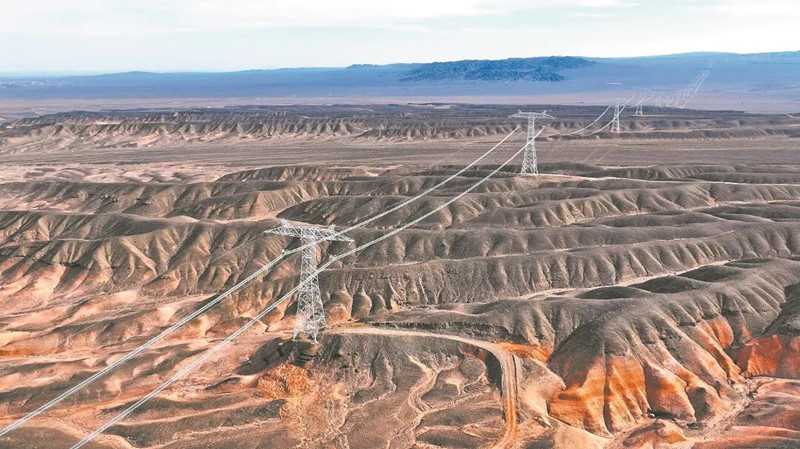
A view of the Xinjiang section of the Hami-Chongqing ±800 kV ultra‑high voltage direct current transmission project. (Photo by Ma Yuan/For chinadaily.com.cn)
According to State Grid Xinjiang Power Company, over its first year of operation, the project has transmitted 25.1 billion kilowatt-hours of electricity. From January to May, it delivered more than 10 billion kWh of green power, meeting 6 percent of Chongqing's total electricity demand. Its maximum single-day transmission reached 130 million kWh.
With a total investment of 28.6 billion yuan ($4.22 billion), the line is China's first UHVDC transmission project built to deliver power from a new energy base in a desert, Gobi or barren land, and the first such receiving channel in southwestern China.
Its supporting power sources have a combined installed capacity of 14.2 gigawatts, with wind, photovoltaic and solar thermal power accounting for more than 70 percent. The project has pioneered a multi-energy complementary system that ensures stable long-distance transmission of a high proportion of renewable energy, breaking the traditional reliance on thermal power.
Designed to transmit 36 billion kWh annually — with clean energy accounting for more than half — the project is a landmark in China's green and low-carbon energy transition, the company said.
It addresses the spatial mismatch between Xinjiang's abundant but under-consumed clean energy and Chongqing's strong electricity demand, which faces the dual pressures of supply security and green transformation.
According to the company, the project has driven over 100 billion yuan in upstream and downstream investment and created more than 30,000 jobs, boosting local equipment manufacturing, energy services, infrastructure and logistics.
For Chongqing, on the other hand, imported green power has helped cut local coal-fired generation, while providing stable, affordable clean electricity for advanced manufacturing, new materials and big data computing.
The company said as of May, Xinjiang's power grid had over 50,000 km of 220 kV and above transmission lines, including 14,800 km of 750 kV ultra‑high voltage transmission lines and 1,113.92 km of 800 kV and above lines.
Meanwhile, Xinjiang's total installed power capacity exceeded 261 GW, with new energy installations reaching 167 GW, accounting for over 60 percent. Xinjiang has built six renewable energy bases of 10 GW each.