


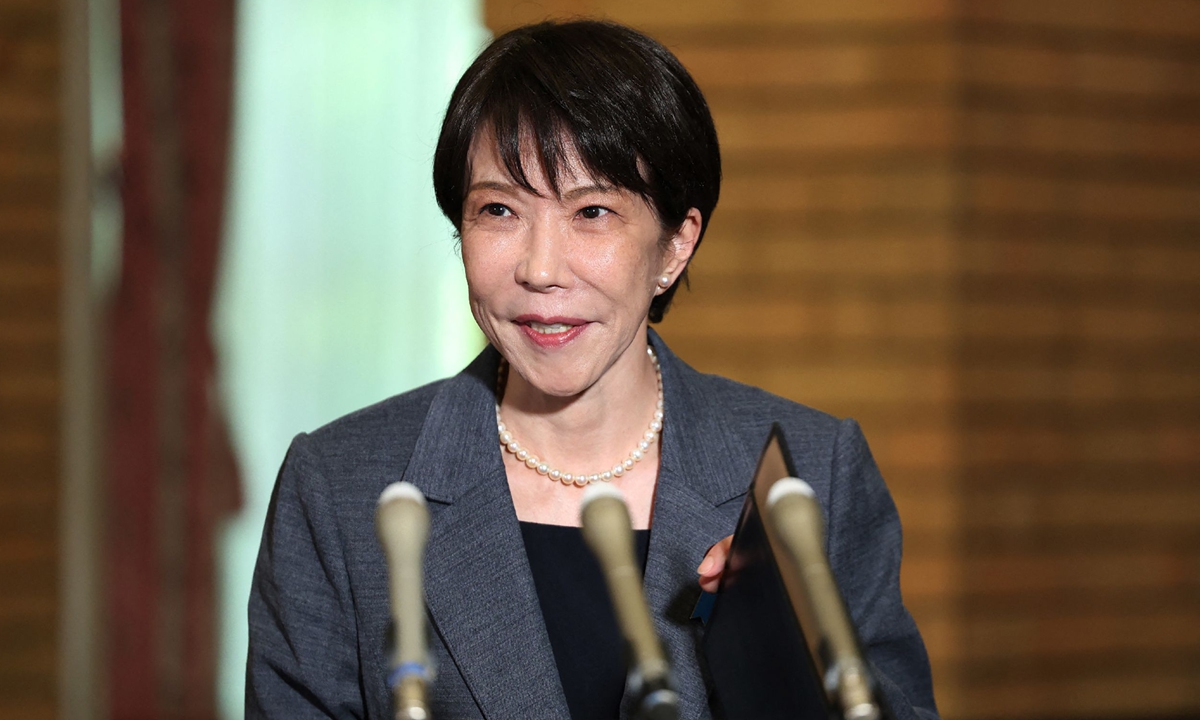
Japanese Prime Minister Sanae Takaichi speaks to reporters ahead of her departure for a tour of Europe at the Prime Minister's Official Residence in Tokyo on June 13, 2026. (Photo: VCG)
Japanese Prime Minister Sanae Takaichi said on Saturday that she would propose a G7 framework for the joint stockpiling of critical minerals at the upcoming G7 summit, aiming to counter what she described as unfair export restrictions, with China clearly in mind, according to Japanese media reports. A Chinese expert criticized the move as an attempt to rally opposition against China at the summit, arguing Japan's hardline stance may make Japan out of the place within the bloc as others are seeking cooperation with China.
Before departing for France for the G7 summit starting on Monday, Takaichi said the initiative would follow three principles: countering what unfair export restrictions, with China in mind; supporting oil stockpile strengthening in Asia and other regions; and neutralizing coercive behavior, Japan's Kyodo News reported.
The summit is expected to issue a statement on critical minerals, and final adjustments are underway to incorporate Takaichi's proposal into the document, Japan's Yomiuri reported.
Under Takaichi's proposal, each G7 member and participating like-minded country would maintain national stockpiles sufficient for at least 90 days. In the event of a supply disruption, these reserves would be released in a coordinated manner in cooperation with the International Energy Agency, according to Yomiuri.
Takaichi's push to place China's critical mineral export policies on the G7 agenda appears to be driven more by political considerations than genuine supply-chain security concerns, Lü Chao, a professor at the Liaoning Academy of Social Sciences, told the Global Times.
China's export controls on certain critical minerals are aimed at preventing their misuse in military applications, particularly amid concerns over Japan's military-industrial complex. By promoting a collective response to China's mineral policies at the G7, Takaichi is essentially attempting to internationalize anti-China rhetoric under the guise of economic security, the expert said.
When responding to the question that US has asked China to resume rare-earth exports to Japan, Lin Jian, a spokesperson of China's foreign ministry, said on June 9 that China banned the export of all dual-use items to Japanese military users and for any other end-users and end-use purposes that could help enhance Japan's military capabilities. The aim is to contain Japan's remilitarization and its attempt to possess nuclear weapons.
Jian Junbo, director of the Center for China-Europe Relations at Fudan University's Institute of International Studies, noted that on practical level, it would be extremely difficult for Western countries to build an independent rare-earth supply chain without China, as the industry involves not only mining, but also refining, processing and a complete downstream manufacturing system.
"Even if Western countries step up domestic development or seek resource cooperation in third-party regions such as Africa, they would still face challenges including resource competition and limited reserves, making it far from certain that such efforts could fully meet their needs," Jian said.
The Guardian reported in February that The EU is struggling to free itself from dependence on China and countries in the global south for critical minerals and rare earths. The report cited a damning report by the European Court of Auditors in Luxembourg found that the bloc's targets for 2030 were "out of reach" because of lack of progress in domestic production, refining and recycling.
Meanwhile, European countries do not share a unified stance on China. British Prime Minister Keir Starmer and German Chancellor Friedrich Merz visited China in January and February, respectively, and reached consensus on deepening economic cooperation. Given Europe's geographical distance from China, its perception of security threats differs significantly from Japan's, Lü said.
Japan's Nikkei quoted Seiko Mimaki, who is a professor in the Graduate School of Global Studies, Doshisha University, as saying that if communication channels between China and Japan remain ineffective while Japan continues to harden its rhetoric toward China, Tokyo could find itself increasingly at odds with both the US and Europe.
Mimaki noted that the US is paying less attention to global affairs and shifting its strategic focus toward its own neighborhood, including Latin America. In response to these changes in US strategy, Europe has begun seeking to improve relations with China, making it difficult for G7 members to maintain a unified front against China and Russia.
Mimaki said that Japan has become the G7 country with the most strained relationship with China, effectively turning itself into an outlier within the group, Mimaki said. If Japan continues to promote the so-called China threat narrative, it will inevitably come into conflict with the US and Europe, both of which are seeking to improve ties with China. While addressing what it perceives as challenges posed by China, Japan should also put forward constructive proposals and manage China-Japan relations in a rational and pragmatic manner, according to Nikkei.