


China's pumped-storage hydroelectricity industry is gearing up for opportunities during the 15th Five-Year Plan (2026-30) period, serving as a critical engine for the nation's green transition and long-term energy security, said experts.
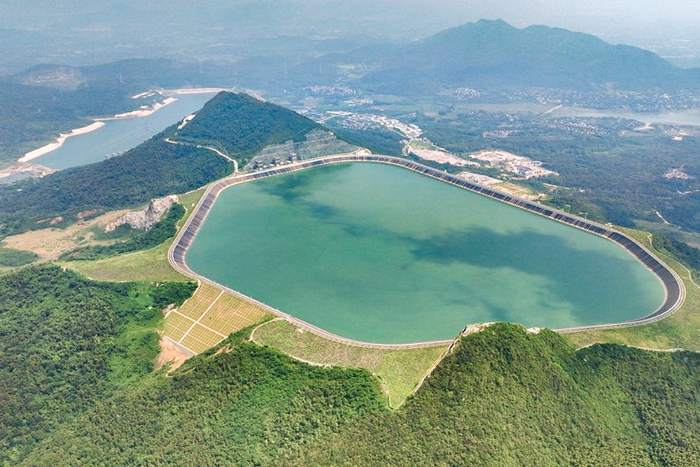
Built by a subsidiary of State Grid Corp of China, the fully operational facility has a total installed capacity of 1.35 gigawatts. (Photo: State Grid Corp of China website)
During the next five years, the country expects to see some 100 million kilowatts of new pumped-storage capacity become operational, with an average annual rollout exceeding 20 million kW, placing the industry at a new high, they said.
"Pumped-storage is to play an increasingly irreplaceable role in expanding the scale and quality of new energy, ensuring the safe and stable operation of the power system," said Zhao Zenghai, deputy head of the China Renewable Energy Engineering Institute.
Zhao said he believes that compared with the 14th Five-Year Plan (2021-25) period, the sector's development scale is expected to experience a rapid leap.
The 100 million kW of newly commissioned capacity is roughly 1.5 times the nation's total cumulative capacity at the end of 2025, with China's total operational pumped-storage capacity projected to reach around 160 million kW by 2030, he said.
Concurrently, the country will actively and systematically advance the construction of approved projects, striving to meet the power system's demand for 400 million kW of flexible capacity by 2035.
These insights were highlighted in the Pumped-Storage Industry Development Report 2025, recently released by the institute in Beijing.
The report noted a highly optimized spatial layout for the coming years. While projects during the 14th Five-Year Plan were heavily concentrated in eastern load centers to address peak-shaving demand in developed areas, the 15th Five-Year Plan will foster a new pattern of coordinated development between eastern load centers and new energy-rich regions in central and western China.
"While closer synergy with new energy will effectively smooth output fluctuations and substantially boost the utilization and consumption of renewables, it will also provide vital regulatory support for cross-provincial power transmission from new energy mega-bases, significantly enhancing the efficiency of transmission corridors," said Zhao.
Ye Xiaoning, a senior engineer at the State Grid Energy Research Institute, said pumped-storage power stations are expected to further solidify their role in system regulation in the years to come.
"In addition to leveraging their peak-shaving and valley-filling capabilities to rapidly respond to grid demands in the central and eastern regions, they will also be serving as vital regulatory support for outbound power transmission in the new energy-rich western and northern regions, effectively smoothing out wind and solar fluctuations and boosting the utilization of new energy," Ye said.
Pumped-storage power stations have been playing a powerful regulatory role within the power system, boasting outstanding peak-shaving and valley-filling capabilities, he added.
Capable of rapidly responding to grid regulation demands, smoothing out the volatility of wind and solar power generation, and effectively enhancing the integration and utilization of new energy, the industry has transitioned from mere scale expansion to prioritizing both scale and quality in recent years, placing greater emphasis on economic viability, safety and ecological friendliness, Ye said.
Technological innovation is also taking center stage. According to the institute, the next five years will see breakthroughs in large variable-speed units and stable operations under wide load ranges, alongside the widespread application of digital and smart technologies across the industrial chain to better meet the flexible regulation needs of a modern power system.
The robust momentum in China's new energy sector aligns seamlessly with its global leadership, said Francesco La Camera, director-general of the International Renewable Energy Agency.
A main driver of the global renewable capacity additions in 2025, which hit a record 692 gigawatts, China accounts for over 60 percent of global capacity additions, playing a leading role across the board in electric vehicles, energy storage deployment and grid investment, he said.