


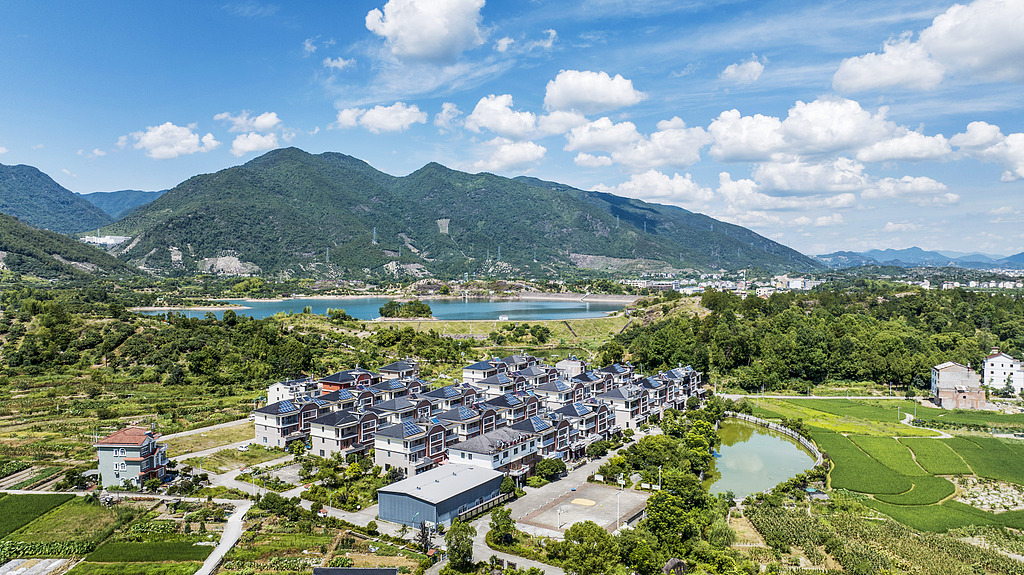
A file photo of Xianju County, one of the examples of Zhejiang's "Thousand Villages Demonstration and Ten Thousand Villages Renovation" Project. (Photo: VCG)
In his book Principles for Dealing with the Changing World Order, renowned investor Ray Dalio observes that Chinese policymakers operate on a multigenerational time horizon. He said Chinese policymakers favor broad, incremental, and forward-looking thinking that aligns with historical patterns over hundreds or even thousands of years, contrasting with shorter-term political cycles common in Western democracies.
In practice, the governance of the Communist Party of China (CPC) is indeed distinguished by its strong strategic orientation. Rather than reacting to electoral cycles, the Party anchors national development in a layered, coherent planning framework that connects five-year plans to longer-term strategic goals.
This year marks the 105th anniversary of the CPC, now the world's largest ruling party with over 100 million members. Its enduring governance role is closely linked to one of its defining features: a sustained commitment to long-term strategic vision that transcends short-term political cycles.
Long-term strategic vision
Chinese President Xi Jinping once told then Italian Prime Minister Giuseppe Conte that China does not measure progress in decades alone, but in centuries and even millennia. This reflects a governing philosophy that prioritizes long-range national rejuvenation over short-term gains.
This strategic patience is not new. During the period of the CPC's Eighth National Congress, Mao Zedong said that it will take 50 to 100 years to build China into a strong and prosperous socialist country. Such statements highlight a consistent thread in CPC governance: development as a historical process rather than a cyclical political timetable.
This long-term orientation is institutionalized through a multi-tiered planning architecture.
At the top level are China's long-term national goals, known as the "Two Centenary Goals." The first goal was to build a moderately prosperous society in all respects by 2021, the 100th anniversary of the CPC. The second is to turn China into a modern socialist country that is prosperous, strong, democratic, culturally advanced, harmonious and beautiful by 2049, the centenary of the People's Republic of China.
Bridging these long-term goals is the five-year planning system. These plans act as a bridge between strategy and action. Each planning period is aligned with the CPC National Congress, ensuring that political direction and economic policy stay consistent. This system allows China to maintain policy continuity over time, while still adjusting priorities when circumstances change.
Supporting this framework are more detailed national and local plans focused on specific sectors. Examples include the Plan on Building the Rule-of-Law China (2020–2025) and the Outline of the Plan for the Construction of China into an Education Powerhouse (2024-2035). Together, these plans connect different regions and policy areas into a more coordinated national development strategy.
At the execution level, annual mechanisms set these long-term plans into motion. The Central Economic Work Conference sets the country's key economic priorities each year. These priorities are then translated into concrete targets through the "Two Sessions," where government work reports outline specific goals and tasks for the year ahead. In this way, long-term strategies are steadily broken down into short-term, actionable steps.
Taken together, this multi-layered system links long-term vision with near-term delivery, forming a governance cycle that integrates strategy, planning, and implementation.
From planning to practice
Zhejiang's "Thousand Villages Demonstration and Ten Thousand Villages Renovation" Project illustrates this long-term planning approach.
Launched in 2003 under the leadership of Xi, then Party secretary of east China's Zhejiang Province, the initiative aimed to improve rural living conditions through large-scale ecological and infrastructure upgrades. Its original goal was to renovate around 10,000 villages and develop 1,000 model villages within five years.
Rather than being a short-term campaign, the project evolved into a sustained, long-term transformation effort. Over more than a decade of continuous implementation, Zhejiang's rural environment and living standards improved significantly. In 2018, the program received the United Nations "Champions of the Earth" award, recognizing its contribution to sustainable development.
Similar long-term strategies can be seen across China's policy landscape.
In poverty alleviation, the CPC adopted a precision-targeting approach, mobilizing millions of grassroots cadres over nearly a decade of sustained effort. This campaign ultimately eliminated absolute poverty in China, marking a historic milestone in global poverty reduction.
In ecological governance, China has rolled out landmark policies such as the 10-year fishing ban on the Yangtze River and pledged to peak carbon emissions before 2030 and achieve carbon neutrality before 2060. These initiatives reflect China's long-term commitment to environmental sustainability over short-term economic gains.
In regional development, China has steadily advanced coordinated regional development strategies such as the Beijing-Tianjin-Hebei and the Yangtze River Delta integration, aiming to reduce regional disparities. A more recent example is the Chengdu-Chongqing economic circle, proposed in 2020. Within five short years, the key region's economic output surpassed 9 trillion yuan ($1.3 trillion) accounting for 30.3% of western China's economy - demonstrating how sustained planning translates into tangible regional growth.
Across more than a century of development, the CPC has consistently governed with a long-term perspective. Rather than reacting to short-term fluctuations, it has relied on strategic planning, institutional continuity and gradual reform to address complex development challenges. As China enters a new stage of development amid an increasingly uncertain global environment, this emphasis on long-term thinking will continue shape the country's future.