


China's next-generation production line to bring thinner, cheaper displays to global laptops, tablets
CHENGDU, June 17 (Xinhua) - China's first next-generation flexible display production line began mass production on Wednesday in Chengdu, the capital of Sichuan Province, set to deliver thinner, cheaper displays to laptops and tablets worldwide.
Operating one of the world's first Gen-8.6 AMOLED production lines, BOE Technology Group Co., Ltd. mainly targets medium-sized premium display panels for laptops and tablets.
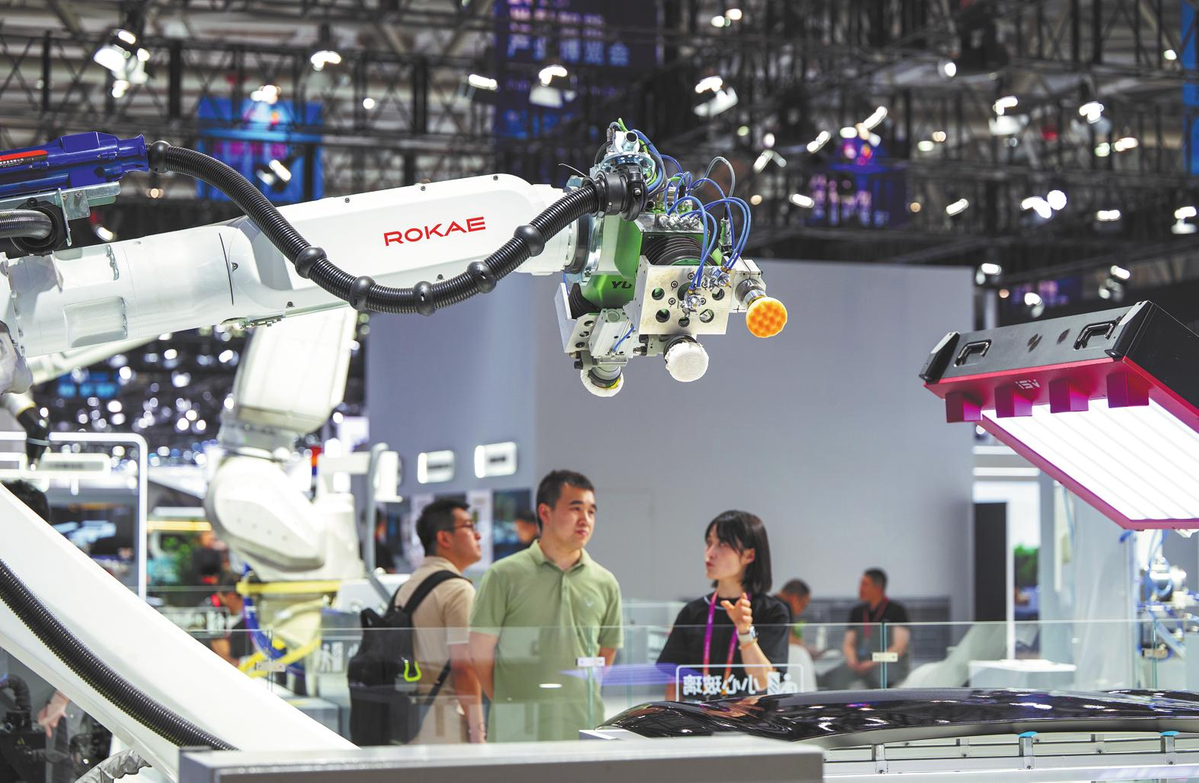
A Rokae robot demonstrates its automatic paint defect sanding technology to visitors during the World Smart Industry Expo 2025 in Chongqing on Sep 5, 2025. (Photo: China Daily)
Compared with traditional liquid-crystal displays, AMOLED, or active-matrix organic light-emitting diode (OLED), is a display technology that delivers purer blacks, richer colors, and thinner panels that can potentially bend.
With an investment of 63 billion yuan (9.3 billion U.S. dollars), the new line is China's largest single industrial project in the display sector, covering a land area of 92.5 hectares, the size of about 130 standard football fields.
It has a designed capacity of 32,000 glass substrates per month, each measuring 2.29 meters by 2.62 meters.
Now, only China and the Republic of Korea (ROK) operate next-generation AMOLED production lines of this kind, with BOE's facility being one of the most advanced and fastest to reach mass production of medium-sized displays.
Feng Qiang, CEO of BOE, said the company will continue to boost R&D investment and deepen cooperation with top terminal brands to promote OLED adoption in the IT sector. With the launch of the new line, over 200 upstream and downstream suppliers are poised to join forces, sparking a wave of collaborative upgrades across the entire supply chain.
As one of the world's largest display panel manufacturers, BOE has a number of manufacturing bases across China, including Beijing, Hefei, Chengdu and Chongqing. Its subsidiaries span over 20 countries and regions such as the United States, Germany, Japan, the ROK, Singapore, India, Brazil, and the United Arab Emirates.
The operation of the production line marks a milestone in China's OLED display expansion from small mobile phone screens to medium-sized IT devices, said Geng Yi, a senior researcher at the China Center for Information Industry Development. "It is not just about bigger screens but represents a full technological upgrade, requiring advances in glass substrates, luminescent materials and driver chips."
From the consumers' perspective, Geng said, mass production means more mid- to high-end laptops and tablets worldwide will feature AMOLED screens, making devices like foldable laptops thinner, more energy-efficient and easier on the wallet than ever before.
As a tech hub in southwest China, Chengdu is home to over 100 major display companies, with the sector's revenue reaching 109 billion yuan in 2025, up 17.2 percent year on year. The industry has logged double-digit growth for five consecutive years, forming a full-chain ecosystem spanning materials and equipment to display panels and end-user applications.
When the new AMOLED line reaches full production capacity, flexible displays made in Chengdu are expected to account for more than 20 percent of the global market share, according to the estimations of the city's high-tech zone.
The new-generation display industry is also offering development opportunities for global companies, with multinational players across the supply chain, such as Messer, Idemitsu Kosan and LG Chem, accelerating their presence in Sichuan.
China stands as the world leader in both the production and consumption of display panels. China Optics and Optoelectronics Manufacturers Association estimated late last year that the country's display industry output would exceed 800 billion yuan in 2025, accounting for nearly 54 percent of the global total.
While the country's 15th Five-Year Plan (2026-2030) aims to greatly elevate the self-reliance level in science and technology, the Ministry of Industry and Information Technology has explicitly called for developing emerging pillar industries, including the new-generation display sector.
Industry insiders say the unconventional, flexible and foldable nature of new-generation displays will open up greater possibilities for AI-powered devices like tablets, laptops and car screens.