


China's phenomenal success in exports deserves admiration. The development strategy behind it should be viewed as a model for others to emulate and even become part of the policy packages attached to financial assistance from the World Bank, the International Monetary Fund and Western governments.
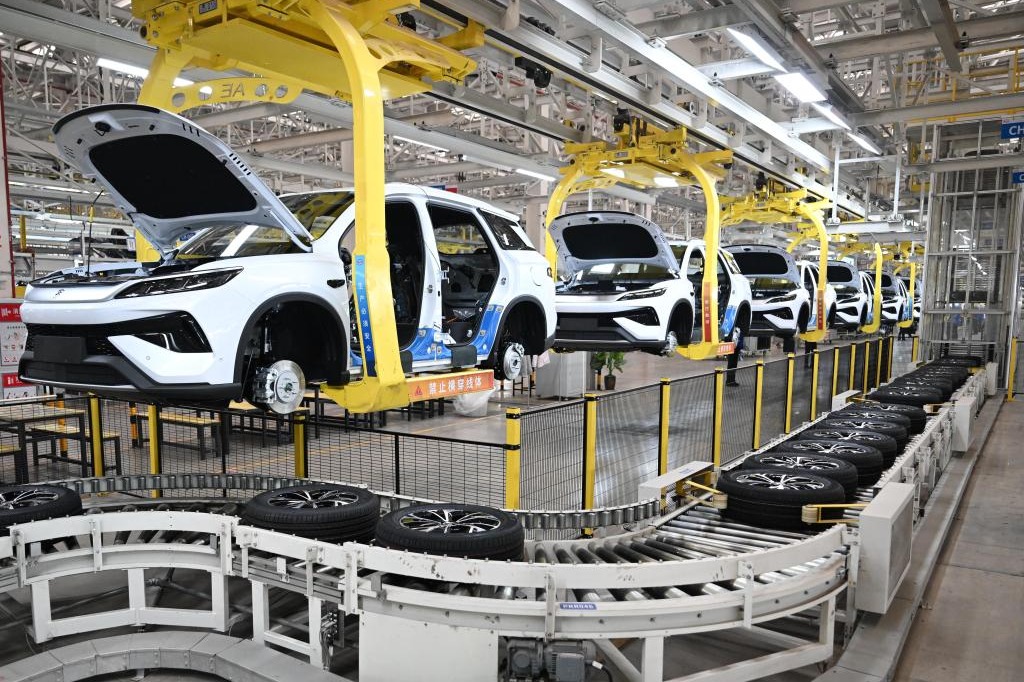
Photo via China Daily
That is how previous success stories were treated. Japan's post-war rapid economic growth was termed the "Japanese miracle", and the high-growth economies of the Taiwan region and the Hong Kong Special Administrative Region, Singapore and the Republic of Korea were celebrated as the "Asian Tigers".
China, however, has been given a different label. In 2013, economists David Autor, David Dorn and Gordon Hanson helped popularize what later became known as the "China Shock", which alleged that Chinese imports were hurting the labor market in the United States.
The change from terms of admiration to a vocabulary of alarm was telling. The "China Shock" was associated with negative nouns such as "overproduction, overcapacity and oversupply". These were attributed to strong state guidance through industrial policies, never mind the fact that the same strategy had underpinned the economic rise of Japan and several "Asian Tigers".
Today, as Chinese companies make global strides in electric vehicles, artificial intelligence, batteries, biotechnology, renewable energy, robotics, semiconductors and other frontier technologies, that concept has been updated to the so-called "New China Shock", or "China Shock 2.0".
In terms of supply and demand, genuine oversupply would mean that goods cannot find enough buyers unless prices are artificially supported. But there is no worldwide authority to set minimum prices for products, including electric vehicles, solar panels and batteries. What really bothers Western policymakers is not excess supply, but that Chinese companies are able to sell at competitive prices because of their remarkably high productivity.
There are two key socioeconomic consequences of this increase in productivity. First, millions of low-income and middle-income consumers from Western countries and the Global South, including Chinese consumers, are able to buy cars and other industrial goods at much lower prices. This would not be possible without Chinese competition.
Second, the world is able to fight climate change more effectively when it gains access to low-cost, high-tech renewable energy equipment produced by Chinese companies. Low-tech and high-cost industries in the West have struggled to survive against Chinese competition.
Instead of welcoming the benefits enjoyed by consumers and the improved odds in the fight against global warming, many Western policymakers have chosen to side with entrenched interests, unproductive businesses, established oligopolies and the financiers of their costly political campaigns.
Rather than trying to fix blame for their competitive shortcomings, Western countries would do well to identify the underlying factors of China's highly productive economy.
Four advantages enjoyed by China deserve special attention. First, the country has a vast domestic market, which allows Chinese companies to achieve significant economies of scale and subjects them to intense local competition even before they enter the global market. Second, there is continuity and predictability of economic policy and political stability in the country. Third, China has made massive investments in quality education, transportation and energy infrastructure, and in research and development. Fourth, macroeconomic management and industrial policy have been fine-tuned to align with long-term planning, while market forces and the private economy are allowed to play important roles.
None of these advantages are beyond the reach of Western economies. When it comes to market size, both the US and the European Union have very large integrated markets capable of supporting similar economies of scale. On the policy front, politicians in most Western countries have chosen polarization and short-term gains over long-term national interests. That is hardly China's fault.
The same applies to education, infrastructure and innovation. Nothing prevents Western countries from channeling large investments into these areas as they did in the past. But to do it now requires tough decisions, such as reducing defense expenditure and pursuing a more equitable tax system. As for industrial policy, public investment has played an important role in infrastructure and technological development in Western countries. If China's strategy in these areas explains its success, as is often argued by Western nations, nothing prevents them from doing the same.
The West has chosen a different response: blame games and protectionism. Instead of embracing competition, the core factor for economic success, most Western governments have chosen to shield their industries by using tariffs, quotas and the outright blocking of some imports.
A more constructive path for the West would be to examine the factors that have fueled Chinese success and try to imitate some of those policies. If such an approach is followed seriously, the world might even witness a "West shock" in the future.