


China-US Youth Exchange | Branching out: US-China ties take root in Beijing
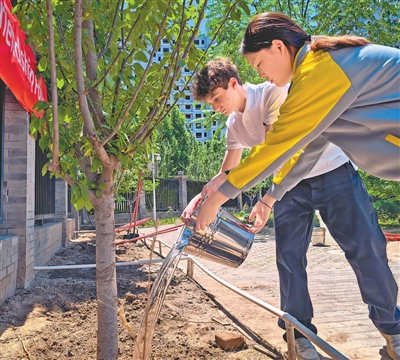
Max Klein knelt in the dirt at a Beijing middle school this month, steadying a young crabapple sapling while a Chinese classmate shoveled soil around its base. A third student poured water. None of them needed instructions.
(Photo: People's Daily)
"The trees will grow taller," said Klein, a 14-year-old from Avenues The World School in New York who has studied Chinese for 11 years. "And so will our friendship."
Klein was one of 12 American middle school students who visited Beijing No. 2 Middle School Chaoyang Branch this month for a youth exchange organized by the Beijing People's Association for Friendship with Foreign Countries. For most of the group, it was their first trip to China, despite years studying the language in US classrooms.
The morning included a basketball game between Chinese and American students, a workshop on drone components and flight mechanics and a short drama performance Across Mountains and Seas about friendship across distance.
"I made a lot of Chinese friends in just one morning," Klein said. "The basketball game brought us closer and the drone class was really exciting."
Josh Ackerman, a teacher at Avenues who led the American group, said the trip gave students a chance to apply what they had studied for years.
"Some of these kids started learning Chinese in kindergarten, others in elementary school," he said. "Coming to China gave them a first-hand feel for this country ‒ the things they learned in books have become real experiences."
Students from both countries took questions from each other afterward, comparing notes on schoolwork, classes and daily routines.
"It gives students like us the chance to talk, understand one another and become friends," Klein said.
Klein drew a comparison to "ping-pong diplomacy," the table-tennis exchanges that helped open relations between the United States and China in the early 1970s.
"This exchange is doing the same kind of thing," he said. "It gives students like us a chance to get to know each other better and learn from one another.
"I think that really matters."
Jonathan Klein, executive chairman of the US-China Green Fund and head of the American delegation, said youth exchanges carry weight beyond the visit itself.
"Young people will shape the future of US-China relations," he said. "The bonds formed through planting trees together carry real meaning.
"Cooperation in green, low-carbon development can help move the relationship forward."
Five crabapple trees now stand in the school’s Four Seasons Garden, planted that afternoon by students from both countries.
"Years from now," Max Klein said, "I believe these trees will remind us of this unforgettable day."
"The saplings will grow as our partnership grows."
(Edited by Zhao Zhengting, Ye Chenyang, Fu Xuan and Zhao Yangyang)