


Blue frontiers, green future: Fangchenggang in Guangxi turns space-to-ground innovation into ecological gains
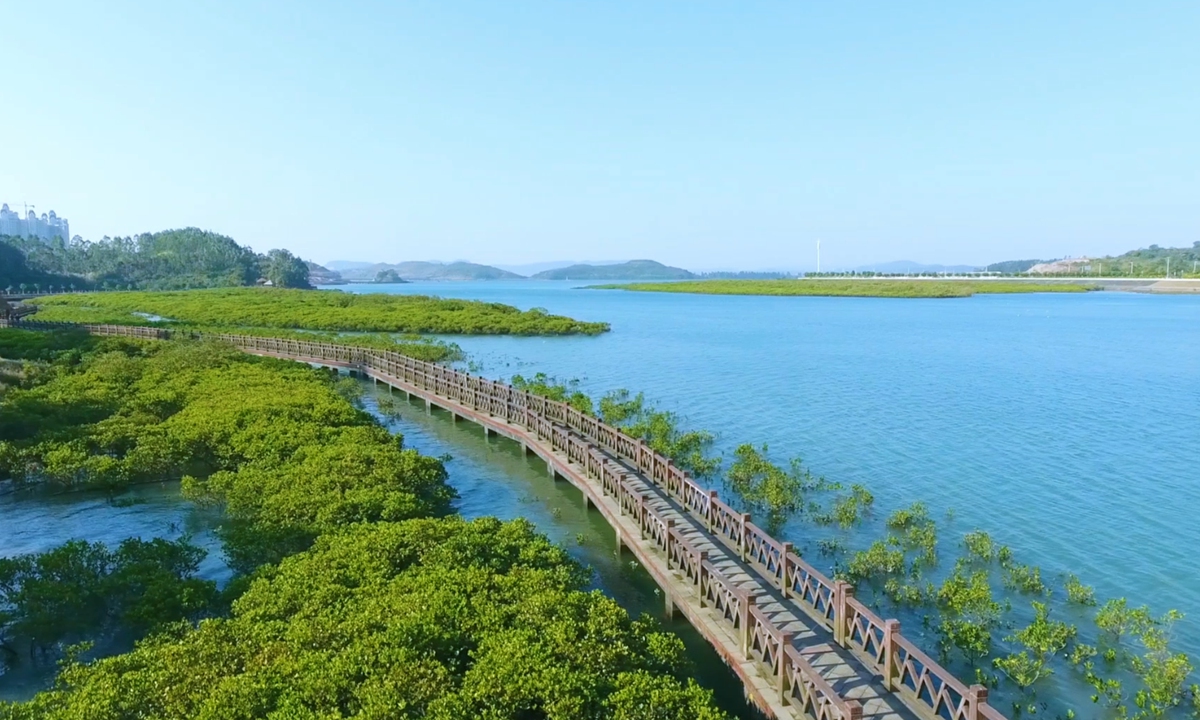
A view of mangrove forests in Fangchenggang, South China's Guangxi Zhuang Autonomous Region (File photo: Fangchenggang City)
On a crisp late autumn morning at the Beilun Estuary National Nature Reserve in Fangchenggang, South China's Guangxi Zhuang Autonomous Region, a ranger team led by Chen Hanbo, director of the reserve, was patrolling the mangrove-lined wetlands when they spotted something never before recorded in the reserve - a large wading bird with snow-white plumage and a long dark beak, standing motionless on the mudflats.
It was an oriental white stork - known in China as the "giant panda of birds," a nationally protected, globally endangered species so rare in Guangxi that scientists see its presence as an indicator of ecosystem health. For a reserve that has watched over this stretch of coastline for decades, it was the first time the bird had been recorded there on camera.
Meanwhile, hundreds of kilometers above the same coastline, the Beibu Gulf-1 satellite was quietly completing another orbit. On the ground, four operating nuclear power units provide stable and reliable electricity for the city. Offshore, rows of wind turbines rotate steadily in the sea breeze, adding a green-tech imprint to the coastal landscape.
From the returning bird to the orbiting satellite and clean-energy coastline, Fangchenggang tells a larger story of how coastal conservation, space-based monitoring and clean energy are being woven into a green development model for China's coastal cities.
Ecological and environmental protection has been a top priority for China in recent years. Notably, at a national conference on ecological and environmental protection on July 17, 2023, sustained efforts were urged to deepen the fight against pollution, accelerate the green and low-carbon transformation of development models, and enhance the diversity, stability and sustainability of the ecosystem, according to Xinhua.
These principles are increasingly being translated into concrete development strategies across China, and Fangchenggang offers a local example of how these national priorities are being put into practice.
Innovative solutionsChen has spent 14 years working in environmental protection. Together with his colleagues, he regularly patrols the reserve's 43-kilometer coastline, identifying and preventing activities that could harm the local ecosystem.
During this period, the reserve's mangrove area expanded from about 1,000 hectares in 2010 to 1,140 hectares in 2025. The number of recorded bird species rose from more than 180 to 320, while the reserve has maintained six consecutive years without a single mangrove destruction case or any large-scale invasion of alien species, Chen said.
Innovative solutions helped achieve such a remarkable progress. Since its successful launch from the Jiuquan Satellite Launch Center on October 19, 2025, Beibu Gulf-1 has been operating steadily in orbit for more than 240 days. Equipped with a synthetic aperture radar (SAR) remote-sensing payload, the satellite is capable of collecting data regardless of weather or lighting conditions and can obtain a broader range of target information. Over the waters of the gulf, the satellite can conduct around-the-clock monitoring of marine ranching site selection and changes in water quality.
Dong Weidong, chief designer of satellite models at AIRSAT, the satellite's developer, told the Global Times that the Beibu Gulf-1 can obtain key parameters such as sea surface temperature, ocean current directions and marine environmental conditions through remote-sensing data.
Combined with analysis of different fish species' habits, it can predict where and when fish schools are likely to appear, helping fishermen improve operational efficiency while protecting fishery resources, he said.
Beyond the sea, the satellite can quickly detect changes in forestry resources, monitor soil conditions, and identify water pollution and illegal waste dumping activities. During natural disasters such as floods and landslides, it can rapidly transmit images from affected areas, providing crucial data support for emergency response and post-disaster reconstruction, according to Dong.
The Beibu Gulf-1 is only one component of Fangchenggang's aerospace monitoring network. Zhongke Satellite is also operating the "White Whale-1" airship to further strengthen capabilities in marine monitoring, port management, disaster prevention and mitigation, and fishery services.
"For environmental protection workers like us, technology has become a crucial tool in enhancing monitoring capabilities," said Chen.
Remote-sensing satellites identify and flag suspected changes in vegetation and land cover, while field teams verify them through a combination of drone inspections and on-the-ground patrols, Chen said.
"This integrated monitoring system that combines space-, air-, and ground-based surveillance provides essential data and greater efficiency for the protection and management of mangroves and other vegetation," he said.
Such efforts have yielded great results. During the 14th Five-Year Plan period (2021-25), Fangchenggang maintained an annual ratio of excellent and good air quality days above 98 percent. The proportion of surface water with good quality and the compliance rate of drinking water sources both remained at 100 percent. Forest coverage increased to 65 percent, according to People's Daily.
Clean energyThese achievements were not only supported by aerospace monitoring systems. On the ground, clean energy supplies have provided a solid backbone for the coordinated development of industry and environmental protection in this coastal city.
Along the shores of the Beibu Gulf stands the Fangchenggang Nuclear Power Plant, western China's first nuclear power project. Units 1 and 2 use CPR1000 technology, while Units 3 and 4, fully commissioned in 2024, adopt China's domestically developed third-generation Hualong One technology, making them the first Hualong One units operating in western China, according to Xinhua.
The city's operating nuclear power units have cumulatively supplied more than 160 billion kilowatt-hours of electricity to the grid, equivalent to saving over 48.5 million tons of standard coal and reducing carbon dioxide emissions by approximately 132 million tons, according to People's Daily.
In May 2025, construction officially began on Phase III of the Fangchenggang Nuclear Power Project. The newly planned Units 5 and 6, both Hualong One reactor, each have a capacity of 1.208 million kilowatts. Together, they are expected to generate 20 billion kilowatt-hours of electricity annually.
Upon completion of the new units, the Fangchenggang nuclear power base will exceed 6.9 million kilowatts in installed capacity and generate up to 53 billion kilowatt-hours annually. Song Zhen, deputy director of the Fangchenggang Municipal Development and Reform Commission told the Global Times that the expansion project aims to obtain approval by 2027.
Among the city's green energy projects, the Guangxi Fangchenggang offshore wind power demonstration project has become a landmark example of coordinating energy transition with ecological protection.
The project is the first offshore wind power project in Southwest China and one of the country's largest offshore wind projects currently under construction in terms of single-project installed capacity. Once fully completed, it is expected to supply more than 5 billion kilowatt-hours of electricity annually and drive more than 20 billion yuan ($2.95 billion) in related industrial investment, Song said.
Green synergyFangchenggang's wind and nuclear power projects have provided a stable supply of clean energy, Chen said. "During project construction, environmental authorities also offer guidance on ecological protection and maintain coordination and communication mechanisms with developers, helping ensure that the projects contribute to sustainable and green development," Chen said.
Fangchenggang's focus on ecological protection has not slowed the coastal city's economic momentum. During the 14th Five-Year Plan period, Fangchenggang's GDP increased from 75.2 billion yuan to 120.1 billion yuan, representing average annual growth of 7.8 percent.
While major industries such as steel and non-ferrous metals continued to develop, clean energy and green new materials also emerged as pillar industries.
Compared with traditional industries such as steel mills and oil-processing plants that developed alongside bulk commodity trade, nuclear power and new energy industries are cleaner, more advanced and strategically important sectors that align with China's overall efforts to foster emerging strategic industries, Hu Qimu, a professor at the Maritime Silk Road Institute of Huaqiao University, told the Global Times.
According to Song, Fangchenggang has not treated energy development and ecological protection as opposing goals. Instead, it has adhered to the principle of "developing while protecting and protecting while developing."
Fangchenggang's green and sustainable development pattern not only aligns with the city's ecological endowments, but also embodies the core principle of one of China's best-known environmental concepts: "Lucid waters and lush mountains are invaluable assets."
Chen recalled that more than a decade ago, activities by coastal residents, such as shellfish harvesting and foraging along the shoreline, posed significant challenges to the survival of mangroves. Today, however, the concept of green development and environmental protection has become deeply rooted among local residents in Fangchenggang.
For Chen, this is a deep well of pride in the progress made and quiet confidence in the years ahead. In the coastal mangrove forest, the Oriental White Stork is set to become a regular sight once more - watched over by satellites above, drones in the air, and rangers like Chen who walk the 43-kilometer coastline.